
LPPRS: Rethinking Location Privacy via Ring Signatures in Mobile Social Networks
LPPRS: New Location Privacy Preserving Schemes Based on Ring Signature over Mobile Social Networks
The paper proposes LPPRS (Location Privacy Preserving schemes based on Ring Signature), a novel framework for a new LBS application called NFPOI (Nearby Friends based on POI). It utilizes RingCT 3.0 to decouple user identities from query content, achieving SOTA-level anonymity and efficiency compared to traditional k-anonymity or homomorphic encryption methods.
TL;DR
The paper introduces LPPRS, a privacy-preserving framework for a new type of query: NFPOI (Finding Nearby Friends based on a Point of Interest). By leveraging the RingCT 3.0 protocol, the authors solve the long-standing trade-off between privacy, efficiency, and query accuracy. Unlike traditional k-anonymity, LPPRS provides unconditional anonymity () even during continuous queries, with minimal computational cost for mobile users.
Problem & Motivation: The Failure of "Cloaking"
Traditional location privacy relies heavily on k-anonymity (forming a "cloak" region) or dummy locations. However, these suffer from three fatal flaws:
- Low Accuracy: Processing a query within an area rather than a point yields "vague" results.
- Tracking Vulnerability: In continuous queries, an adversary (like an honest-but-curious SNS) can use graph analysis to de-anonymize the user.
- High Overhead: Alternatives like Homomorphic Encryption (HE) or Private Information Retrieval (PIR) are too "heavy" for smartphone hardware.
The authors identify a specific gap: no current system allows a user to search for friends near a specific future destination (e.g., "Which friends are near the hotel I booked in London?") without revealing their current location and intent to the server.
Methodology: The Core of LPPRS
LPPRS shifts the focus from "hiding the location" to "breaking the linkage" between the sender and the message.
1. Anonymous Identity via Ring Signatures
Instead of using email or phone numbers, a user’s registration ID is a Ring Signature Public Key. When Alice sends a query, she signs it using a ring of members. The SNS can verify that the query came from a legitimate user but cannot distinguish Alice from the other members.
2. Substitution Location (sl) vs. Cloak Regions
Instead of a blurred region, LPPRS uses a Substitution Location—a nearby public landmark (like a subway station). This preserves high query accuracy while shielding the user's exact coordinate (e.g., a private home).
3. Dual Frameworks
- Scheme 1 (Semi-TTP): Uses a Cloud Server (CS) to help select ring members and filter results, preventing malicious users from decoys.
- Scheme 2 (TTP-free): Removes the CS entirely, using Tor (anonymity networks) and public RSA keys for result encryption.
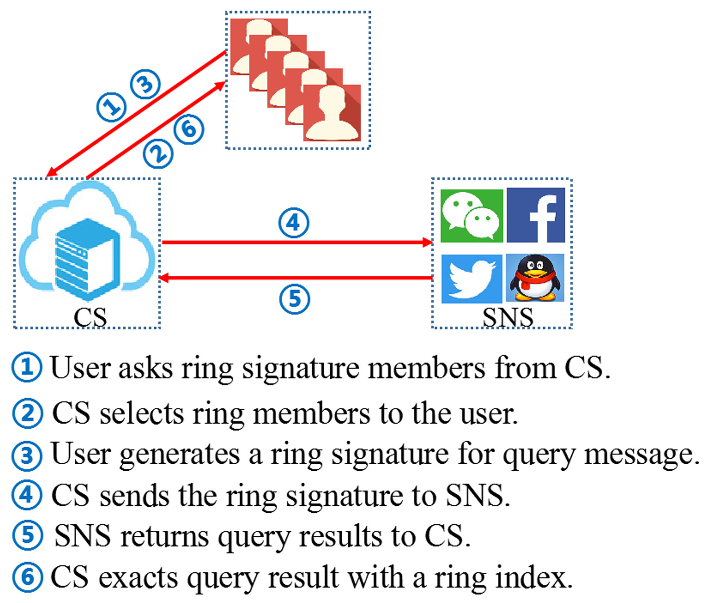 Figure 1: Framework of the Semi-TTP LPPRS scheme involving User, CS, and SNS.
Experiments & Results: Performance vs. Privacy
The authors compared LPPRS against SOTA methods (including those using Paillier HE and Bilinear Pairings).
- User Side Efficiency: The computation is limited to one RSA encryption, one AES decryption, and one Ring Signature generation. Most of this can be done offline.
- Server Scalability: Even as the ring size increases to 1024 (providing high anonymity), the verification time is ~3 seconds.
- Communication Overhead: The signature size follows a logarithmic growth curve ( bytes), making it ideal for mobile networks.
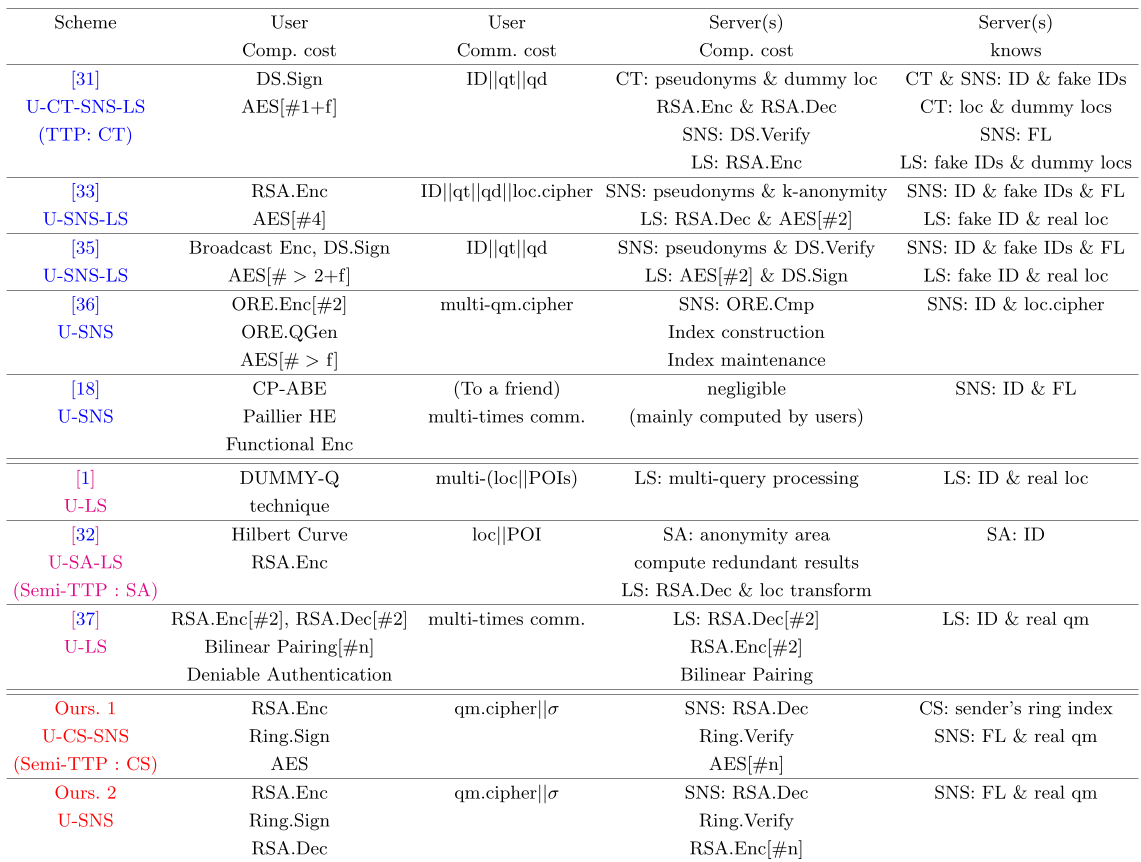 Table 1: LPPRS vs. Existing Works. Note that LPPRS is the only scheme providing identity, location, and query privacy without heavy server/user costs.
Critical Analysis & Conclusion
Why it Works
The "magic" resides in RingCT 3.0. By utilizing a protocol designed for confidential blockchain transactions (Monero), LPPRS inherits "unconditional anonymity." If an attacker cannot distinguish a signer despite having infinite computation power, the user's query privacy is mathematically guaranteed.
Limitations
The primary trade-off is the Ring Size . A larger increases security but burdens the SNS with higher verification and encryption costs ( for result delivery). Furthermore, the scheme assumes that the CS and SNS do not collude; if they were the same entity, the Semi-TTP model's anonymity would degrade.
Final Takeaway
LPPRS marks a shift toward lightweight cryptographic anonymity for LBS. It proves that by using the right primitive (Ring Signatures), we can achieve privacy-by-design in social networks without the clunky overhead of traditional encryption or the inaccuracy of spatial cloaking.