
LsRec: Toward Efficient Large-Scale Social Recommendation via Clustering and Matrix Sketching
LsRec: Large-scale social recommendation with online update q
The paper introduces LsRec, a large-scale social recommendation framework that combines offline Matrix Factorization (MF) with a unique online incremental update mechanism. By integrating user-level social influence and item clustering via k-means++, it achieves SOTA performance in large-scale online scenarios.
TL;DR
LsRec is a hybrid recommendation framework designed to conquer the "scalability vs. accuracy" trade-off. By combining user social graphs with automatic item clustering, it performs fine-grained Matrix Factorization within localized spaces. The true innovation lies in its online incremental update capability—leveraging matrix sketching to handle new data chunks with minimal computational overhead, significantly outperforming traditional batch-retraining models.
Context & Motivation: The Scalability Bottleneck
Modern Recommender Systems (RS) act as the primary filter for the "Information Overload" era. While Collaborative Filtering (CF) and Matrix Factorization (MF) have proven effective, they face two fundamental walls:
- Data Sparsity: As items and users grow, the interaction matrix becomes increasingly empty.
- Static Constraints: Most MF models require a total "re-learn" phase to accommodate new data, which is computationally suicidal for real-time applications like e-commerce or social news feeds.
The authors of LsRec argue that social networks and item attributes are not just "auxiliary data" but are the keys to decomposing the problem into manageable, high-density clusters.
Methodology: The Core Architecture
The LsRec framework operates in two distinct phases: Offline Computation and Online Incremental Update.
1. User-Level Social Influence
Instead of treating social links as binary (friend or not), LsRec defines influence as a function of:
- Trust Circles: The overlap of observed items between friends.
- Behavior Breadth: Users with more historical records are weighted more heavily across the social network.
2. Fine-Grained Item Clustering
The system utilizes DBpedia knowledge bases to build rich item profiles (representations). Using k-means++, items are grouped into clusters. This allows the model to learn localized latent vectors and for each cluster, reducing predictive variance and focusing the model on specific item domains (e.g., sci-fi movies vs. historical documentaries).
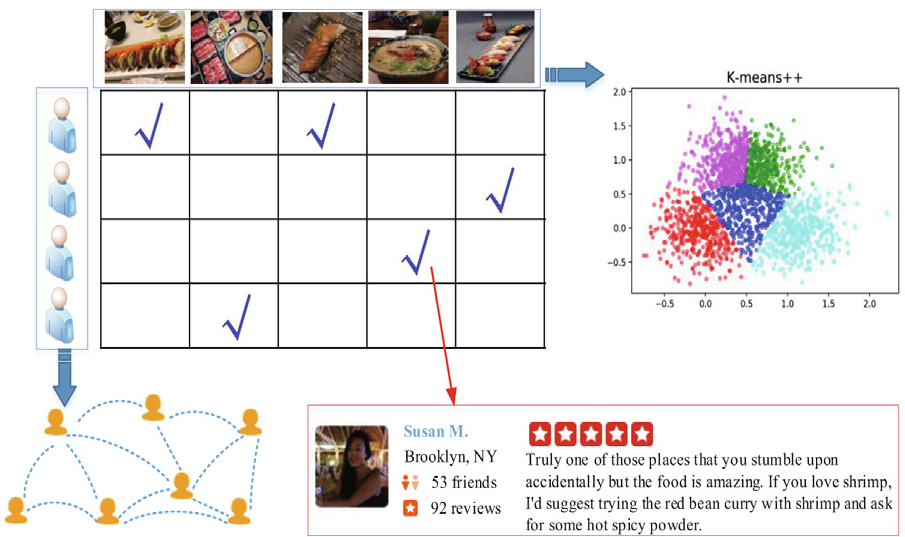
3. Online Incremental Updates via Matrix Sketching
This is the "special sauce." When a new data chunk (new users/items) arrives, LsRec avoids full SGD retraining. Instead, it uses Matrix Sketching:
- Assigns new items to existing clusters.
- Updates feature vectors and by approximating the updated rating matrix through a low-rank sketch.
- Triggers a full re-learn only if the prediction error exceeds a specific threshold.
Experimental Battleground
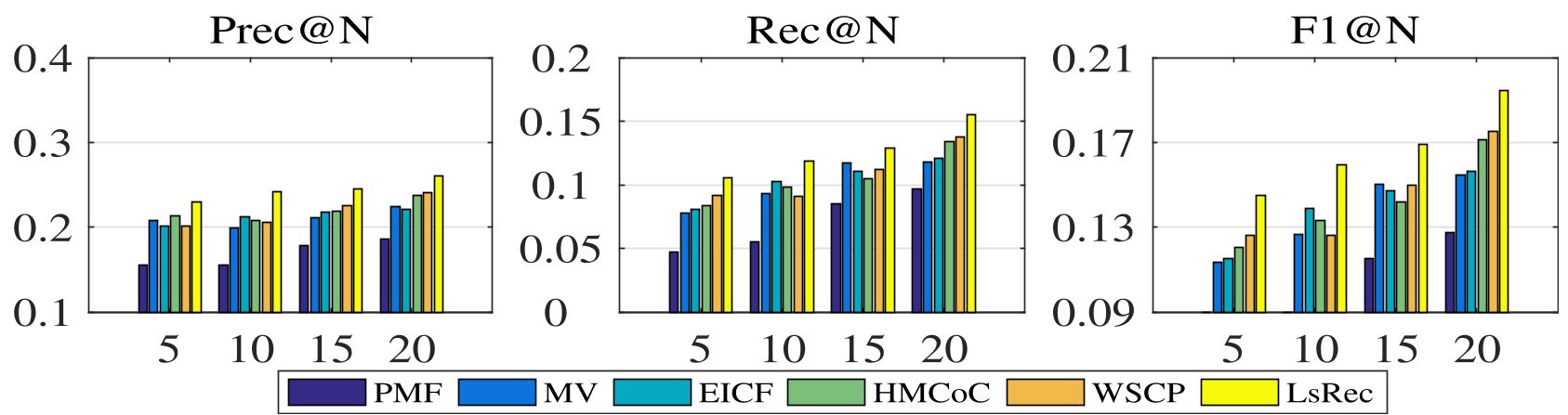
The researchers tested LsRec against five SOTA benchmarks (PMF, MV, EICF, HMCoC, WSCP) across four diverse datasets.
Key Findings:
- Accuracy Transition: LsRec consistently yielded lower RMSE/MAE. For the DoubanMovie dataset, it achieved an RMSE of 1.0256, significantly better than PMF’s 1.2208.
- Top-N Performance: On metrics like Precision@N and F1-score, LsRec showed a marked "gap" above competitors, indicating that clustering indeed helps capture niche user preferences.
The Efficiency Win
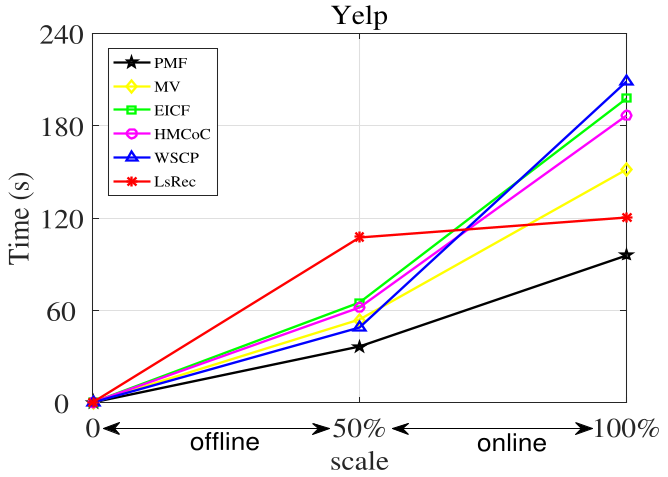
While LsRec takes slightly longer in the offline phase (due to the clustering and multi-model training), its online update time is near-instantaneous compared to methods that require feature space re-learning. This makes it a viable candidate for real-world production environments.
Critical Insight & Conclusion
LsRec’s success suggests that "Divide and Conquer" remains one of the most effective strategies in machine learning. By breaking the global matrix into item-based clusters, the model effectively injects an Inductive Bias that users have distinct behaviors in different categories.
Future Outlook: The authors identify that capturing the temporal evolution of user preferences and implementing this in a distributed (e.g., Spark/Flink) manner are the next frontiers. For practitioners, the key takeaway is clear: don't just throw more hardware at a huge MF; cluster and sketch your way to efficiency.