
LSTM-Based Emotion Detection: Bridging the Gap Between Physiology and IoT
LSTM-Based Emotion Detection Using Physiological Signals:IoT Framework for Healthcare and Distance Learning in COVID-19
This paper proposes an integrated IoT framework for real-time human emotion detection using physiological signals and Long Short-Term Memory (LSTM) networks. Designed for healthcare and distance learning during COVID-19, it combines advanced MAC protocols (TS-MAC and R-MAC) with deep learning to achieve 95% classification accuracy and ultra-low communication latency.
TL;DR
In the wake of the COVID-19 pandemic, remote monitoring of mental well-being has transitioned from a luxury to a necessity. This paper introduces an end-to-end framework that captures human emotions through wearable physiological sensors. By combining LSTM-based deep learning for high-accuracy classification (95%) and custom MAC protocols for ultra-low latency (<1ms), the authors provide a viable solution for real-time pastoral support in distance learning and remote healthcare.
Problem & Motivation
Human emotions are complex biological phenomena. While we often attempt to detect them via facial or voice recognition, these "external" signals can be faked or obscured. Physiological signals (like heart rate or skin conductance) offer a more "honest" window into our internal state because they are governed by the Autonomic Nervous System (ANS), which is difficult to consciously control.
However, two major barriers prevent widespread adoption:
- Wearability vs. Accuracy: Using too many sensors (like full EEG caps) is impractical for daily use, while using too few can drop accuracy.
- Communication Bottlenecks: Real-time monitoring requires extreme reliability and near-zero latency, which standard Bluetooth or Wi-Fi struggle to guarantee in congested environments.
Methodology: The Core Engine
The authors attack this problem from two angles: the "Brain" (Deep Learning) and the "Nerves" (IoT Framework).
1. The Brain: LSTM for Temporal Dynamics
Emotions aren't instantaneous; they are sequences. The authors chose Long Short-Term Memory (LSTM) networks because they excel at remembering long-term dependencies in time-series data.
- Data Prep: Signals were resampled to 200 Hz to reduce cloud processing load.
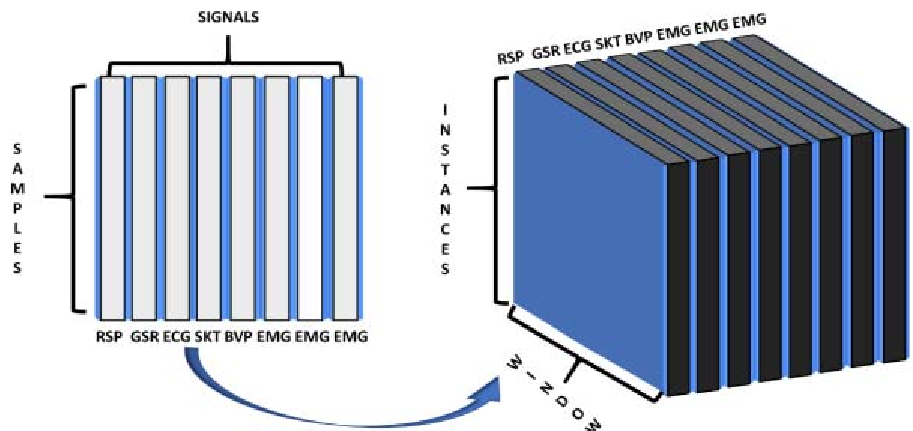
- Input: A multimodal matrix (Instance × Window × Sensor) feeds the LSTM cells.
- The Math: The model uses input, forget, and output gates to decide which physiological spikes denote a shift from "Relaxing" to "Scary" or "Boring" to "Amusing."
2. The Nerves: TS-MAC & R-MAC
To ensure the data reaches the "Brain" in time, the authors modified the IEEE 802.15.4e standard.
- TS-MAC (Time-Sensitive): Prioritizes retransmission within the same superframe to keep delay under 1ms.
- R-MAC (Reliability-Enabled): When a transmission fails, instead of resending the full 16-bit packet, it sends a high-precision 8-bit "delta" (the change since the last reading). This "lossy but fast" compression significantly boosts reliability without sacrificing the logic of the emotion detection.
Experiments & Results
The framework was tested on a dataset involving 30 participants across four emotion categories: Amusing, Boring, Relaxing, and Scary.
Performance vs. Sensors (Ablation)
The study found a "Sweet Spot" for sensor selection. While Combination C4 (All 8 sensors) reached 95% accuracy, Combination C2 (ECG, BVP, GSR, SKT) performed almost as well (~91%) without needing intrusive facial EMG sensors or chest respiration belts.

Latency Breakthrough
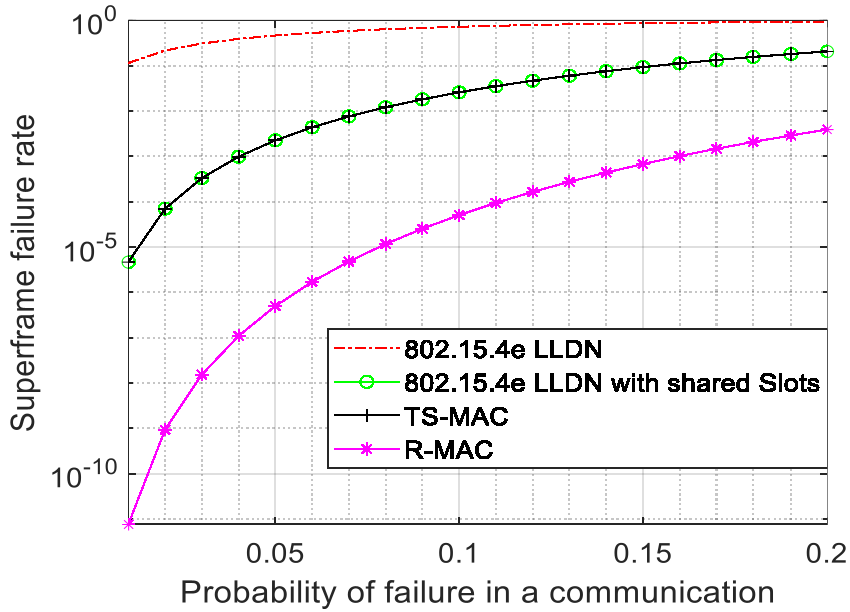
In communication tests, the proposed TS-MAC and R-MAC protocols maintained a latency of ~1 ms even as the probability of channel failure increased, whereas standard LLDN protocols saw delays spike up to 10 ms.
Critical Insight & Conclusion
The true value of this work lies in its holistic optimization. Most AI papers ignore the network layer, and most network papers use dummy data. By proving that an 8-bit delta retransmission (R-MAC) is "good enough" for an LSTM to maintain high F-scores, the authors have paved the way for more efficient wearable tech.
Limitations: The study currently processes data on a cloud server. Future work should look at Edge Computing—moving the LSTM inference directly onto the IoT Hub or a smartphone—to further reduce the dependence on a stable internet connection for critical healthcare alerts.
Final Takeaway: Real-time emotion sensing is no longer science fiction. By optimizing the protocol for reliability and the model for temporal patterns, we can now "see" the mental fatigue of a student or the distress of a remote patient through their wristband.