
LUIMA: Moving Legal Search from Keyword Matching to Conceptual Understanding
Introducing LUIMA: an experiment in legal conceptual retrieval of vaccine injury decisions using a UIMA type system and tools
The paper introduces LUIMA (Legal UIMA), a specialized semantic extraction toolbox designed for conceptual legal document retrieval within the vaccine injury compensation domain. Utilizing the UIMA framework, LUIMA combines rule-based sub-sentence annotation and machine learning-based sentence classification to represent legal arguments and achieve retrieval results that outperform commercial full-text search systems.
TL;DR
Researchers have developed LUIMA (Legal UIMA), a semantic processing pipeline that understands the "role" of sentences in legal decisions. By identifying whether a sentence is a Legal Rule or an Evidence-Based Finding, and recognizing complex patterns like "burden of proof" formulations, the system significantly outperforms commercial giants like WestlawNext in retrieving relevant precedents for vaccine injury cases.
Background: The "Semantic Gap" in Legal Tech
In the legal world, two sentences can share identical keywords but serve opposite functions. For example, a sentence summarizing a witness's rejected theory and a sentence stating the judge's final conclusion might both contain the words "tetanus vaccine" and "gastroparesis."
Standard search engines often fail to distinguish between these, potentially misleading an attorney. The goal of this research is to bridge this gap by injecting Argumentation Mining into the retrieval process.
Methodology: The LUIMA Pipeline
LUIMA is built on the Apache UIMA framework (the same architecture behind IBM Watson). Its pipeline transforms unstructured legal prose into a structured conceptual graph.
1. Functional Type System
The core of LUIMA is its Type System, which categorizes text into layers:
- Sub-sentence level: Identifies Terms (e.g., "MMR Vaccine"), Mentions (grouping synonyms), and Formulations (complex patterns like "Petitioner bears the burden of showing...").
- Sentence level: Classifies the "Rhetorical Role" of the sentence (e.g., LegalRuleSentence, EvidenceBasedFindingSentence).
2. Architecture and Data Flow
The system processes documents through a series of annotators, segments them into a Lucene index, and then applies a "Learning to Rank" model to prioritize documents with the highest qualitative matches.
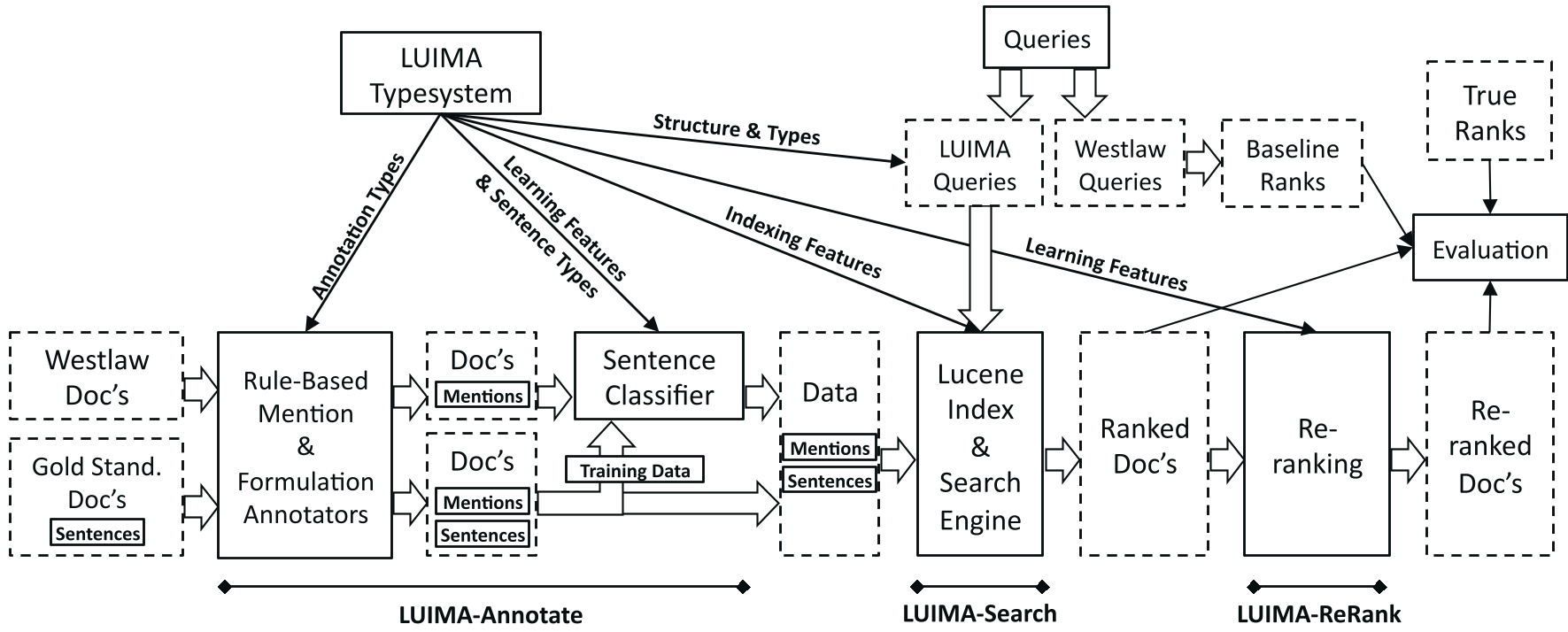 Figure 1: The LUIMA Pipeline, from raw legal text to a semantically enriched search index.
Experiments & Results: Beating the Baseline
The researchers tested LUIMA against WestlawNext (WLN) using eleven specific queries related to the National Vaccine Injury Compensation Program.
- Semantic Superiority: LUIMA outperformed the baseline in almost every query.
- Winning Metrics: The system achieved a Mean Average Precision (MAP) of 0.60, a massive jump from the commercial baseline of 0.38.
- Feature Insight: The "Lucene Score" combined with "Vector Space Similarity (VSS)" proved to be the most potent features for reranking, confirming that a mix of keyword relevance and semantic conceptual similarity is the "sweet spot" for legal IR.
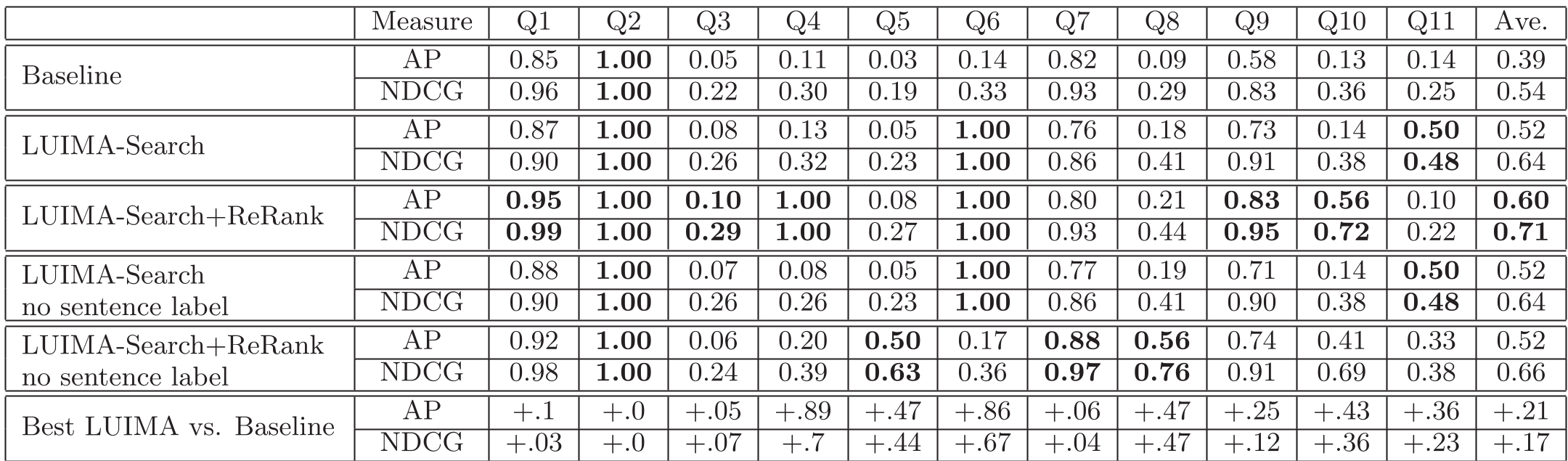 Figure 2: Performance metrics showing LUIMA consistently outperforming the WestlawNext baseline (Top rows).
Critical Insight: Why Does This Work?
Traditional search engines are broad but shallow. LUIMA is narrow but deep. By manually crafting rules for Legal Formulations (using the UIMA Ruta language), the researchers "taught" the system the nuance of legal reasoning. While the automated sentence classifier (ML-based) had only mediocre performance on its own, it still provided enough "signal" to the search engine to filter out irrelevant context, proving that structural intent is just as important as lexical content.
Conclusion & Future Outlook
LUIMA represents a successful feasibility study for Conceptual Legal Retrieval.
Key Takeaways:
- Domain Expertise Matters: Hand-crafted rules for legal terms still provide a significant edge over "blind" machine learning in specialized fields.
- Argumentation roles: Understanding why a sentence was written (to state a rule vs. to find a fact) is the key to precision in legal search.
The authors plan to release LUIMA as open-source software, potentially providing the community with a "scaffold" to build smarter legal AI tools. As we move into the era of LLMs, the structured approach of LUIMA provides a necessary grounding for the "black box" of modern neural networks.
Full citation: Grabmair, M., et al. "Introducing LUIMA: an experiment in legal conceptual retrieval of vaccine injury decisions using a UIMA type system and tools." ICAIL '15.