
Unveiling the Silent Majority: A Temporal Analysis of Lurking Behaviors in Social Networks
Understanding lurking behaviors in social networks across time
This paper explores the temporal dynamics of "lurkers"—passive members of Online Social Networks (OSNs)—across Flickr, FriendFeed, and Instagram. Using the LurkerRank algorithm, the authors analyze how lurking behavior evolves, its relationship with active users, and responsiveness latency over time.
TL;DR
In the digital ecosystems of Instagram, Flickr, and FriendFeed, the "silent majority" or lurkers define the network's consumption patterns. This paper moves beyond static definitions to track lurkers across time, revealing that lurking is a specialized behavioral profile rather than just "inactivity." By applying LurkerRank, the research demonstrates that lurkers exhibit high latency, follow a preferential attachment to "alpha" active users, and rarely transition into active contributors without external stimulus.
The "Zero-Contributor" Fallacy
A common misconception in Social Network Analysis (SNA) is that a lurker is simply a user with zero posts. The authors deconstruct this by showing that "potential lurkers"—defined by a high followee-to-follower (in/out-degree) ratio—only partially overlap with zero-contributors. On platforms like Flickr, the overlap is as low as 12% for favorite-based interactions, proving that many highly ranked lurkers do interact, just in subtle, non-vocal ways.
Methodology: Ranking and Evolution
The core of the analysis relies on LurkerRank (LR), a PageRank-style algorithm where a user's lurking strength is determined by their neighbors' influence and their own consumption-to-production ratio.
The LurkerRank Formula
The paper defines LurkerRank through an interplay of in-neighbor driving (information consumption) and out-neighbor driving (referencing) functions:

By applying this formula to weekly snapshots of network data, the authors generated time-series data of "lurking intensity" for millions of users.
Key Insights: Latency and Attachment
1. The Sluggish Pulse of the Lurker
Lurkers operate on a different clock. While a generic user might respond to a post within 10 days, top-ranked lurkers on Instagram take over 40 days to provide a response. This high responsiveness latency suggests that lurkers consume content in "batches" or are highly selective about when they break their silence.
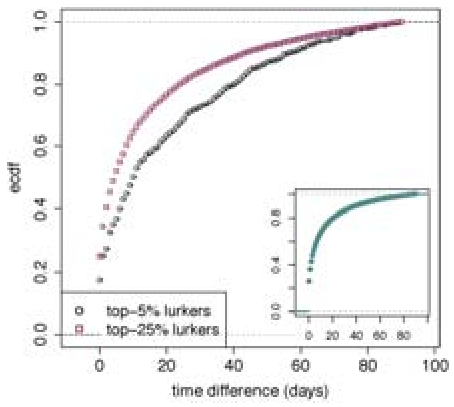 Figure: Cumulative distribution of response latency showing the significant gap between general users and top lurkers.
2. Lurkers Follow the Leaders
Does a "rich-get-richer" dynamic apply to lurkers? The study confirms Preferential Attachment. Active users who already have many lurker followers are significantly more likely to attract new ones. On Flickr, for every 120 existing lurker connections, an active user gains one new lurker per week. However, the reverse isn't true: lurkers don't "scale up" their following of active users as they grow older in the system.
Clustering Temporal Trends
Using fuzzy c-means clustering, the researchers identified the "spectral signatures" of lurking. They found that most users fall into "plateau" or "stagnation" clusters.
The most striking finding? There is a distinct lack of "decreasing" clusters. This suggests that lurking is an absorbing state; once a user settles into a lurking pattern, they are unlikely to spontaneously become an active poster.
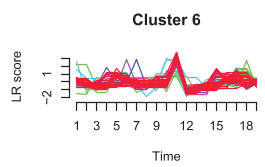 Figure: Various clusters of lurking behavior. Note the lack of trends showing a consistent decline in lurking scores.
Conclusion and Future Outlook
This work transforms our understanding of lurkers from "invisibles" to "specific nodes with predictable temporal patterns." For community managers and platform architects, the takeaway is clear: lurkers are not "pre-active" users; they are a distinct class of consumers. To "de-lurk" them requires more than time—it requires targeted strategies to break the high-latency, high-consumption loop.
Future Work: The authors aim to integrate these temporal insights directly into "time-aware" ranking algorithms that can predict when a lurker is most likely to be receptive to engagement.