
M4M: Turning Your Social Circle into a Decentralized Hardware Cloud
M4M: A model for enabling social network based sharing in the Internet of Things
M4M (Machine-4-Machine) is a decentralized framework that enables social-network-based sharing of IoT device capabilities (e.g., GPS, camera). It introduces an access control model derived from social trust and a "Friend-Recommender" algorithm that optimizes network structure to maximize resource availability (Vertex Potential).
TL;DR
The M4M (Machine-4-Machine) model proposes a paradigm shift where IoT devices aren't just isolated silos but assets shared across social trust networks. By leveraging Facebook-like friendship links, M4M allows your phone to "borrow" a friend's GPS or camera sensor securely. The paper introduces Vertex Potential—a metric for sharing capacity—and an optimization algorithm that suggests new friends specifically to maximize your access to diverse IoT services.
The Sharing Gap in IoT
We are heading toward 20+ billion connected devices, yet most remain locked to a single user. If I need a high-precision temperature reading and don't have the sensor, but my neighbor does, why can't I access it?
Current hurdles include:
- Access Control Complexity: Manually managing permissions for every peer is a nightmare.
- Trust: How do we ensure the requester isn't a malicious actor?
- Discovery: How do we find a specific capability (an "Action") across a massive, decentralized network without revealing exactly who is providing or requesting it?
Methodology: Socially-Aware Resource Discovery
The authors treat the IoT world as a graph , where is the social network, is the set of device actions, and represents the "contracts" or sharing permissions between friends.
1. The Search-to-Act Algorithms
M4M defines two primary search modes:
- One-mode (Sequential): Uses a hybrid BFS-DFS to find the first available instance of a service.
- All-mode (Parallel): Searches the entire reachable neighborhood to execute an action on all available devices (e.g., "get temperature from everyone nearby").
2. Anonymity vs. Efficiency
A key insight is the trade-off between privacy and speed. The authors define k-ARP (k-Anonymity Requirement Performer), ensuring a requester only knows a service came from within a "neighborhood of ," rather than identifying the specific provider.
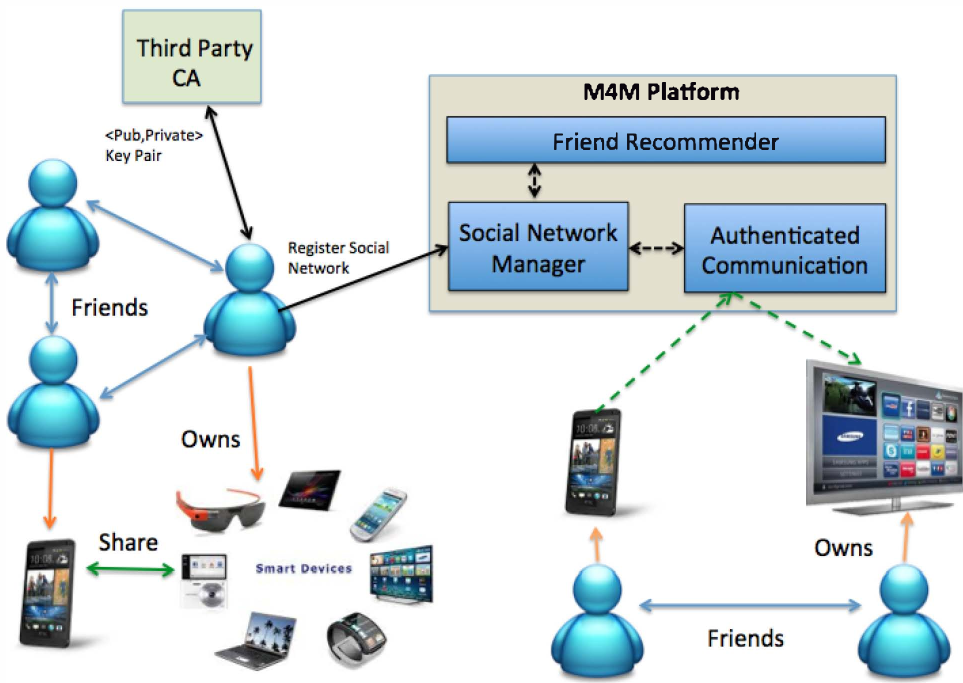 The M4M architecture balances local peer-to-peer communication with a cloud-mediated Social Network Manager to enforce trust.
Maximizing Network Potential
The paper introduces Vertex Potential, the fraction of total network actions reachable by a node.
The authors discovered that real-world social structures (Barabasi-Albert graphs) are naturally suited for IoT sharing because their "scale-free" nature places most nodes just a few hops away from highly connected hubs.
The Friend-Recommender
The most innovative part of the work is the Friend-Recommender algorithm. Unlike traditional social recommendations based on "mutual friends," M4M recommends friends based on Capability Differentials. If Node A has a Camera and Node B has a Barometer, and they aren't connected, the system suggests a link to bridge that functional gap.
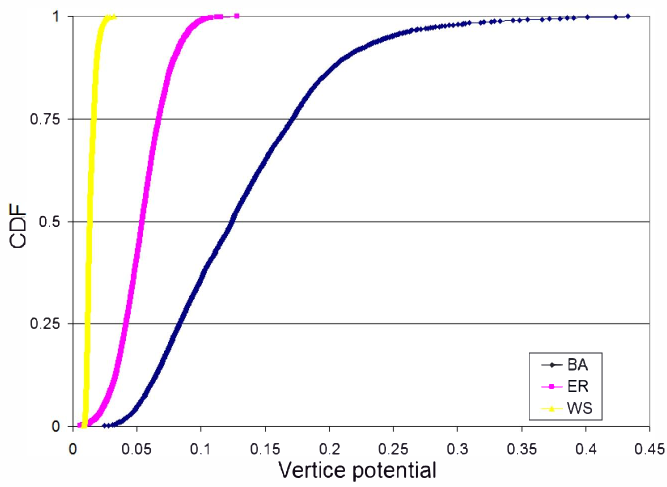 Comparison of Vertex Potential across different graph models. BA graphs (Barabasi-Albert) consistently outperform others, reaching higher potential with fewer hops.
Prototype: Facebook-Powered IoT
The authors didn't just stop at math; they built an Android app. Using the Facebook SDK for identity and MQTT (a lightweight messaging protocol) for communication, they demonstrated a smartphone sharing its GPS data with a friend's device upon request, traversing the social graph in real-time.
Critical Insight & Future Outlook
While M4M provides a brilliant framework for discovery, it leaves the Incentive Layer for future work. Why would a friend let me drain their battery to use their GPS? Future iterations will likely need to integrate micro-payments or "reputation points" to prevent free-riding.
The Takeaway: M4M proves that the "Social Internet of Things" isn't just a buzzword—it’s a mathematically viable way to turn billions of stagnant devices into a fluid, shared resource pool.