
Decoding Distress: Machine Classification of Suicidal Ideation on Twitter
Machine Classification and Analysis of Suicide-Related Communication on Twitter
This paper presents a machine learning framework for classifying suicide-related communication on Twitter into seven distinct categories, including "suicidal ideation," "reporting," and "flippant references." By employing an ensemble Rotation Forest classifier and a specialized lexicon, the researchers achieved a SOTA F-measure of 0.728 overall and 0.69 specifically for detecting suicidal ideation.
TL;DR
Researchers from Cardiff University have developed a robust machine learning system capable of navigating the "noisy" world of Twitter to identify genuine suicidal ideation. By moving beyond simple keywords and using an ensemble Rotation Forest classifier, the model can distinguish between actual cries for help and flippant, sarcastic references to suicide with an F-measure of 0.69.
The Challenge: Why Keywords Aren't Enough
In the realm of social media, the word "suicide" is a polysemy. It can appear in a news report, a memorial post, a political campaign, or—most commonly and frustratingly for researchers—as a flippant exaggeration (e.g., "This exam makes me want to kill myself").
Prior work often failed because it couldn't handle this nuance. If an algorithm flags every use of "kill myself," it creates a "crying wolf" effect, overwhelming prevention services with false positives. The core difficulty lies in contextual sentiment: how do we teach a machine that "asleep and never wake" is a danger sign, while "I'm dying of laughter" is not?
The Methodology: Multi-Layered Feature Engineering
The authors didn't just throw data at a model; they built a sophisticated feature pipeline:
- Lexical & Structural (Set 1): Traditional POS tags and a custom list of 62 keywords derived from dedicated suicide forums.
- Psychological & Emotive (Set 2): Utilizing LIWC (Linguistic Inquiry and Word Count) to capture the "logic of the soul"—terms related to cognitive mechanisms, inhibition, and sadness.
- Social Media Patterns (Set 3): Regular expressions (RegEx) specifically designed for short-form Tumblr/Twitter slang like "trigger warning" or "end it all."
The Model Architecture
Rather than relying on a single classifier, the team utilized Rotation Forest (RF).
- The Logic: RF splits features into subsets and applies PCA to each. This preserves the diversity of the "signals" in the text while reducing the "noise" (colinearity).
- Voting: A Maximum Probability decision method was used to pick the most confident prediction among Base Classifiers (SVM and Naive Bayes).
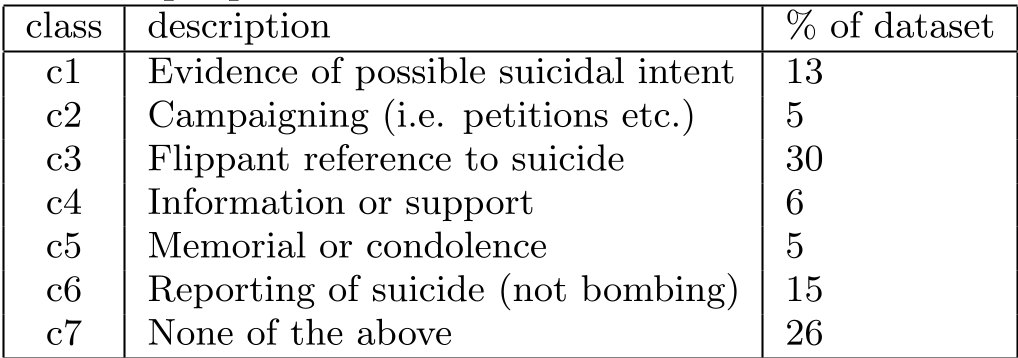 Table 1: The distribution of the 7 classes showing that 'Flippant' use (c3) actually dominates the dataset.
Experimental Results: Slaying the Sarcasm Dragon
The "Flippant" class (c3) was the hardest to crack. However, by identifying affective states like "levity," "gaiety," and "jollity," the model learned to recognize the context of humor.
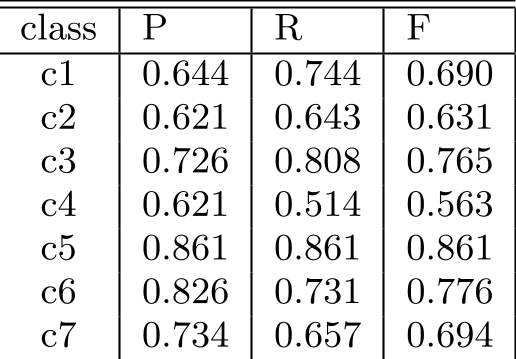 Performance metrics across different categories; note the high performance in Memorial (0.86) and Reporting (0.77).
Key Findings:
- Suicidal Ideation (c1): Achieved a Recall of 0.744, meaning it successfully caught nearly 75% of actual ideation posts.
- The Power of PCA: Applying PCA to subsets (Rotation Forest) significantly improved the F-measure from 0.61 (baseline SVM) to 0.69.
- Word Lists: Terms like "want to be dead" and "end it all now" remained the strongest predictors, but only when combined with affective features like "misery" or "alarm."
Critical Insight: The "Quiet" Markers of Suicide
A fascinating takeaway from the PCA analysis was the negative correlation. The absence of words related to "security," "admiration," and "temporal certainty" were often as predictive of suicidal intent as the presence of "death." Suicidal language on Twitter is characterized not just by what is said, but by the void of positive affective states.
Conclusion & Future Outlook
This work represents a vital bridge between computer science and suicidology. While the data is from 2015, the methodology of using domain-specific lexicons combined with ensemble voting remains a gold standard in clinical NLP.
The next frontier? Scaling this to real-time intervention systems that respect user privacy while providing a safety net for the most vulnerable users in the digital town square.
Disclaimer: If you or someone you know is in crisis, please contact a local suicide prevention hotline immediately.