
MALSEND: Unraveling Academic Success Patterns for Students with Special Educational Needs via AI
Using Machine Learning Advances to Unravel Patterns in Subject Areas and Performances of University Students with Special Educational Needs and Disabilities (MALSEND): A Conceptual Approach
This paper introduces MALSEND, a conceptual Human-Machine Intelligence (HMI) platform designed to identify learning patterns and performance trends among university students with Special Educational Needs and Disabilities (SEND). By leveraging unsupervised machine learning like K-means clustering and dimensionality reduction on large-scale administrative datasets, the framework seeks to bridge the gap between specific disabilities and academic success.
TL;DR
The MALSEND project (Machine Learning for Special Educational Needs and Disabilities) is a pioneering conceptual framework that uses unsupervised machine learning to analyze the academic journeys of disabled students. By identifying hidden clusters in performance data, it aims to lower the 31.5% dropout rate for SEND students by providing data-driven career and subject advice.
Background Positioning
Higher education support for disabled students has historically been reactive (providing transport or software) rather than proactive (guiding toward strengths). MALSEND positions itself as a Human-Machine Intelligence (HMI) platform, acting as a strategic bridge between institutional data and student success.
1. The Critical Gap: Why Traditional Advice Fails
Despite 30,000 disabled students entering UK universities annually, the disparity in outcomes is stark. Current career guidance often lacks an empirical understanding of how specific neurodivergence—such as ADHD, Dyslexia, or Asperger’s—interacts with specific subject demands.
The authors identify a "data silence": while universities collect vast amounts of engagement and grade data, it is rarely analyzed through the lens of disability-specific learning trajectories.
2. Methodology: From Raw Data to Insight
MALSEND adopts a multi-stage pipeline designed to handle the complexity and privacy requirements of student data.
Data Acquisition and Ethics
The study utilizes 15,000+ anonymized student records spanning 8 years, adhering to GDPR and HESA disability coding standards. Variables include:
- Demographics: Age, sex, and status.
- Academic History: UCAS points, entry type (e.g., Foundation vs. A-level).
- Engagement Metrics: Module grades, sits/re-sits, and credit accumulation.
The Algorithm Pipeline
The core of the methodology relies on Unsupervised Learning, chosen because it allows the data to "speak for itself" without pre-defined labels that might carry human bias.
- Dimensionality Reduction (PCA): Simplifies the dataset by identifying the most influential variables (e.g., does "attendance" matter more for an ADHD student than a dyslexic student?).
- K-means Clustering: Groups students into "performance profiles" based on their disability type and success in specific modules.
- Association Rule Learning: Discovers non-obvious relationships, such as "Students with Dyslexia in Subject X often excel in Module Y."
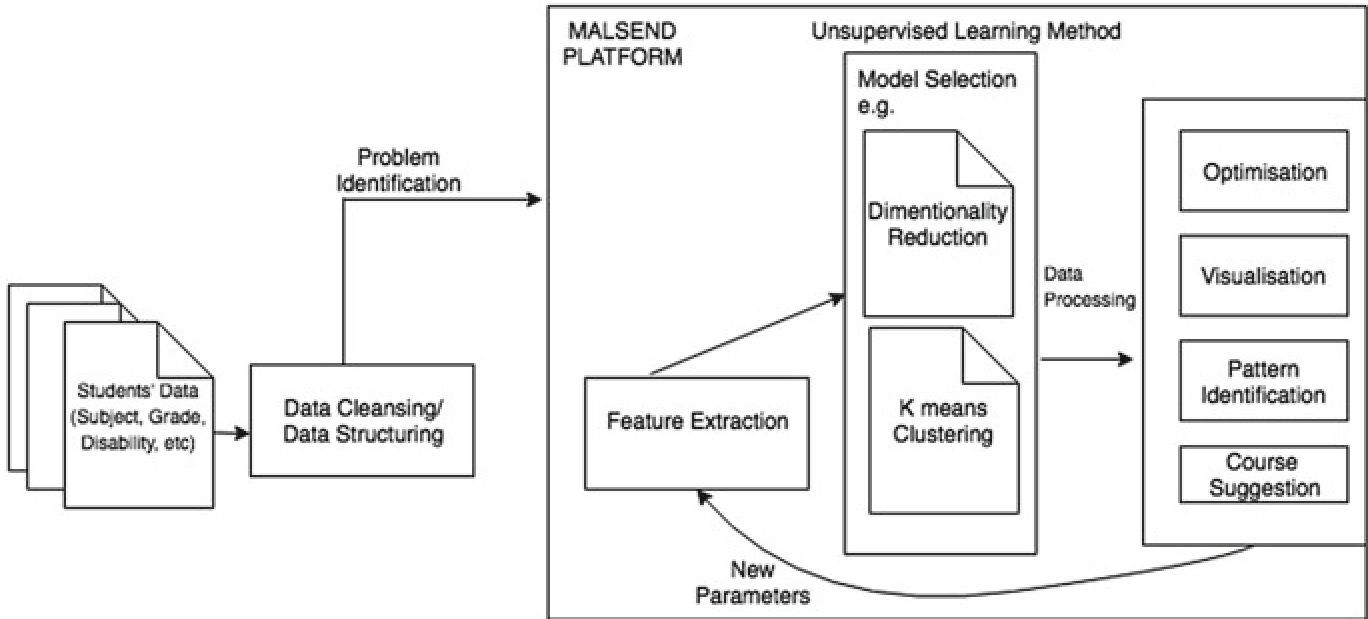 Figure 1: The conceptual architecture of the MALSEND platform, highlighting the flow from data sets to knowledge generation.
3. Analysis: The HESA Coding Frame
To ensure the model is robust, it utilizes the standardized UK coding frame (HESA/DRC). This allows the platform to categorize students into distinct impairment groups, enabling more granular analysis across different types of neurodivergence.
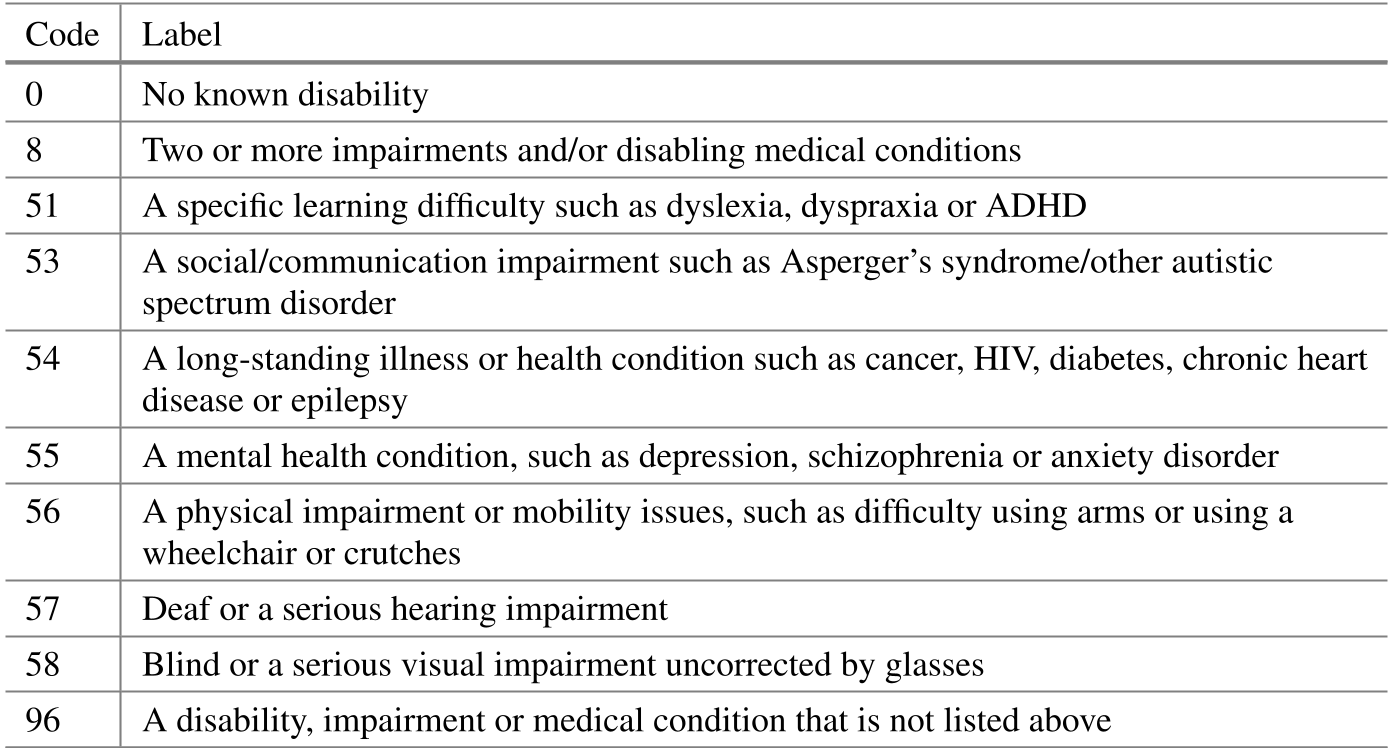 Table 1: The standard coding used to classify disabilities, forming the "labels" for pattern discovery.
4. Critical Insights & Future Impact
MALSEND is not just a technical exercise; it is a policy-shaping tool.
- For Career Advisers: It provides a "recommendation engine" for subjects where students with similar profiles have historically thrived.
- For Institutions: It identifies "bottleneck" modules where high failure rates for specific SEND groups might indicate a need for a more inclusive curriculum design.
- For Students: It offers a "voice" through data, showing that their learning path is part of a recognizable, supportable pattern.
Limitations & Next Steps
As a pilot study involving two universities, the authors acknowledge representation bias. The next phase requires scaling the "Collective Intelligence" model to more institutions to account for socio-economic factors and diverse course offerings.
Conclusion
The MALSEND framework represents a shift toward Precision Education. By applying the same machine learning rigor used in finance and healthcare to the SEND sector, we move closer to an educational environment where "special needs" are met with "specialized insights."
Key Takeaway: AI's greatest value in education may not be in automation, but in its ability to uncover the hidden strengths of neurodivergent learners that human intuition alone might miss.