
Decoding the Voice of Media: Machine Learning for Arabic News Style Detection
Machine Learning Approach for Detecting News Agencies' Linguistic Style in Arabic
This paper presents a binary classification model designed to detect news agencies' linguistic styles in Arabic using Machine Learning and NLP. By utilizing TF-IDF features and Linear Support Vector Machines (SVM), the authors developed a system capable of distinguishing between specific agency styles (notably Al-Jazeera) and other regional outlets with a 90% average accuracy.
TL;DR
Can an algorithm tell the difference between BBC Arabic and Al-Jazeera just by looking at a few sentences? This study proves it can. By combining custom-scraped Arabic datasets with Natural Language Processing (NLP) and Support Vector Machines (SVM), researchers developed a model that identifies a news agency's "linguistic fingerprint" with 90% accuracy.
Problem & Motivation: The Hidden Language of Ideology
Journalism is rarely neutral. Whether a territory is described as "occupied" or "disputed" is often a deliberate choice dictated by a newsroom's internal (and usually secret) style guide. These guides serve as an ideological compass, ensuring consistency in tone and narrative.
The authors identified several critical gaps:
- Manual Burden: Editors face immense pressure to conform to internal styles, a process that is currently manual and time-consuming.
- Resource Scarcity: While English NLP is mature, Arabic—a morphologically rich language—lacks robust tools and open-source datasets for style classification.
- Ideological Detection: Existing newsroom tools focus on fact-checking or workflow automation, but few address the "Why" and "How" of institutional linguistic style.
Methodology: The Engineering of Language
The researchers built a specialized pipeline focused on Binary Classification ("Conform" vs. "Non-Conform").
1. Data Collection & Topic Specificity
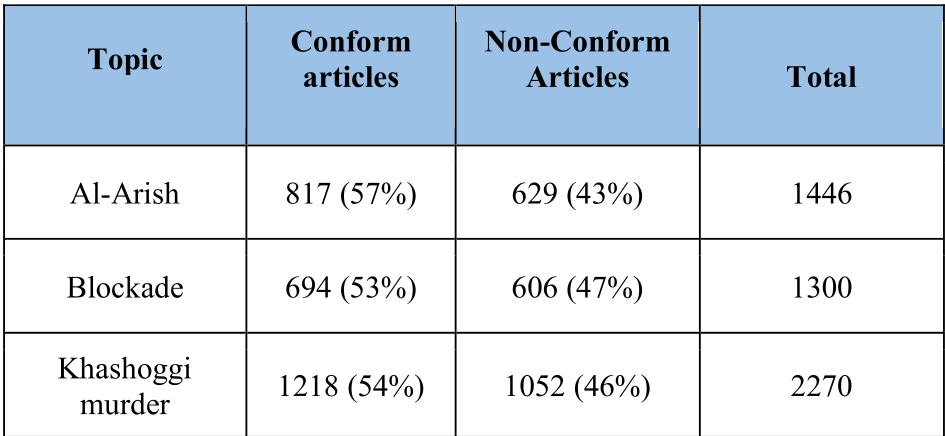
Because style can vary by subject, the authors built topic-specific datasets around controversial Middle Eastern events:
- The Al-Arish conflict in Egypt.
- The Blockade of Qatar.
- The Jamal Khashoggi murder.
2. The NLP Pipeline
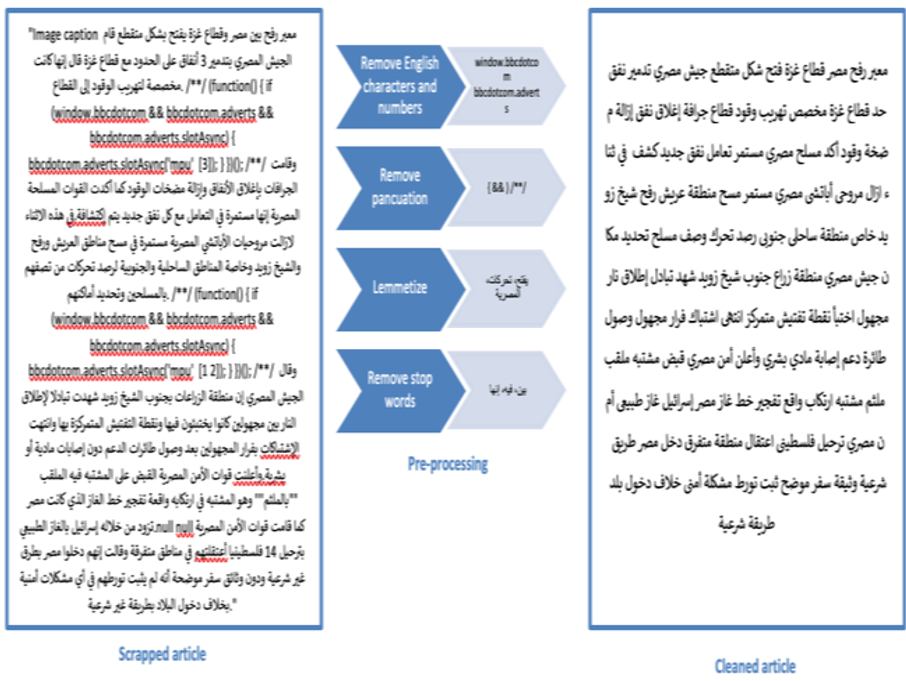
The core of the methodology lies in the Arabic-specific preprocessing. Using the Farasa toolkit, the text underwent lemmatization (reducing words to their roots), which is essential for Arabic due to its complex grammar.
For feature extraction, TF-IDF (Term Frequency-Inverse Document Frequency) was used. Unlike simple word counting, TF-IDF weights words based on their uniqueness to a specific document, effectively highlighting the "ideological" keywords used by one agency over others.
3. Classification via Linear SVM
The choice of Linear Support Vector Machine (SVM) was strategic. SVM is highly effective for high-dimensional text data. By finding the optimal "hyperplane" that separates the styles of different agencies, the model could classify new articles with high confidence.
Experiments & Results: High Precision in Media Analysis
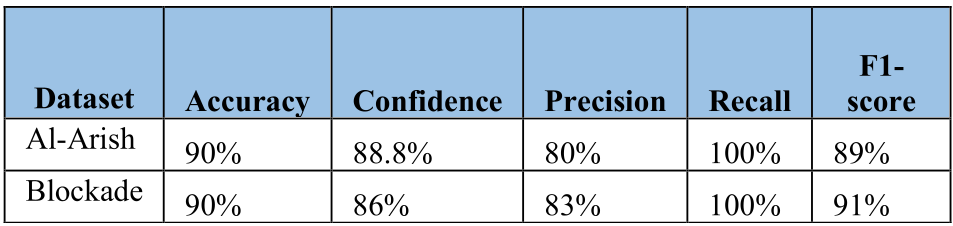
The results across multiple datasets were remarkably consistent. The model didn't just guess; it identified specific patterns.
- Average Accuracy: 90%
- Recall: 100% (Meaning the model never missed an article that actually belonged to the target agency).
- F1-Score: ~90%
Deep Insights: Analyzing the "Weights"
One of the most valuable outputs of the SVM model is the Weight Vector. By looking at which words (or N-grams) had the highest weights, the researchers could identify the specific terms that defined an agency's style. For example, specific phrasing around geopolitical entities acted as strong signals for the classifier.
Critical Analysis & Conclusion
The Value
This work transcends simple text classification; it provides a tool for computational social science. It allows researchers to quantify how news agencies evolve their interpretations of sensitive topics over time.
Limitations
- Semantic Nuance: As the authors noted, TF-IDF relies on word occurrence. It sometimes struggles with "boundary features"—neutral words that appear frequently in all news but happen to skew towards one class in a small dataset.
- Dataset Noise: The reliance on web scraping introduces HTML artifacts that can occasionally confuse the model.
Summary
The study proves that even with relatively "simple" machine learning models compared to today's massive LLMs, task-specific Arabic news classification is highly effective. Looking forward, the integration of Deep Learning (Neural Networks) and Semantic Embeddings will likely push these boundaries even further, allowing for a more nuanced understanding of "stance" and "sentiment" beyond mere word choice.