
Beyond Motion: Elevating Fall Detection through Biological Risk Profiles
Machine Learning-based Fall Detection in Geriatric Healthcare Systems
This paper proposes a context-aware Fall Detection System (FDS) for geriatric healthcare that integrates a subject's biological and physiological risk profile with wearable sensor data. By combining machine learning (ML) with structured risk categorization, the authors achieve improved prediction accuracy, specifically identifying k-nearest neighbors (kNN) and Decision Trees as top-performing classifiers.
TL;DR
Motion sensors alone aren't enough for reliable geriatric care. This paper breaks new ground by proving that integrating a patient's medical history (biological risk factors) into machine learning models significantly improves fall detection accuracy. By categorizing users into risk levels based on clinical "Odds Ratios," the proposed system reduces missed falls (False Negatives) for high-risk individuals.
Context & Motivation: The Missing Link in FDS
As the global elderly population surges, Ambient Assisted Living Systems (AALS) are becoming critical infrastructure. Current Fall Detection Systems (FDS) are generally "health-blind"—they treat a 20-year-old athlete and an 80-year-old with vertigo the same way if their accelerometer readings look similar.
This paper argues that context is king. A stumble by a high-risk patient is statistically more likely to be a fall than a similar movement by a low-risk individual. The authors leverage the medical concept of the Odds Ratio (OR) to transform a person's medical profile into a predictive feature.
Methodology: The Two-Step Intelligence
The research is split into two distinct analytical phases:
1. Risk Factor Categorization
The authors identified 23 biological factors (e.g., history of stroke, visual deficits, use of walking aids). Each factor is weighted by its Odds Ratio—a statistical measure of how much that factor increases the likelihood of a fall.
- Core Formula: A weighted normalized score determined the subject's category.
- Model Performance: Ordinal Logistic Regression achieved a 91.8% accuracy in correctly placing subjects into High, Medium, or Low risk tiers.
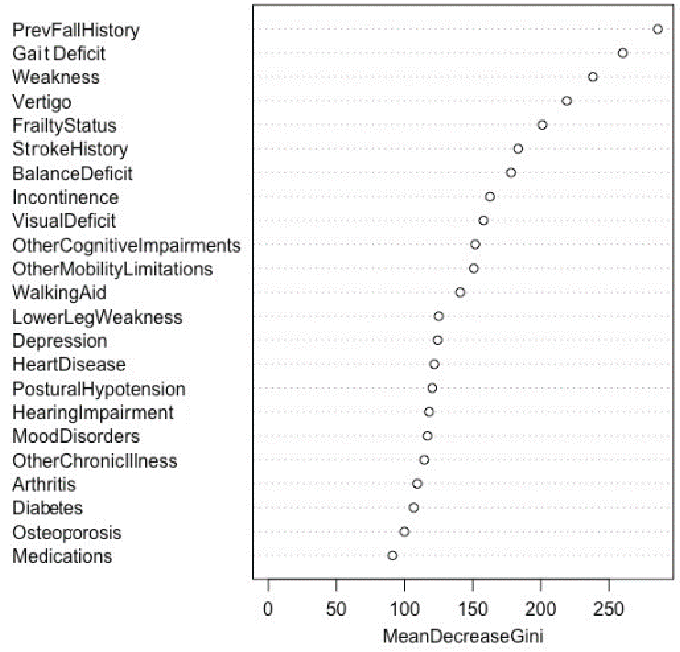 Figure 1: Random Forest Mean Decrease Gini showing which biological factors (like visual deficits or balance) most influence risk.
2. Sensor-Based Fall Detection
Using the UMAFall Dataset, the team compared standard ML (kNN, SVM, ANN) against a "Risk-Aware" version where the risk category was added as a feature.
Experimental Insights & Results
The "Risk-Aware" approach outperformed baseline models across the board.
- Accuracy Boost: Decision Trees saw the largest jump, rising from 81% to 85%.
- The kNN Winner: kNN remained the most reliable overall, reaching 84.1% accuracy when used with wrist-worn sensors.
- Safety Critical Metrics: For "High-risk" subjects, the True Positive Rate (TPR) reached 0.76. This means the system is far better at catching falls when they matter most.
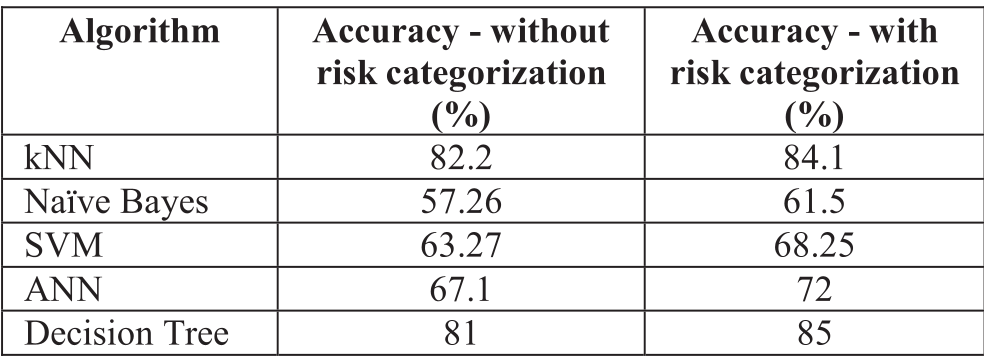 Table 1: Improvement in accuracy across different algorithms after adding risk categorization.
Critical Analysis: A Step Toward Personalized Medicine
The brilliance of this work lies in its simplicity: it doesn't just ask "What happened?" (acceleration), but "To whom did it happen?" (profile).
Strengths:
- Inductive Bias: By injecting clinical knowledge (Odds Ratios) into the model, they create a stronger inductive bias that helps the model differentiate between vigorous ADLs (Activities of Daily Living) and Actual Falls.
- Sensor Placement: The study confirms that wrist-worn sensors (common in smartwatches) are actually more accurate (82.2%) for this specific dataset than waist-worn ones (81.3%).
Limitations:
- Simulated Demographics: The initial risk categorization was performed on simulated data based on clinical literature, rather than a single unified dataset containing both medical history and motion data for every individual.
- Small Subject Pool: The motion data came from only 17 subjects, which may not capture the full range of age-related movement variance.
Conclusion and Future Outlook
This paper serves as a blueprint for the next generation of IoT healthcare. The authors plan to move toward closed-loop feedback systems, where deployment results retrain the model in real-time. For developers in the wearables space, the message is clear: the most accurate motion models of tomorrow will be the ones that understand the patient's medical history today.