
Precise Timing Prediction: Eliminating Pessimism in Chip Design via Machine Learning
Machine Learning-Based Pre-Routing Timing Prediction with Reduced Pessimism
This paper introduces a machine learning-based framework for pre-routing timing prediction in digital circuit design. By training a Random Forest model on net-level delay and slew features, the approach achieves timing accuracy near post-routing sign-off tools, effectively bridging the gap between placement and final routing.
TL;DR
Researchers have developed a machine learning-based approach to predict circuit timing before routing is even performed. By utilizing Random Forest models to estimate net delays and slew rates, they achieved results remarkably close to "Golden" sign-off tools, reducing false alarms by 66% and preventing the costly "over-design" typical of current commercial CAD tools.
Background: The Cost of Uncertainty
In the world of VLSI (Very Large Scale Integration), the placement stage is critical. Here, gates are positioned, and optimizations like gate sizing are performed. However, the signals actually travel through wires that haven't been routed yet.
Because routing significantly impacts delay, current commercial tools use highly pessimistic "worst-case" estimates. This pessimism is a double-edged sword: it ensures the chip works, but it forces engineers to use more power and area than necessary—essentially designing for a "ghost" problem that might not exist after routing.
The Core Innovation: Net-Based ML Prediction
The authors propose moving away from simple analytical formulas toward a data-driven model. Their strategy involves training models for individual net delays and slew rates.
1. Feature Engineering
To represent a net before it is wired, the authors identified several "Inductive Biases" in the form of features:
- Physical Distance: Horizontal and vertical distances between drivers and sinks.
- Capacitance: Load and drive strength.
- Context Sinks: This is the "secret sauce." Since a net can have multiple sinks, the locations of other sinks (context) affect how a router will build the tree for the target sink. They used statistical signatures (median and standard deviation) to describe this context.
2. Architecture Comparison
The study compared Lasso Regression, Neural Networks, and Random Forests. While Neural Networks are powerful, Random Forest proved superior here due to its robustness in handling the specific tabular features of EDA (Electronic Design Automation) data.
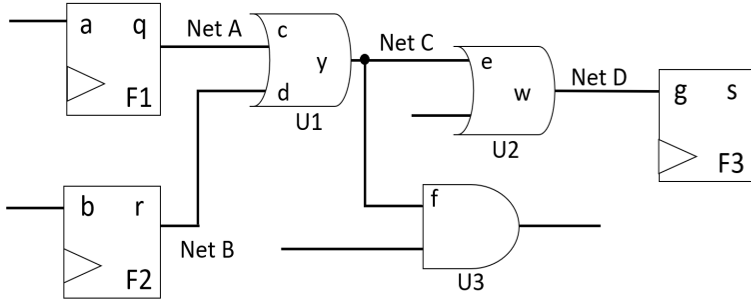 Figure: The net delay model predicts timing from driver input to specific sinks, integrating gate and wire characteristics.
Experimental Breakthroughs
The team tested their approach on ITC’99 benchmarks using a 45nm process. The results were stark:
- Accuracy: The Random Forest model achieved a 0.97 correlation with Synopsys PrimeTime (the industry standard).
- Reduced Pessimism: While commercial tools often over-estimated slack error by 2ns, the ML approach stayed within a narrow error margin.
- Efficiency: The model is 30x faster than running a full post-routing sign-off analysis, making it viable for iterative optimization during placement.
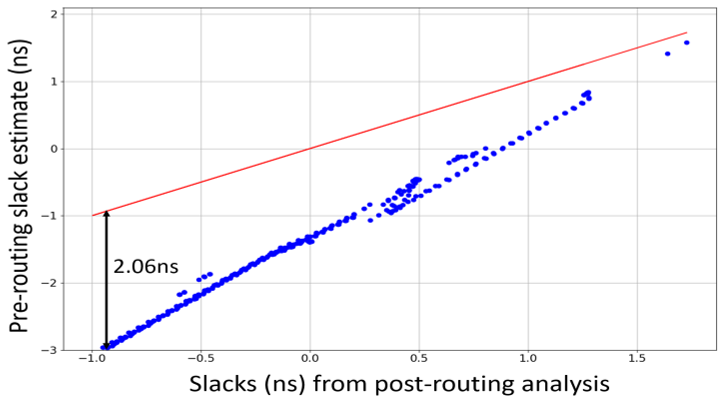 Figure: Commercial tools (left) show massive divergence from the ideal line, while the proposed ML model (right) closely tracks the "Golden" sign-off values.
Custom Loss Functions
A fascinating technical detail is the use of an Asymmetric MSE in their Neural Network tests. In timing analysis, under-estimating delay (optimism) is dangerous because the chip might fail. Over-estimating (pessimism) is just inefficient. The authors designed a loss function that penalized under-estimation more heavily, successfully shifting the error distribution to the "safe side."
Critical Analysis & Conclusion
This work marks a shift from "rule-of-thumb" engineering to "data-aware" engineering in hardware design. By proving that pre-routing timing can be predicted with near-sign-off accuracy, it opens the door for:
- Lower Power Consumption: Smaller gates can be used if we know timing isn't as tight as the pessimistic tools suggest.
- Faster TTM (Time to Market): Fewer iterations between placement and routing stages.
Limitations: The model currently focuses on 45nm benchmarks. As we move to 3nm or 2nm processes, factors like quantum effects and complex multi-patterning will require even more sophisticated features or perhaps Graph Neural Networks (GNNs) to capture the spatial layout.
Final Takeaway
The era of "safe but wasteful" chip design is ending. Machine learning provides the granularity needed to see "through" the uncertainty of the placement stage, allowing for leaner, faster, and more efficient silicon.