
When Will They Leave? High-Precision Temporal Churn Prediction in Retail Banking
Machine Learning for Customer Churn Prediction in Retail Banking
The paper investigates a machine learning framework for predicting customer churn in retail banking up to six months in advance. By comparing six ML techniques on real-world longitudinal data, it identifies Stochastic Boosting as the superior method for temporal churn forecasting.
Executive Summary
Customer retention is the economic backbone of retail banking; attracting a new customer is significantly more expensive than keeping an existing one. This paper moves beyond simple binary classification to answer the more difficult question: Exactly when will a customer churn? By leveraging a massive dataset of 130,000 customers and a rolling-window methodology, the researchers demonstrate that Stochastic Boosting can predict churn up to six months in advance with remarkable accuracy (AUC > 94%). This work transforms churn prediction from a reactive alert into a proactive scheduling tool for marketing departments.
The "Invisible" Churn Problem
Unlike the telecommunications industry, where customers must cancel a contract, banking is often non-contractual. A customer might simply stop using their debit card or move their savings to a competitor without ever closing their account.
The authors identify three core challenges:
- Defining Churn: They define it as 6 months of inactivity combined with an asset/debt balance below €25.
- The Long Tail: Less than 1% of banking customers churn, creating a massive "needle-in-a-haystack" class imbalance.
- The Temporal Aspect: Identifying a churner is useless if you don't know the window of opportunity to intervene.
Methodology: The Rolling Window Framework
The researchers restructured 24 months of raw interaction data (product balances, transaction counts, etc.) into rolling windows. To predict churn months ahead, they used a 6-month historical "look-back" period.

Six ML algorithms were pitted against each other:
- Stochastic Boosting (SB): The eventual winner.
- Random Forests (RF): Strong performance but slightly edged out by SB.
- Support Vector Machines (SVM), Logistic Regression (LR), CART, and MARS.
To handle the 1% imbalance, the authors used undersampling, creating balanced training sets that allowed the models to learn the specific characteristics of churners without being overwhelmed by the majority "loyal" class.
Key Insights: What Drives a Churner?
The study reveals that the predictors of churn shift depending on the time horizon:
- Short-term (1-2 months out): The total value of bank products held and the presence of cards in other banks are critical.
- Medium-term (3-4 months out): Transaction frequency drops and the existence of a mortgage loan outside the bank becomes a dominant indicator.
Interestingly, demographic data (marital status, age) proved significant in survival analysis: younger, single, and less educated customers were found to be more "volatile."
Experimental Results
The Results section highlights the superiority of Stochastic Boosting. While traditional Survival Analysis (Cox Regression) could predict if a customer would churn over 24 months, it struggled with the specific month of departure.
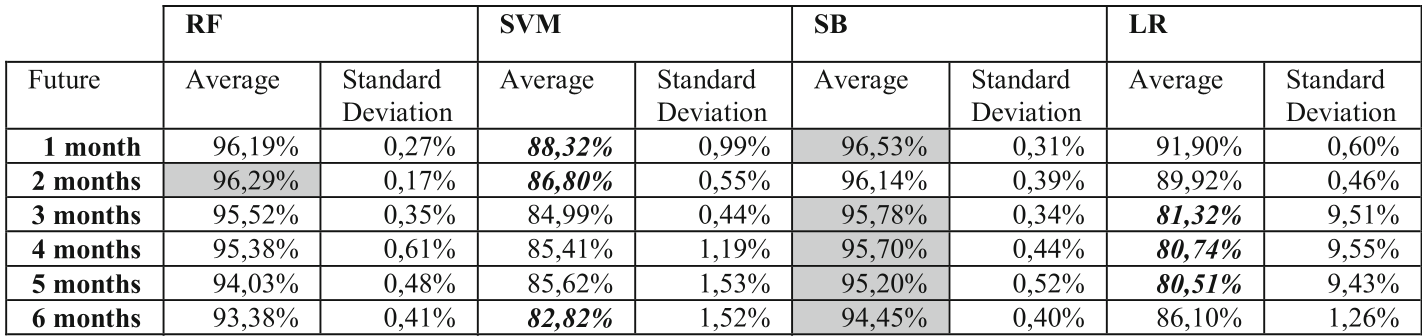
As shown in the data, SB provides an AUC of 0.965 for the 1-month horizon. Even at the 6-month mark, it maintains a 0.944 AUC, showcasing the robustness of the features extracted from the 6-month historical window.
Critical Analysis & Future Outlook
Takeaway: This paper proves that ML-driven temporal forecasting is ready for deployment in real-world retail banking. By moving away from static models to dynamic rolling windows, banks can "re-score" their entire customer base every month.
Limitations: The study relies on a 2-year window. While sufficient for high-frequency transactions, it may miss the multi-year cycles of "sticky" products like mortgages or long-term investments.
Future Work: The authors suggest an "Integrated Recommendation Engine." Imagine a system that not only predicts a customer will leave in 3 months but also identifies that a specific "Personal Loan" offer would be the most effective lever to keep them. This transition from Predictive to Prescriptive analytics is the next frontier for Fintech.