
Stochastic Boosting in Retail Banking: Predicting the "When" and "Why" of Customer Churn
Machine Learning for Customer Churn Prediction in Retail Banking
This paper investigates customer churn prediction in retail banking using six machine learning methods, achieving high predictive accuracy on real-world datasets. The study proposes a rolling time window framework to predict not only if a customer will leave but specifically when (up to 6 months in advance), with Stochastic Boosting (SB) emerging as the top-performing model.
TL;DR
Predicting customer attrition is a billion-dollar problem for banks. This study moves beyond simple "will they leave?" binary classification to "when will they leave?" over a 6-month horizon. By leveraging real-world data from 130,000 customers and utilizing Stochastic Boosting, the researchers achieved over 96% AUC in forecasting near-term churn, identifying external banking relationships as a critical "red flag" for customer loyalty.
Problem & Motivation: The Non-Contractual "Silent" Exit
In retail banking, there is rarely a "breakup" letter. Unlike a gym membership or a Netflix subscription, a bank customer simply stops swiping their card or transfers their balance elsewhere. This is known as a non-contractual setting, and it makes identifying churners incredibly difficult.
The authors identify two fatal flaws in prior work:
- Imbalance Ignorance: Churners represent less than 1% of the population, leading many models to simply "guess" everyone stays to achieve high (but useless) accuracy.
- Temporal Ambiguity: Knowing a customer might leave in the next year is too vague for a marketing team. To be actionable, a model must predict if the churn is imminent (1 month) or distant (6 months).
Methodology: Rolling Windows and Stochastic Boosting
The core innovation lies in the data structuring. Instead of a single snapshot, the researchers used Rolling Time Windows.

- The Framework: For a 24-month dataset, the model looks at months 1-6 (features) to predict month 7 (label). It then slides to months 2-7 to predict month 8, and so on.
- The Algorithms: Six models were tested: Random Forests (RF), SVM, Stochastic Boosting (SB), Logistic Regression (LR), CART, and MARS.
- The "Acid Test": To prove the model wasn't just identifying "unhappy people" but actually "when they leave," the authors tested the model on a dataset consisting only of churners, forcing the model to distinguish between "churched now" and "churned later."
Experiments & Results: Identifying the Leaders
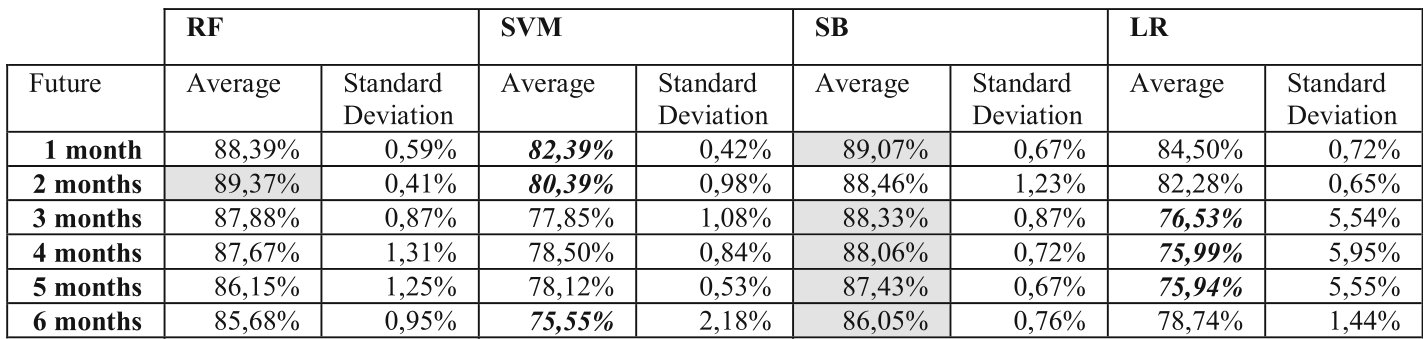
The results were conclusive: Stochastic Boosting (SB) and Random Forests (RF) dominated the leaderboard.
Key Findings:
- Stochastic Boosting (SB) reached an AUC of 96.53% for 1-month horizons.
- As the time horizon increased (e.g., predicting 6 months out), accuracy naturally decayed but remained robust (SB AUC ~94.45%).
- Feature Importance:
- 1-2 Months Horizon: Success depends on "Total value of bank products" and "Existence of cards in another bank."
- 3-4 Months Horizon: Predictive power shifts to "Number of transactions" and "External mortgage loans."
Deep Insight: Why Does This Work?
The effectiveness of Stochastic Boosting here stems from its ability to handle non-linearities and rare events. By iteratively re-weighting misclassified samples, SB focuses on the difficult-to-predict churners that simpler models (like Logistic Regression) miss.
Furthermore, the survival analysis (Cox Regression) revealed a fascinating social dimension: Age and Education are strong stay-indicators, while Web-based Acquisition (opening an account online) actually correlates with higher loyalty, likely due to the convenience of the digital ecosystem reducing "friction" that causes churn.
Conclusion & Future Look
This research provides a production-ready blueprint for banks. By shifting from static survival curves to dynamic machine learning horizons, institutions can prioritize high-value customers who are most at risk of leaving in the immediate future.
Limitations: The study relies on a 2-year window; longer-term patterns (macroeconomic shifts) remain unexplored. Future work integrating "Next Best Product" recommendations could allow banks to not only predict churn but automatically present a tailor-made incentive to prevent it.