
Peer-Targeted Detection: Elevating Cyberbullying Classification with Pronoun and Skip-Gram Analysis
Machine learning approach for detection of cyber-aggressive comments by peers on social media network
This paper presents a supervised machine learning framework for detecting cyber-aggressive comments targeting peers on social media. By introducing two novel feature extraction hypotheses—pronoun tracking and skip-grams—the study enhances the performance of Logistic Regression and SVM classifiers on Kaggle datasets.
TL;DR
With the rise of social media-linked teen suicides, detecting cyber-aggression has moved from a "nice-to-have" feature to a critical safety requirement. This paper introduces a supervised learning approach that moves beyond simple profanity counting. By focusing on peer-directed markers—specifically the word "you" and non-contiguous word associations (skip-grams)—the researchers boosted detection accuracy (AUC) from 82% to nearly 87%.
Background: The Limits of Keyword Matching
Prior work in toxicity detection often relied on "blacklists" or basic N-grams. While effective at catching a stray curse word, these methods struggle with the nuance of intent. There is a massive psychological difference between a user typing "This movie is [bad word]" and "[Bad word] you." The former is an opinion; the latter is a targeted attack. Current filters often fail to distinguish between offensive comments directed at public figures versus those attacking fellow participants (peers), the latter of which leads to significantly higher rates of teen demoralization.
The Core Insight: Why "You" and "Skip-Grams" Matter
The authors' methodology is built on two primary technical hypotheses:
- The Pronoun Hypothesis: Peer-directed bullying almost always involves second-person pronouns. By extracting the TF-IDF scores of pronouns like "you" or "ur," the model gains a proxy for "target directionality."
- The Skip-Gram Hypothesis: Bullies often bypass simple filters by adding filler words between insults. Skip-grams allow the model to associate "You" with "idiot" even if there are several words in between (e.g., "You are such a massive idiot").
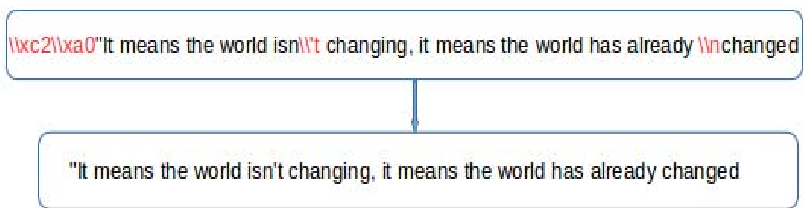 Figure 1: The proposed pipeline, from normalization to Chi-Squared feature selection and final classification.
Methodology: From Raw Text to Feature Vectors
The researchers utilized a structured pipeline to handle the "dirty" data of social media:
- Normalization: They implemented a dictionary of 500 bad words that includes "leetspeak" variations (e.g.,
@$$for ass). Crucially, they applied stemming only to the dictionary to avoid losing semantic information in the main corpus. - Feature Selection: Using the Chi-Squared (X²) test, they filtered roughly 100,000 potential features down to the 3,000 most statistically significant ones. This ensures the model remains computationally efficient while focusing on high-impact terms.
- Classification: They compared Support Vector Machines (SVM) with Linear Kernels and Logistic Regression. Interestingly, Logistic Regression slightly outperformed SVM in this specific binary classification task when additional features were added.
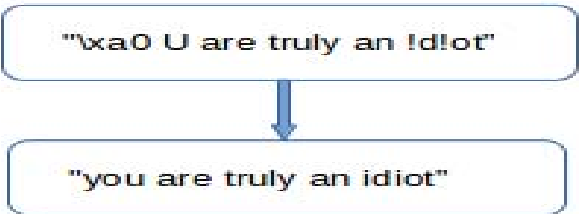 Figure 2: Pre-processing steps to normalize slang and flexible language.
Experimental Results & Performance Gains
The model was validated on a Kaggle dataset of ~6,500 comments. The jump in performance was notable when the "Peer-Directed" hypothesis was applied:
- Standard Features (TF-IDF/N-gram): 82.69% AUC
- With Pronoun Features: 86.58% AUC
- With Skip-Grams: 86.87% AUC
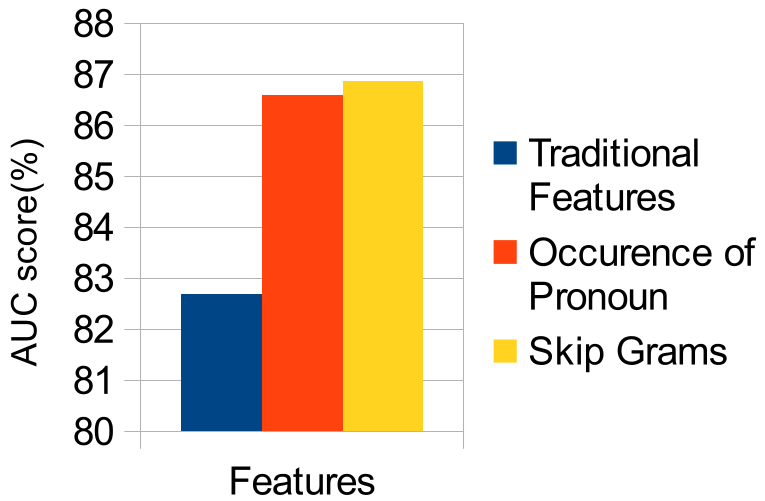 Figure 3: Visual representation of the Accuracy/AUC boost provided by the authored hypotheses.
The use of 2-skip-grams and 3-skip-grams (looking at word pairs separated by 1 or 2 intervening tokens) proved most effective. This suggests that the "grammar of bullying" is relatively consistent—aggressive intent is often framed within a few tokens of a personal pronoun.
Critical Analysis & Future Outlook
While the 4%+ increase in AUC is significant for a supervised model, the paper acknowledges a persistent challenge: Sarcasm. A comment like "Wow, you're a real genius" might pass a skip-gram check but still constitute bullying.
Takeaway: This work demonstrates that effectively fighting cyber-aggression isn't just about knowing "bad words," but about understanding who those words are being thrown at. Future iterations integrating Sentiment Analysis or Transformer-based embeddings (like BERT) could potentially solve the sarcasm gap that this dictionary-and-statistical approach leaves open.
Academic Conclusion
By moving the focus from "what is said" to "to whom it is said," the authors provide a practical, high-efficiency path for social media platforms to automate the protection of their younger users without the need for manual moderation at scale.