
Proactive AML: Detecting Money Laundering Before the First Transaction
17321_Usage of machine learning methods for early detection of money laundering schemes.
The paper presents a machine learning framework for the early detection of money laundering (ML) and terrorist financing (TF), specifically targeting organizations at the "account opening" stage. By utilizing Gradient Boosting Decision Trees (LightGBM) and sophisticated categorical encoding like TargetEncoder with double cross-validation, the authors achieved an ROC-AUC of 0.8849, enabling proactive risk management before transactions occur.
TL;DR
In the high-stakes world of Anti-Money Laundering (AML), waiting for a suspicious transaction to occur is often too late. Researchers from the National Research Nuclear University (MEPhI) have developed a machine learning framework that identifies high-risk organizations at the stage of opening a current account. By applying LightGBM and advanced categorical encoding, they achieved an ROC-AUC of 0.8849 without needing a single byte of transaction history.
The "Zero-Knowledge" Motivation
Modern financial supervision faces a "Catch-22": robust control often blocks legitimate businesses (leading to profit loss), while criminal detection usually happens after the funds have already moved.
The core challenge addressed here is the lack of transactional activity. When an entity first approaches a bank, there is no "behavioral history" to analyze. Previous works relied heavily on expert rules, which are easily bypassed by new laundering schemes. The authors' intuition was that the "DNA" of an organization—its registration data, capital structure, and public procurement history—contains enough latent signals to predict its propensity for illegal activity.
Methodology: Engineering the Invisible
The paper emphasizes the importance of data preprocessing, particularly for categorical variables which are prevalent in legal documentation.
1. Advanced Categorical Encoding
Standard techniques like One-Hot Encoding often fail with high-cardinality data. The authors explored various encoders, concluding that TargetEncoder with Double Cross-Validation provides the best balance. This technique replaces a category with the mean of the target variable but uses a nested validation structure to prevent the model from "cheating" (target leakage).
2. Model Architecture
While several algorithms were tested, Gradient Boosting (LightGBM) emerged as the winner. The pipeline utilized:
- Feature Selection: Greedy direct selection narrowing 42 features down to 15.
- Optimization: Comparison between
hyperopt(Random Search) andoptuna(Bayesian TPE).
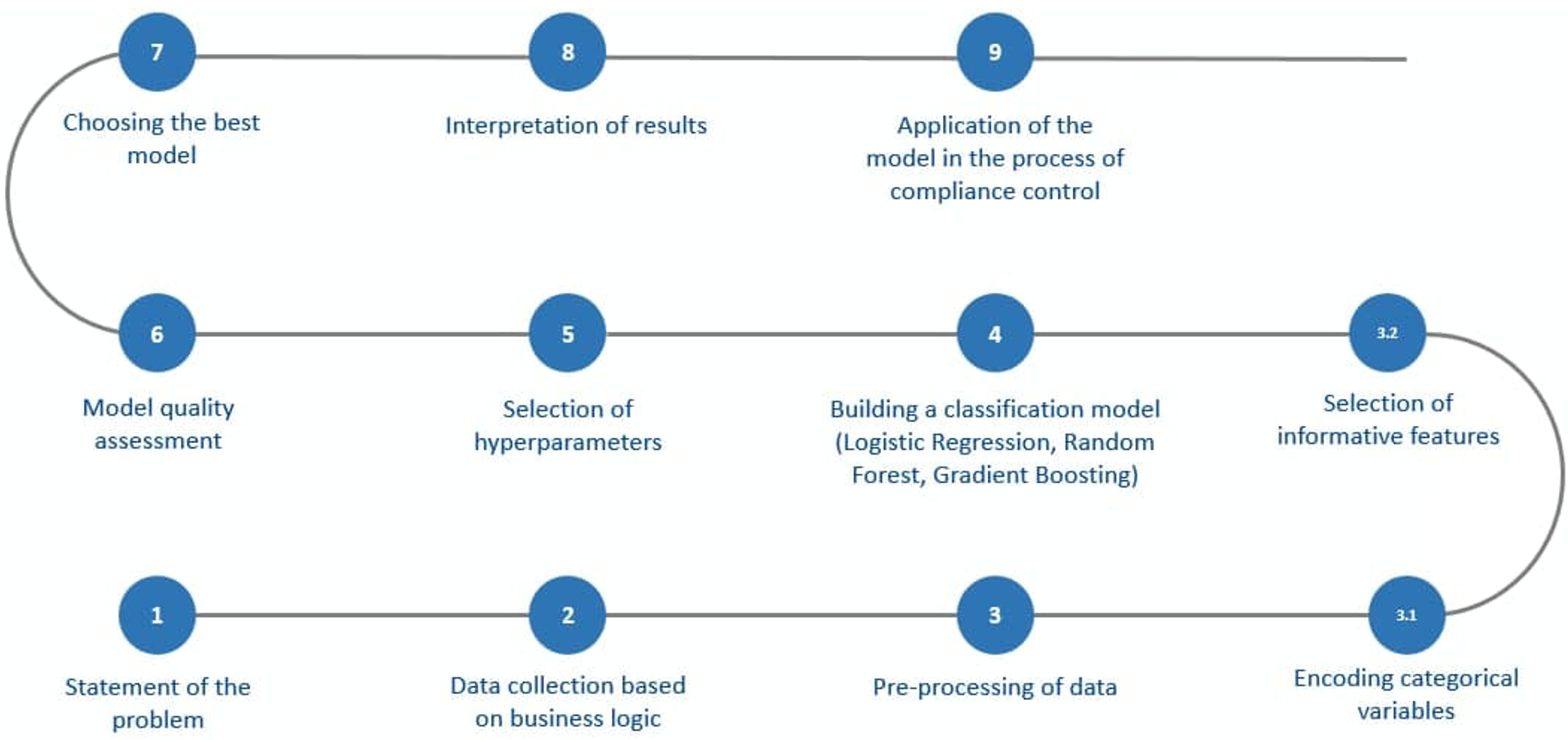 Above: The research workflow from data acquisition to model assessment.
Experimental Warfare: Optuna vs. Hyperopt
A fascinating aspect of this research is the head-to-head comparison of hyperparameter tuning libraries. Across 15,000 trained models, the authors found a trade-off:
- Hyperopt: Reached a "quality plateau" faster (lower computational cost).
- Optuna: Achieved a higher absolute ROC-AUC score but required more iterations.
 Table 1: Final model metrics across Subsamples.
The final model demonstrated exceptional stability, with OOS (Out-of-Sample) and OOT (Out-of-Time) ROC-AUC scores staying consistently above 0.88, proving the model generalizes well to future data.
Critical Insight: The Regulatory Shift
The paper doesn't just propose a model; it proposes a paradigm shift. By identifying the "type of activity," "authorized capital size," and "founder composition" as the most significant features, the study provides a roadmap for regulators (like the Bank of Russia) and credit organizations to build a "Pre-check" layer.
Limitations: While the ROC-AUC is high, the Recall remains relatively low (~0.32 on OOT data). This suggests that while the model is very accurate when it does flag an entity, it still misses a portion of sophisticated laundering schemes that mimic legitimate business profiles perfectly.
Conclusion
This MEPhI study proves that machine learning can bridge the gap in early AML detection. Moving forward, integrating these tabular models with Graph Neural Networks (GNNs) to map the relationships between founders could potentially solve the "low recall" issue and provide an even more impenetrable shield against financial crime.