
Deciphering the "Bricoleur": Using Machine Learning to Model Educational Robotics
Machine Learning for modelling and identification of Educational Robotics activities
The paper presents an automated identification system for Educational Robotics (ER) that integrates Educational Data Mining (EDM) and Learning Analytics (LA). By applying supervised and unsupervised machine learning (ML) to logs of student interactions with tools like Lego Mindstorms EV3, the researchers successfully model problem-solving behaviors and predict performance outcomes.
TL;DR
Educational Robotics (ER) is a cornerstone of constructionist learning, but assessing it is notoriously subjective. This paper introduces a system that transforms raw "trial-and-error" interaction logs into quantifiable learning trajectories. By leveraging K-Means clustering and SVMs, the authors can now predict whether a student team will succeed or fail based on their "tinkering" style—effectively acting as a real-time intelligent sensor for the classroom.
The Assessment Bottleneck in Open-Ended Learning
ER environments are "open-ended," meaning there is no single right way to solve a challenge. While this is great for creativity, it is a nightmare for assessment. Teachers usually rely on qualitative observations, which are:
- Biased: Influenced by the observer's focus and beliefs.
- Unscalable: It is impossible to monitor five groups of students simultaneously and capture every insight.
The authors argue that we need Educational Data Mining (EDM) to extract objective patterns from the noise of student programming attempts.
Methodology: From Raw Strings to Learning Metrics
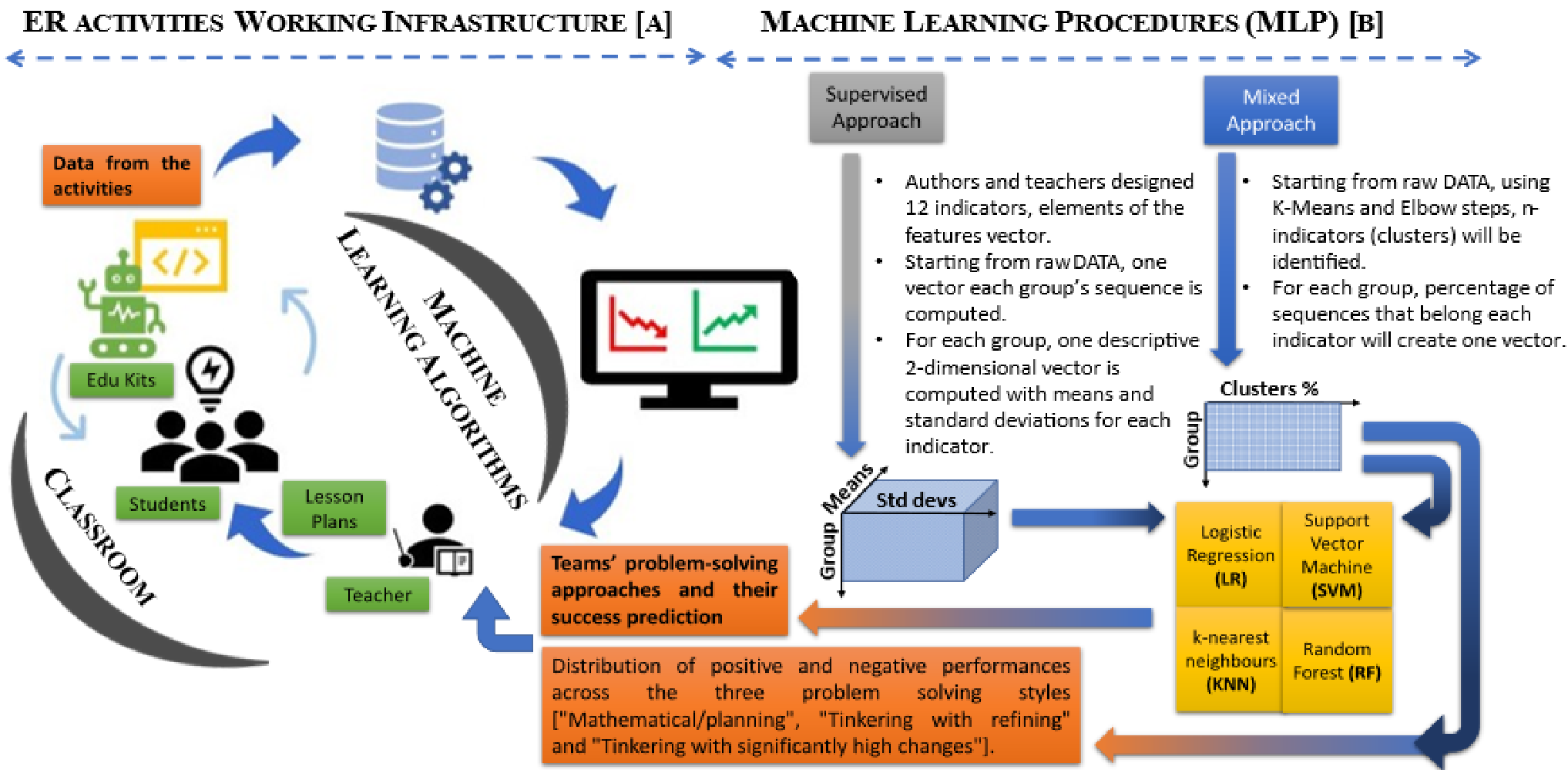
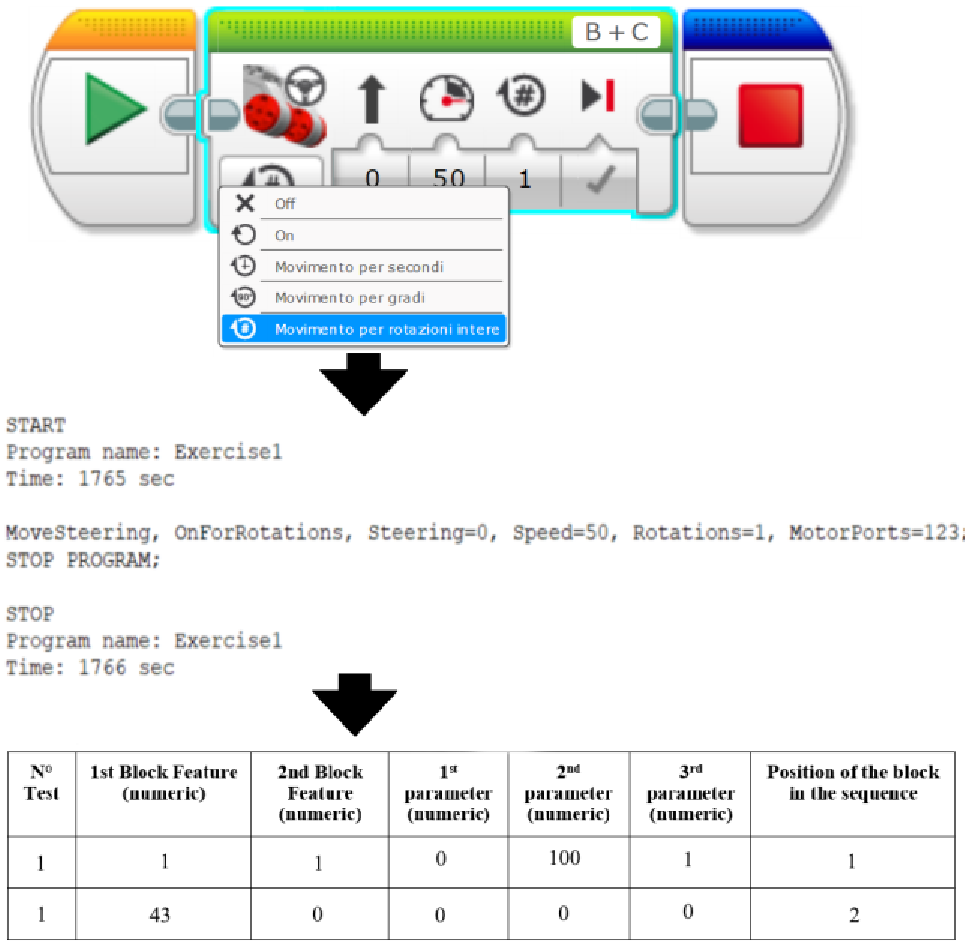
The researchers modified the Lego Mindstorms EV3 environment to log every "run" and "change" a student group made. This raw data is then processed through two distinct pipelines:
1. The Expert-Driven Path (A Priori Knowledge)
Experts defined 12 specific indicators (e.g., the number of Motor/Loop blocks, or the "Delta" of change between versions). This captures the physicality of the programming—showing exactly how much a team nudged their parameters after seeing the robot fail.
2. The Data-Driven Path (Unsupervised Clustering)
Using K-Means Clustering, the system grouped sequences based on mathematical similarity rather than human intuition. This avoids the "human-in-the-loop" bias and uncovers behaviors that educators might miss.
The Three Faces of Student Problem-Solvers
The study identified three core behavioral patterns that directly impact performance:
- Mathematical/Planning: These "planners" do most of their work before hitting 'play.' They have fewer tests and fewer changes. Interestingly, this doesn't guarantee success—if their initial formula is wrong, the project fails.
- Tinkering with Refining: This is the "Bricoleur" approach. They make small, incremental adjustments based on the robot's feedback. This group usually achieves the best outcomes.
- Tinkering with High Changes: These students are "Trial and Error" addicts. They change huge portions of code without understanding the feedback. This behavior is a strong predictor of failure.
Critical Analysis & Results
The paper highlights that SVM (Support Vector Machines) combined with K-Means features ("Mixed Approach") provides the most robust prediction of student success.
Why does this matter? It allows for a Recall-driven pedagogical approach. By identifying "Tinkering with High Changes" groups early, a teacher can intervene before the students become frustrated and disengaged. Instead of just grading the final robot, we are finally grading the process of learning.
Limitations & Future Work
While promising, the dataset is still relatively small. The authors acknowledge that moving toward a "Trustworthy AI" framework is essential, especially when these algorithms might influence a student's grade or a teacher's perception of their ability.
Conclusion
This research moves Educational Robotics from a "black box" of play into a measurable science. By treating software logs as a "virtual sensor," we can support the constructionist ideal—learning by doing—while providing the rigorous feedback necessary for formal education.