
Decoding the Silent Struggle: Wearable Emotion Recognition for Parkinson’s Disease
A Machine-Learning Based Emotion Recognition System in Patients with Parkinson’s Disease
The paper presents a wearable emotion recognition system for Parkinson's Disease (PD) patients using Support Vector Machines (SVM). By leveraging physiological data (heart rate, skin conductance, temperature) from smartwatches, the system achieves a state-of-the-art accuracy of 91.3% in classifying positive vs. negative emotional states.
TL;DR
Parkinson’s Disease (PD) doesn't just affect movement; it masks emotions through a condition called hypomimia. This paper introduces a machine-learning system that bypasses the "masked face" of PD by using smartwatch-based physiological signals (heart rate, skin conductance, temperature). Using an SVM-RBF model, the researchers achieved 91.3% accuracy in distinguishing positive from negative emotions, proving that the body speaks even when the face cannot.
The "Masked Face" Problem: Why Computer Vision Fails
In the world of Affective Computing, facial expression analysis is king. However, for the 3% of the global population over 60 living with Parkinson’s, this technology fails.
The loss of dopaminergic neurons leads to hypomimia—a clinical reduction in facial reactivity. To an AI trained on healthy subjects, a PD patient might appear "indifferent" or "angry" regardless of their true internal state. Furthermore, PD disrupts the limbic loop, creating a specific deficit in processing and expressing negative emotions. The authors realized that to truly "see" the patient, we must look beneath the skin.
Methodology: From Wrist to Reward
The researchers developed a hardware-software pipeline designed to capture "affective ground truth" through three layers:
- Wearable Layer: A smartwatch capturing Heart Rate (HR), Galvanic Skin Response (GSR), and Skin Temperature.
- Stimulus Layer: Patients watched 12 emotional videos (Joy/Happiness vs. Anger/Disgust).
- Labeling Layer: The study compared two "teachers" for the AI:
- SAM (Self-Assessment Manikin): A clinical 9-point scale where patients self-report.
- Commercial Vision Software: Standard facial recognition.
The Feature Engineering Bridge
The team extracted 27 distinct features, with a heavy emphasis on cardiac dynamics (21 features). These included standard deviations of heart rate and derivatives of skin conductance, capturing the subtle "fight or flight" responses of the Autonomic Nervous System.
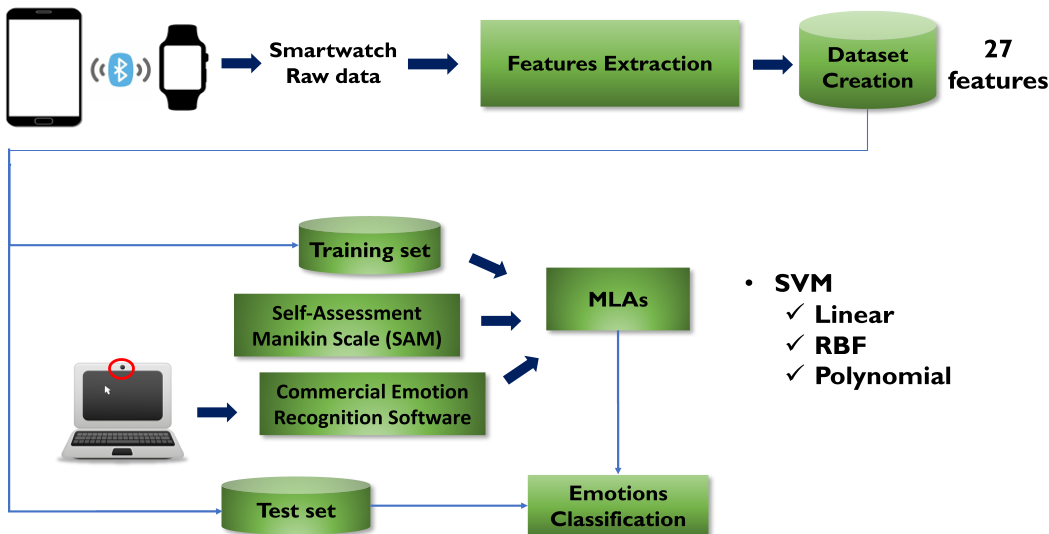 Figure 1: The proposed architecture integrating wearables, smartphone data collection, and stimulus delivery.
Results: Physiology Outperforms Vision
The study’s most striking find was that physiology knows more than the face.
When the SVM was trained using labels from commercial facial recognition software, accuracy for negative emotions plummeted to near-random (approx. 50% for linear kernels). However, when trained using the patient's self-reported feelings (SAM) and physiological data, the SVM-RBF (Radial Basis Function) kernel soared.
Key Performance Data:
| Model | Overall Accuracy (SAM Labels) | 0-Class (Negative) Accuracy |
|---|---|---|
| SVM-RBF | 91.3% | 83.7% |
| SVM-Linear | 77.3% | 65.4% |
| SVM-Poly | 76.9% | 69.4% |
 Table 1: Performance of SVM kernels using SAM-based ground truth labels.
Critical Insights: Why RBF?
The superiority of the RBF kernel suggests that the relationship between physiological markers and emotional states in PD patients is non-linear. A simple linear threshold can't distinguish a "stress-induced" heart rate spike from an "excitement-induced" one; the RBF kernel’s ability to map data into higher-dimensional spaces allows it to find the complex boundaries between these states.
Conclusion and Future Outlook
This work confirms that while the "Parkinsonian Mask" might hide emotions from human observers and standard webcams, the autonomic nervous system remains a vibrant channel for emotional expression.
Future Implications:
- Continuous Monitoring: Imagine a smartwatch that alerts caregivers when a patient is entering a depressive or highly anxious state in real-time.
- Therapeutic Feedback: Clinicians can use this data to adjust L-dopa dosages by monitoring the patient's emotional "baseline" throughout the day.
- Limitation: The current study uses a controlled video stimulus; moving this to "in-the-wild" environments with high motion artifacts remains the next great challenge.
By shifting the focus from the face to the fiber—the autonomic nervous system—this research provides a vital tool for restoring the "emotional voice" of those living with Parkinson's.