
ECG-Based Biometrics: The Future of Resource-Efficient Security in IoMT
Towards Machine Learning Enabled Security Framework for IoT-based Healthcare
This paper proposes an ML-based biometric security framework for the Internet of Medical Things (IoMT). By extracting unique features from Electrocardiogram (ECG) signals using polynomial approximation and a Multilayer Perceptron (MLP) model, it achieves a secure user authentication mechanism tailored for resource-constrained medical devices.
TL;DR
The surge in Internet of Medical Things (IoMT) devices has created a critical tension between data security and battery longevity. This paper introduces an innovative framework that replaces heavy traditional cryptography with ML-based biometric authentication. By extracting lightweight "Entity Identifiers" (EIs) from a patient's own ECG signals and verifying them via a Multilayer Perceptron (MLP), the system ensures data integrity with minimal computational overhead.
Problem & Motivation: The "Heavy" Cost of Security
In the world of connected healthcare, sensor nodes are often tiny, battery-powered devices. Protecting sensitive patient data (PHI) is non-negotiable due to regulations like GDPR and HIPAA, yet traditional encryption creates two major hurdles:
- Computational Burden: Generating and managing external keys drains the limited power of IoMT sensors.
- Vulnerability to False Attacks: Pre-existing quantization methods are often too generic, allowing sophisticated attackers to predict parameters and link network identities to stolen data.
The authors’ core insight is that the human heart is a unique signal generator. Since ECG signals are inherently random to the observer but unique to the individual, they can function as a "built-in" security key that requires no external distribution.
Methodology: From Heartbeats to Bio-Keys
The proposed framework follows a sophisticated pipeline to transform raw, noisy heart signals into a reliable security protocol.
1. Signal Pre-processing & QRS Detection
Raw ECG signals are filtered to remove noise using linear and non-linear transformations. The focus is on the QRS complex—the most prominent part of the ECG waveform.
- Linear Filter (): Highlights the frequency components of the heartbeat.
- Non-linear Transform (): Squaring the signal to emphasize peaks.
2. Polynomial Approximation: The Efficiency Trick
Storing a full QRS complex is memory-intensive. The authors solve this by using polynomial approximation. Instead of storing the whole wave, they store a few mathematical coefficients that describe the curve. This drastically reduces the transmission overhead while retaining the "fingerprint" of the heartbeat.
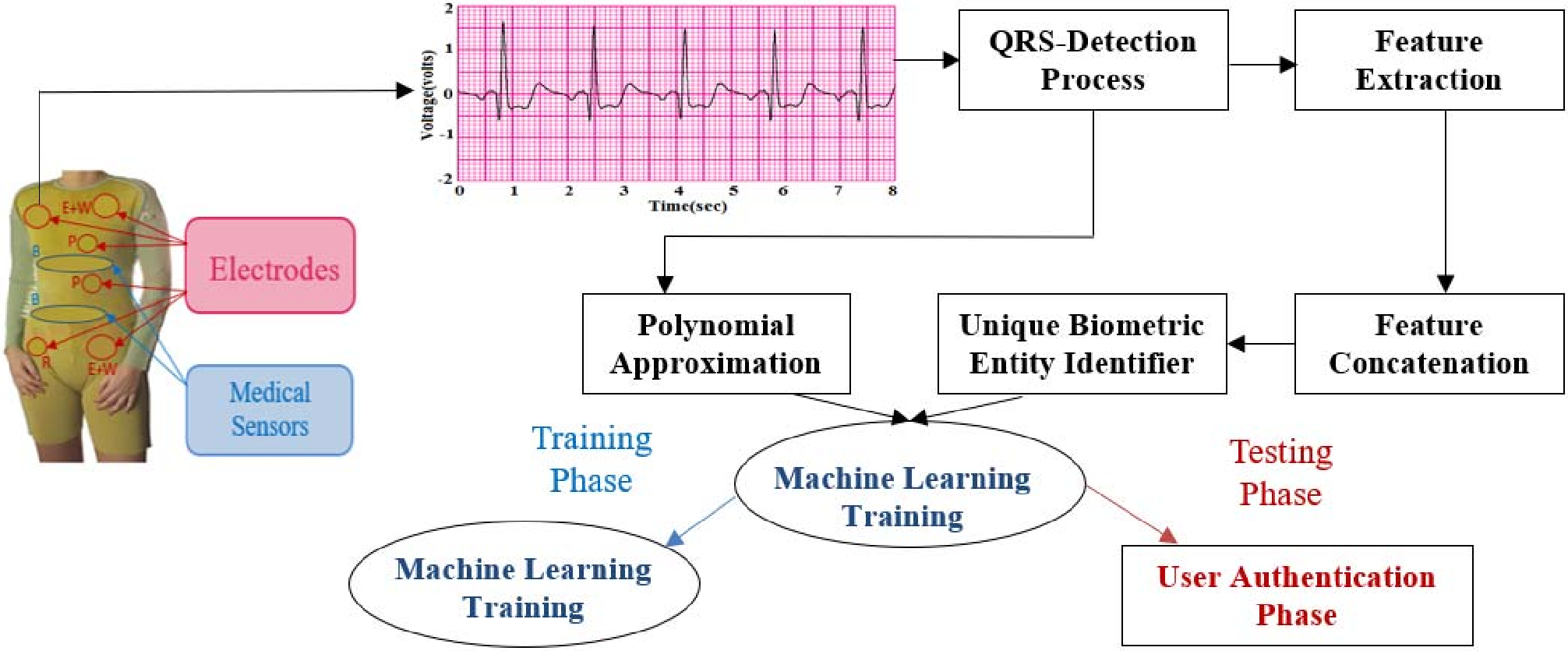 Figure: The end-to-end flow from ECG signal capture to ML-based authorization.
3. ML-based Authentication
The framework utilizes a Multilayer Perceptron (MLP).
- Input: Unique biometric EIs (derived from RR-intervals) + Polynomial coefficients.
- Mechanism: During the training phase, the model learns the specific temporal evolution of the patient's ECG. In the testing phase, it acts as a gatekeeper, verifying if the current signal matches the authorized user.
Experiments & Results: A Comparative Advantage
The paper compares the proposed ML framework against several existing schemes (PSKA, FABSC, FBKM).
| Scheme | Core Metric | Limitation | Proposed Advantage |
|---|---|---|---|
| PSKA | Keys via PPG/ECG | Small keys vulnerable to Brute Force | Higher entropy through ML EIs |
| FABSC | Signcryption | High computational power needed | Lightweight polynomial features |
| FBKM | Fuzzy Bio-Keys | No error-correction mechanism | Robustness through MLP training |
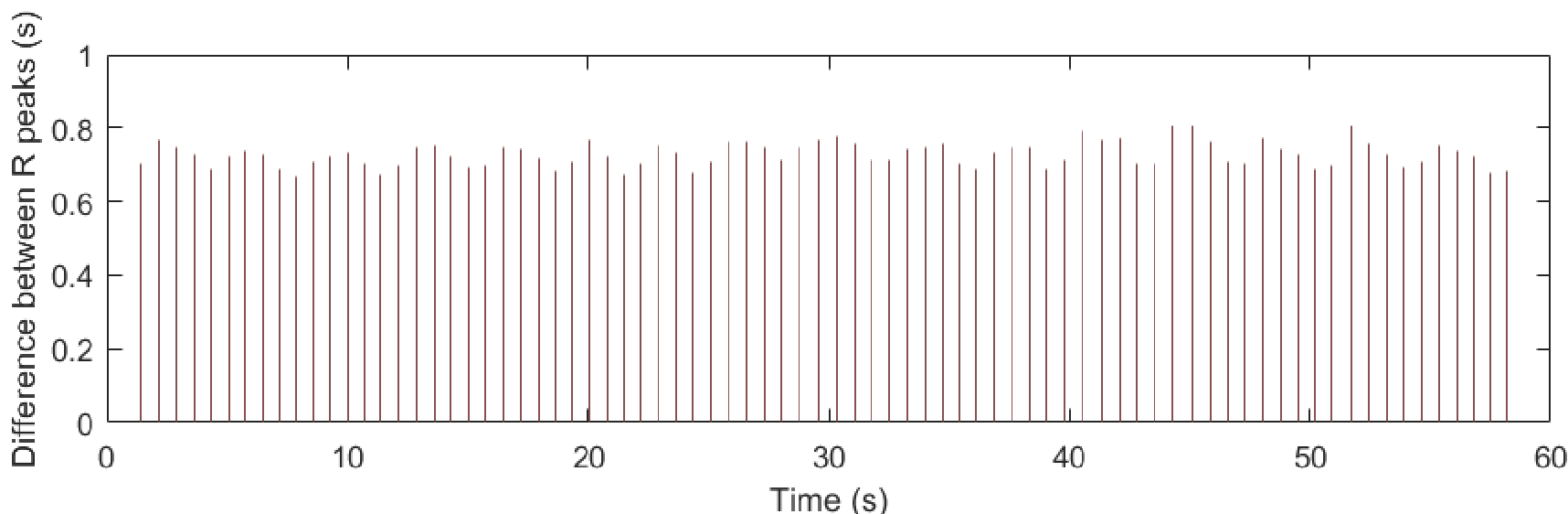 Graph: Visualizing the RR-intervals which form the backbone of the entropy used for key generation.
By using Direct Sequence Spread Spectrum (DSSS) for communication, the framework also ensures that the signal remains resistant to interference and eavesdropping, making it suitable for noisy, real-world hospital environments.
Critical Analysis & Conclusion
Takeaway
The shift from "possession-based" security (keys) to "inherent" security (biometrics) is a game-changer for IoMT. This paper effectively proves that Machine Learning doesn't have to be a resource hog—when applied correctly to feature extraction (like polynomial coefficients), it actually saves energy.
Limitations
- Temporal Stability: While heartbeats are unique, ECG signals can change due to stress, medication, or aging. The paper mentions the training phase, but the frequency of "re-training" to handle drift is not fully explored.
- Hardware Implementation: The "limited power" claim needs further empirical validation on specific MCUs (like ARM Cortex-M0) to quantify exactly how many milliamp-hours are saved.
Future Outlook
As we move toward 6G and Edge-AI, frameworks like this will likely evolve into "Zero-Trust" architectures for wearables, where your identity is continuously verified by your biological signature, rather than a one-time login.