
Beyond the Human Eye: Boosting CTG Interpretation with Machine Learning Ensembles
Machine learning ensemble modelling to classify caesarean section and vaginal delivery types using Cardiotocography traces
This paper presents a machine learning ensemble framework to classify Cardiotocography (CTG) traces into vaginal or caesarean section delivery types. By combining Fisher’s Linear Discriminant Analysis (FLDA), Random Forest (RF), and Support Vector Machine (SVM), the authors achieved a SOTA Sensitivity of 87%, Specificity of 90%, and an AUC of 96% on the CTU-UHB open database.
TL;DR
Perinatal monitoring relies heavily on Cardiotocography (CTG), yet human error in interpreting these traces remains a billion-pound problem. This research introduces a robust machine learning pipeline using SMOTE for data balancing and a Heterogeneous Ensemble (FLDA + RF + SVM) to classify delivery types. The results are a major leap forward: reaching 96% AUC and solving the "Sensitivity Gap" that plagues most medical AI models.
The Subjectivity Crisis in Obstetrics
For over 45 years, CTG has been the gold standard for monitoring fetal heart rates (FHR) and uterine contractions (UC). Despite its ubiquity, studies suggest that 50% of birth-related brain injuries could have been prevented with correct interpretation.
The core issue? Visual variability. Two doctors may look at the same trace and disagree on the risk level. Traditional machine learning models also struggle because "normal" births heavily outnumber "caesarean" or "acidosis" cases. When a model sees 90% normal data, it learns to predict "normal" every time—achieving high accuracy but failing to save the 10% of babies at risk.
Methodology: Mining the "Invisible" Signals
The researchers moved beyond basic FIGO guidelines (baseline heart rate, accelerations, etc.) and extracted 13 advanced features, categorizing them into:
- Linear/Morphological: The classic visual cues used by midwives.
- Non-Linear/Complexity: Features like Sample Entropy (SampEn) and Detrended Fluctuation Analysis (DFA) that quantify the "chaos" and health of the central nervous system.
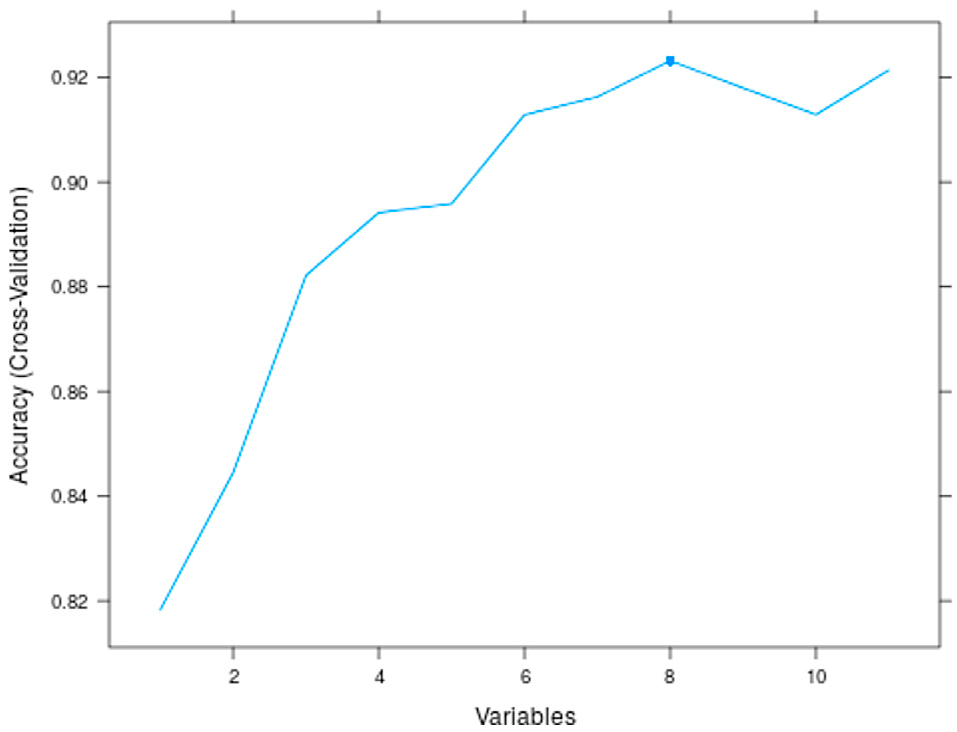 Figure 1: Recursive Feature Elimination (RFE) identified 8 critical variables, dominated by non-linear features.
The Secret Sauce: SMOTE & Ensembling
To fix the imbalance (only 46 caesarean vs 506 normal records), the authors used SMOTE to synthetically generate high-risk examples for the training phase. However, the true breakthrough came from combining three vastly different mathematical approaches:
- FLDA: Checks for linear separability.
- Random Forest (RF): Uses bootstrap aggregation to handle outliers near decision boundaries.
- SVM: Maximizes margins in high-dimensional space.
By selecting models with low correlation (<0.75), the ensemble ensures that when one model misses a subtle cue, the others act as a safety net.
Results: A New Benchmark for Clinical Decision Support
The shift from a single SVM to a triple-model ensemble was transformative.
| Metric | Single SVM (Baseline) | Ensemble (Final) |
|---|---|---|
| Sensitivity (High Risk) | ~0% (Failed) | 87% |
| Specificity (Normal) | 99% | 90% |
| AUC (Total Performance) | 60% | 96% |
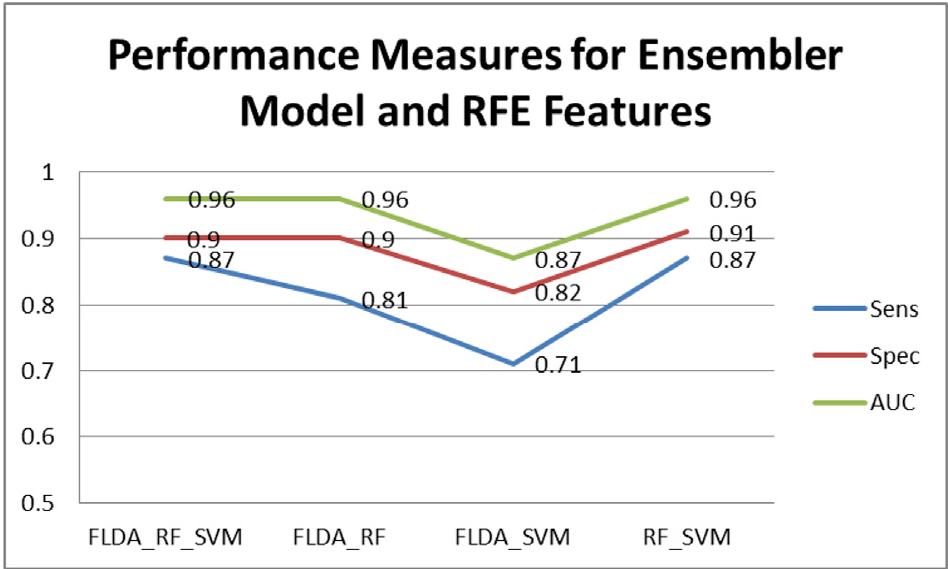 Figure 2: The Ensemble model achieved 96% AUC, demonstrating near-perfect discrimination capabilities.
The MSE (Mean Square Error) remained low at 9%, proving that the model didn't just "guess" high-risk cases but actually learned the underlying physiological patterns of fetal distress.
Critical Analysis & Future Outlook
This work proves that non-linear features are not just academic curiosities—they are the most discriminative variables for fetal health. The exclusion of standard FIGO features (like accelerations) from the top-ranked variables suggests that current clinical guidelines might be focusing on the wrong metrics.
Limitations: The study uses the CTU-UHB database (552 records). To be truly "clinical grade," this needs validation on thousands of diverse patients. Furthermore, the reliance on SMOTE is a "synthetic" fix; future SOTA work should aim for larger, real-world imbalanced datasets using cost-sensitive learning.
The Next Frontier: The authors suggest moving toward Deep Learning (Stacked Autoencoders). By removing the "Feature Engineering" stage, AI might discover even more subtle biomarkers for hypoxia that we haven't even named yet.