
Decoding Balance: Machine Learning as a Diagnostic Lens for Elderly Fall Risk
Abstract-Falling is a serious problem in an aged society such that assessment of the risk of falls for individuals is imperative for the research and practice of falls prevention. This paper introduces an application of several machine learning methods for training a classifier which is capable of classifying individual older adults into a high risk group and a low risk group (distinguished by whether or not the members of the group have a recent history of falls). Using a 3D motion capture system, significant gait features related to falls risk are extracted. By training these features, classification hypotheses are obtained based on machine learning techniques (K Nearestneighbour, Naive Bayes, Logistic Regression, Neural Network, and Support Vector Machine). Training and test accuracies with sensitivity and specificity of each of these techniques are assessed. The feature adjustment and tuning of the machine learning algorithms are discussed. The outcome of the study will benefit the prediction and prevention of falls
This paper presents a binary classification framework to distinguish older adults with a fall history (fallers) from those without (non-fallers) using 32 gait features. The study evaluates five machine learning models—KNN, Naive Bayes, Logistic Regression, Neural Network, and SVM—reaching a test accuracy of up to 85.8% after PCA refinement.
Executive Summary
TL;DR: This study demonstrates that machine learning models can distinguish elderly "fallers" from "non-fallers" with high accuracy by analyzing 32 specific gait features. By leveraging PCA and standardization, the researchers achieved an 85.8% accuracy rate, moving beyond simple observation to quantitative risk assessment.
Positioning: This work serves as an important bridge between traditional biomechanics and modern data science, proving that the subtle "noise" in human movement contains enough signal to predict individual fall history.
Problem & Motivation: The Invisible Markers of Stability
Falling is not just an accident; it is a manifestation of underlying physiological shifts. While clinicians use manual tests, these are often qualitative. The challenge lies in the high-dimensional nature of gait: when you walk, your hip angles, knee torques, and toe clearances all interact in a complex manifold. Prior to this study, the systematic application of multiple ML classifiers to distinguish fallers based on 3D captured gait data was largely unexplored. The authors hypothesized that ML could navigate this complexity better than traditional statistical averages.
Methodology: From Motion Capture to Probability
The researchers utilized a Vicon 3D motion capture system (10 cameras) and a Bertec dual-belt instrumented treadmill to extract 32 gait features. These included:
- Spatial-Temporal: Walking speed, step width, stride length.
- Kinematic: Peak joint angles of the hip, knee, and ankle.
- Kinetic: Ranges of joint torques and push-up forces.
Classifier Architecture and Refinement
The study compared five core algorithms: KNN, Naive Bayes (NB), Logistic Regression (LR), Neural Networks (NN), and SVM.
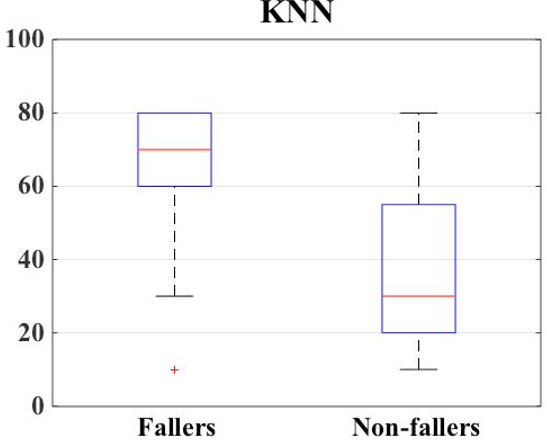 Figure 1: The probability output of the KNN classifier, showing a clear distinction between the two groups despite the overlapping nature of human movement.
To handle the "curse of dimensionality" (32 features for 35 participants), the authors introduced:
- Z-Score Standardization: Balancing variables with different units (e.g., meters vs. Newton-meters).
- PCA (Principal Component Analysis): Reducing 32 features to 2 principal components, which significantly boosted performance by removing redundant noise.
Experiments & Results: The Power of PCA
Initial results showed significant overfitting—for instance, Logistic Regression hit 100% training accuracy but failed to generalize well on test data. However, after applying PCA, the performance across all models stabilized and improved.
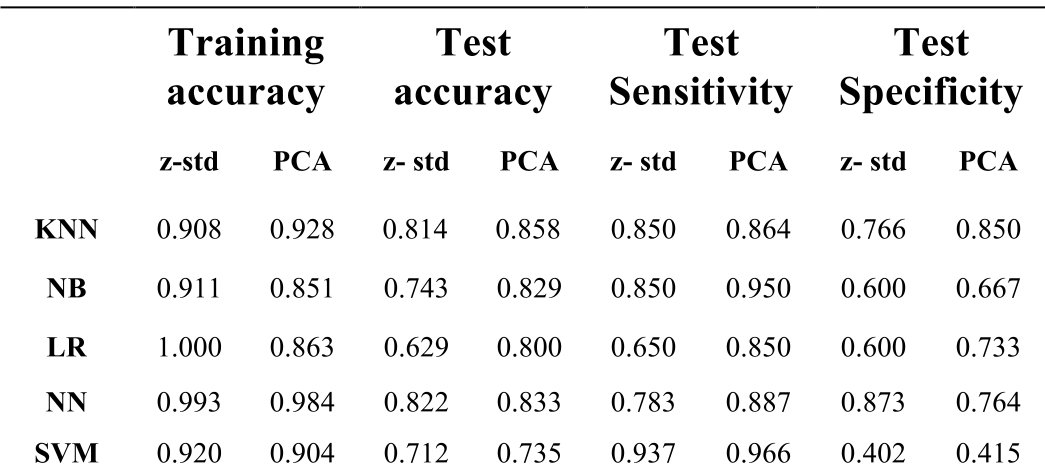 Table 2: Comparison of standardized vs. PCA-enhanced results. Note the jump in KNN test accuracy to 85.8%.
Key Findings:
- KNN & NN emerged as the most robust classifiers (85.8% and 83.3% accuracy).
- Sensitivity vs. Specificity: SVM showed very high sensitivity (96.6% in PCA mode), meaning it is excellent at identifying fallers, but it struggled with specificity (41.5%), often misclassifying non-fallers as being at risk.
- Regularization: By adding a penalty term to Logistic Regression (L1 regularization), the model became "sparser," effectively identifying which gait features were useless and driving their weights to zero.
Critical Analysis & Conclusion
Takeaway
The study successfully validates that gait-related features are not just descriptive but predictive. The transition from raw kinematic data to a "probability of being a faller" marks a shift toward personalized preventative healthcare.
Limitations & Future Work
- Sample Size: 35 participants is a small cohort for ML. Future studies need "big data" to refine these models further.
- Retrospective vs. Prospective: The study identified people who had already fallen. The ultimate goal—which the authors admit is the next step—is to track participants over time to see if these models can predict future first-time falls.
- Feature Expansion: Incorporating the Center of Mass (CoM) derivatives could provide even deeper insights into dynamic stability.
This research lays the groundwork for a future where a quick 5-minute treadmill walk could provide an elderly patient with a "Stability Score," allowing for early intervention before an injury occurs.