
Deciphering IBD: Machine Learning the Gut’s Functional Protein Landscape
Using machine learning to identify major shifts in human gut microbiome protein family abundance in disease
This paper introduces a machine learning-based framework to identify significant shifts in human gut microbiome protein family abundances (KEGG orthologs) associated with Inflammatory Bowel Disease (IBD). By integrating Kolmogorov-Smirnov statistical tests, Random Forest classifiers, and NLP-based text analysis of protein descriptions, the study successfully identifies a subset of ~500 protein families that sharply differentiate healthy states from various IBD subtypes.
TL;DR
Inflammatory Bowel Disease (IBD) is more than just a change in "who" lives in your gut; it is a fundamental shift in "what" your gut microbiome is doing. This research utilizes a hybrid pipeline of Random Forests and Natural Language Processing (NLP) to identify key protein families (KEGG orthologs) that act as functional signatures for IBD, achieving 99% classification accuracy and proving that functional data separates disease states more clearly than species taxonomy.
Background: The Functional Mirror of Disease
For years, microbiome research focused on taxonomy—counting the different species of bacteria. However, because different bacteria can perform identical metabolic roles (functional redundancy), species counts are often noisy. This study shifts the lens to KEGG (Kyoto Encyclopedia of Genes and Genomes) protein families. The core insight? While our microbial residents vary, their collective "protein toolkit" is usually stable in health but becomes radically distorted in IBD.
Problem: The Dimensionality Curse
Metagenomic sequencing generates billions of DNA reads. Mapping these to ~10,000 KEGG protein families creates a massive 620,744-entry matrix. For biologists, manually investigating which of these 10,000 proteins matter is like looking for a needle in a haystack. As we move toward datasets with 1 million proteins, we need a scalable way to automate the discovery of anomalies.
Methodology: A Two-Stage Intelligence Pipeline
1. The Abundance Classifier
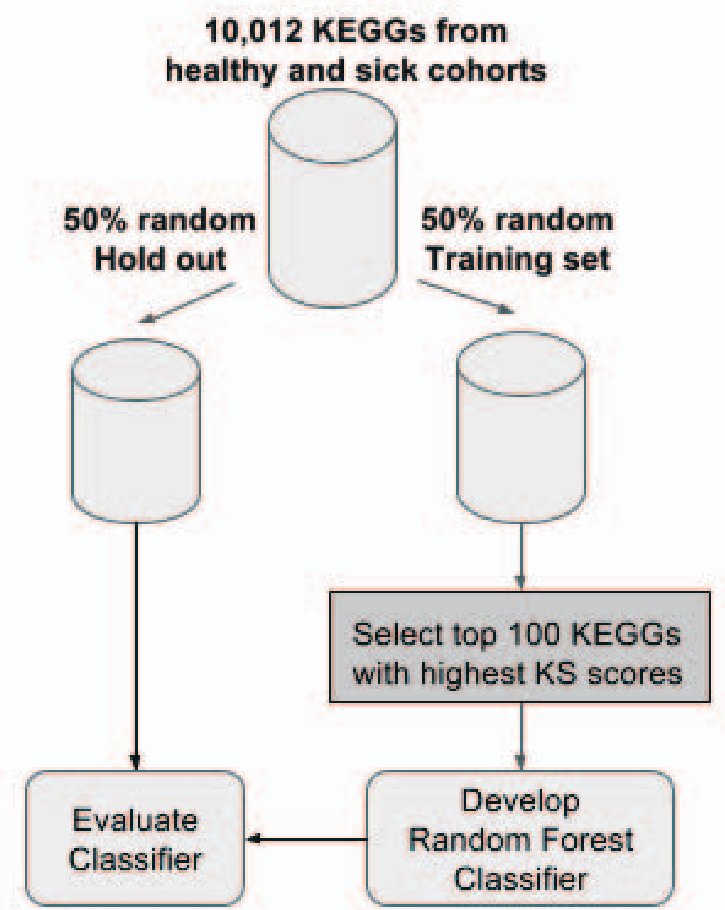
Instead of throwing all 10,000 features into a model, the authors used a "simulation of growth" approach. They split the KEGGs into training and hold-out sets.
- Feature Selection: They used the Kolmogorov-Smirnov (KS) test to pick the top 100 most statistically distinct KEGGs.
- Model: A Random Forest (RF) was trained on these 100 proteins to learn the characteristic patterns of "over-abundance" vs. "under-abundance" in IBD.
- Inference: This model was then applied to the remaining thousands of proteins to assign a "confidence score" for disease association.
2. The NLP Benchmarking
The researchers asked a fascinating question: Can we predict if a protein is associated with IBD just by reading its manual? They took the text descriptions of KEGG entries and applied TF-IDF (Term Frequency-Inverse Document Frequency) to turn biological descriptions into vectors, then trained classifiers (SVM, Naive Bayes) to link text to the abundance labels found in Step 1.
Experiments & Results: Clearer Signals than Taxonomy
One of the paper's most striking findings is the Principal Component Analysis (PCA). While species-level PCA (Figure 4a) shows some clustering, the KEGG-level PCA (Figure 4b) shows a much tighter, more distinct separation between healthy individuals (HE), Ulcerative Colitis (UC), and Crohn’s Disease (CD).
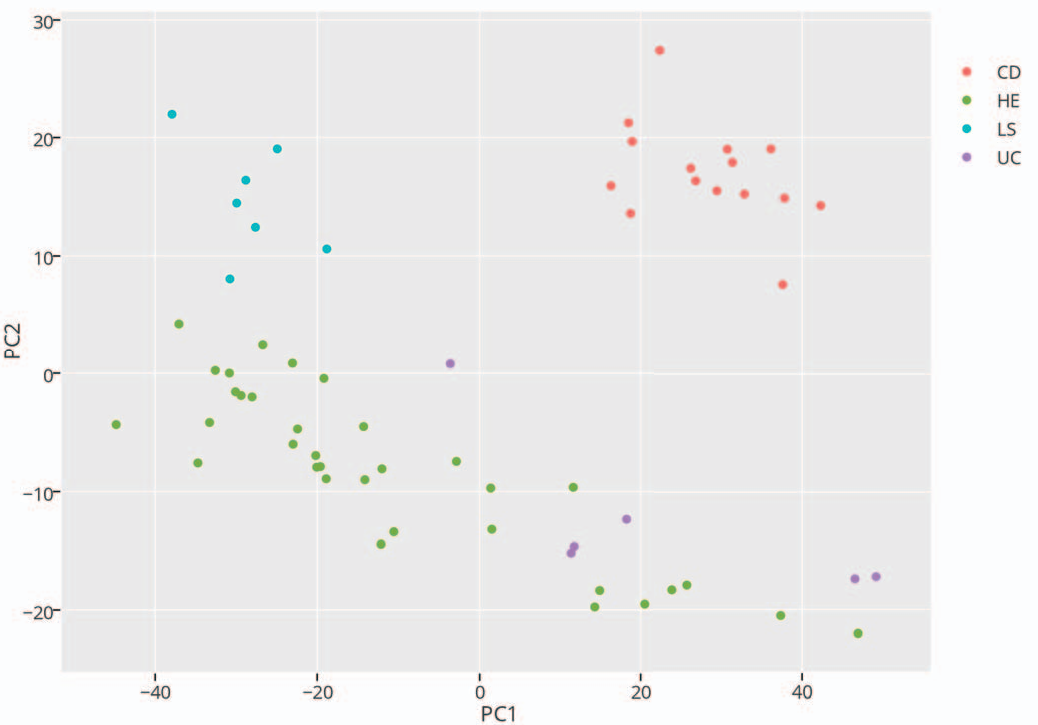 (a) Species PCA shows overlap; (b) KEGG PCA provides distinct disease clusters.
Key Biological Insights
The machine learning pipeline didn't just find random correlations; it identified biologically relevant pathways:
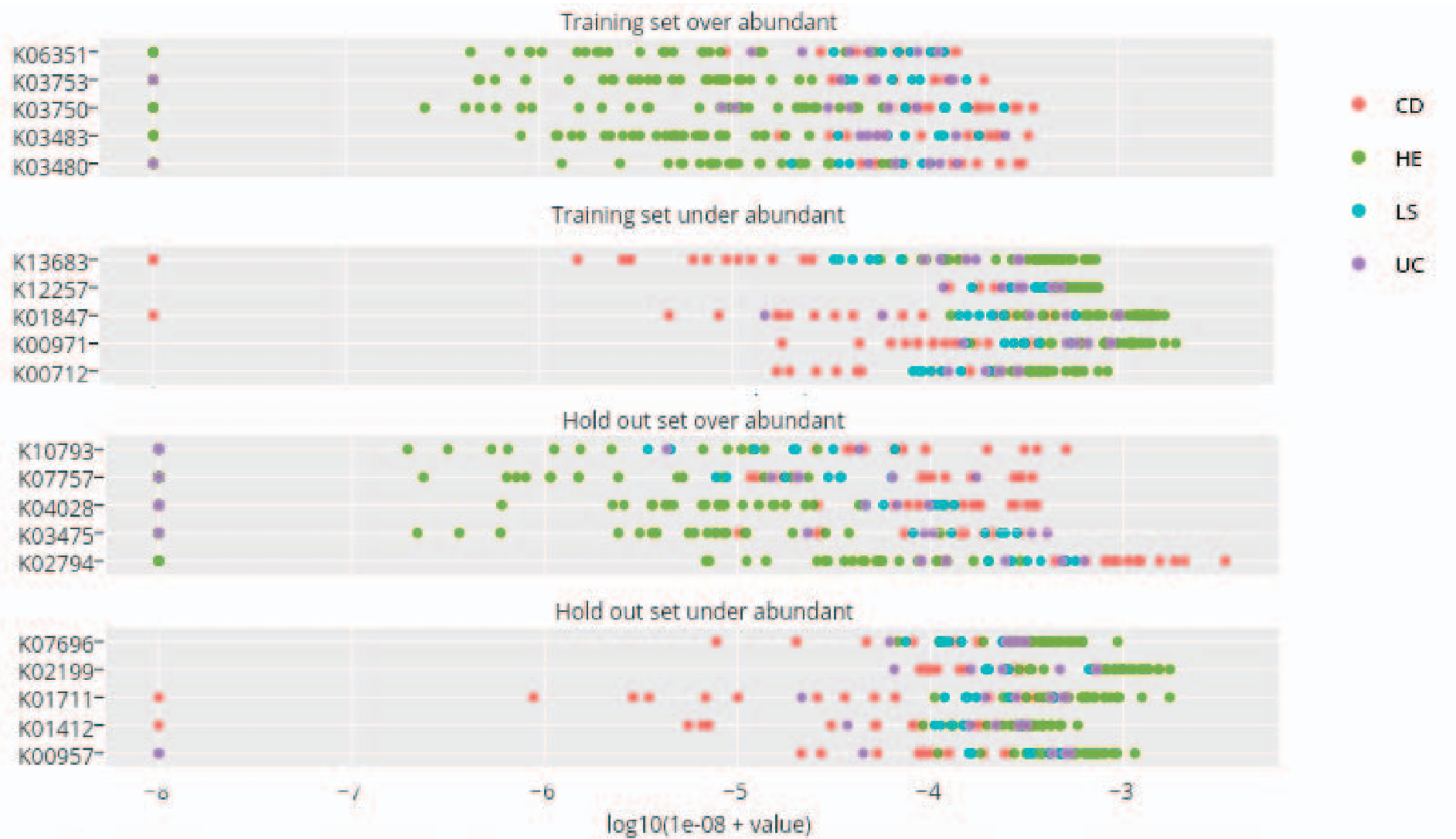
- Over-abundant in IBD: Phospho-transferase systems (PTS) and nitrate reductase (mobB). These are linked to sugar transport and nitric oxide production—a known hallmark of inflammation.
- Under-abundant in IBD: Amino acid biosynthesis and carbohydrate metabolism. In IBD, the microbiome shifts away from "building" nutrients for the host toward "harvesting" nutrients for its own survival.
Critical Insight & Future Outlook
This work demonstrates that functional profiles are superior to taxonomic profiles for disease classification. The NLP component, while baseline, opens the door for "Knowledge-Graph" style microbiome analysis, where AI understands the meaning of a gene's function to predict its role in pathology.
The limitation of this study lies in its sample size (62 subjects); however, the pipeline is specifically designed for the "1000x growth" in data expected in the coming years. As we move toward 1 million protein targets, these automated discovery pipelines will be the only way to convert raw sequences into actionable medicine.