
Forecasting the 10%: Decoding High Healthcare Utilizers with Machine Learning
Machine Learning Approaches for Predicting High Utilizers in Health Care
This paper presents a comprehensive machine learning framework to forecast medical expenditures for "high utilizers" (top 10% spenders) in the Texas Medicaid program. Using diverse models including LASSO, Gradient Boosting Machines (GBM), and Recurrent Neural Networks (RNN), the study achieves a high predictive accuracy (R-squared ~0.7) and introduces methods to quantify variable contributions for clinical interpretability.
TL;DR
Healthcare costs are notoriously concentrated: a tiny fraction of the population consumes the majority of resources. This study evaluates LR, LASSO, GBM, and RNNs on 1.7 million Medicaid records to predict these "high utilizers." While RNNs win on raw accuracy, the authors reveal a critical catch—deep learning's "reasons" for its predictions are far less stable than traditional models like LASSO, posing a challenge for clinically-actionable AI.
Motivation: The 64% Problem
In the United States, the top 10% of healthcare users account for roughly 64% of total expenditures. For Managed Care Organizations (MCOs), identifying these individuals before they incur massive costs is the "Holy Grail" of preventive medicine. Traditional linear risk-adjustment models often miss the temporal nuances—the sequence of a diagnosis followed by a specific procedure and medication—that signal a spike in future costs.
Methodology: From Linear to Recurrent
The researchers processed over 45,000 unique features (ICD-9, CPT, NDC codes) into 1,300 aggregated categories. They tested four distinct architectural philosophies:
- Linear Baseline (LR/LASSO): The industry standard for risk adjustment.
- Gradient Boosting (GBM): Non-linear ensemble trees that capture feature interactions (e.g., how Age + Diabetes might interact).
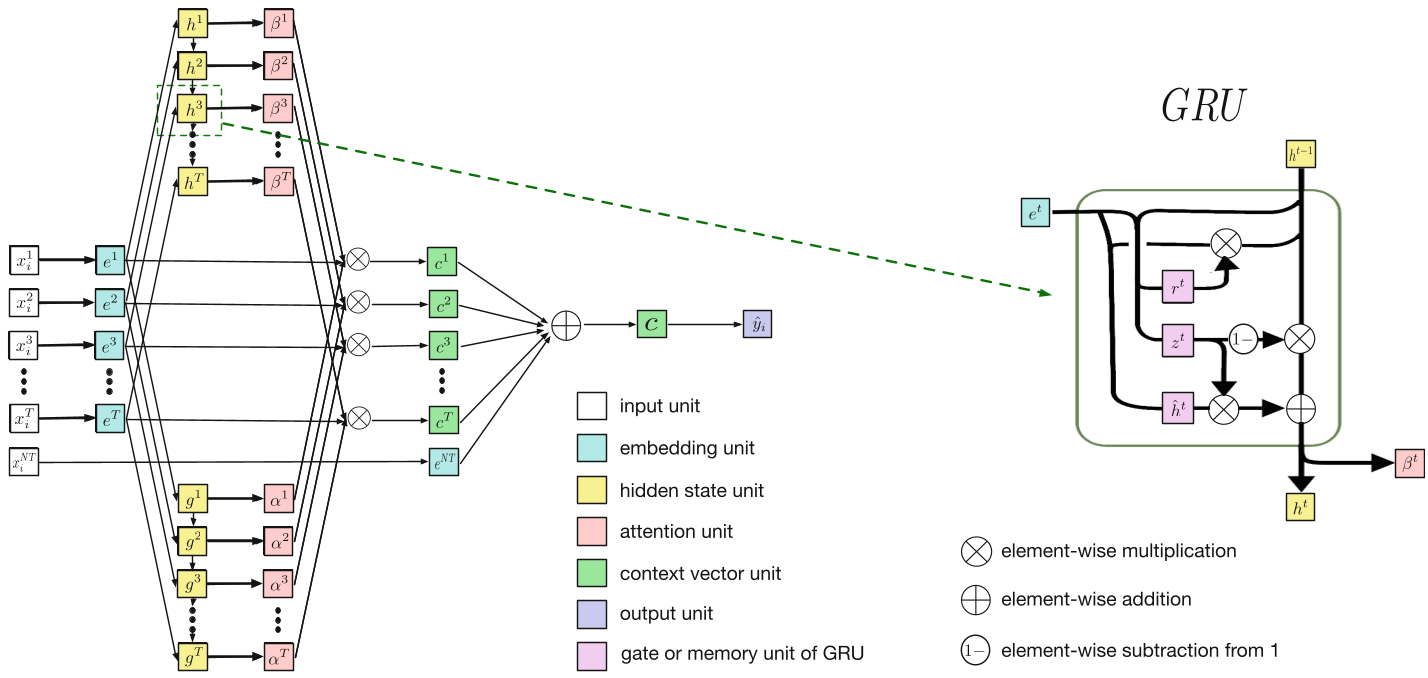
- Recurrent Neural Networks (RNN): Sequences of events modeled over time to capture the "trajectory" of a patient's health.
Architecture Overview
The RNN structure specifically uses an embedding layer and an attention-like mechanism to aggregate temporal data before feeding it into a regressor.
Key Insights from Experiments
1. The Value of History
Does more data always help? The authors found that including up to three prior quarters of data significantly boosts performance. However, by the fourth quarter, the gain saturates. This suggests that for Medicaid populations, a 9-month clinical window is the "sweet spot" for predicting immediate future costs.
2. The Interpretability Paradox
The paper's most striking finding isn't about accuracy, but about stability. By resampling the data 10 times, they tested whether the models "pointed" to the same risk factors consistently.
- LASSO: Extremely stable. The influential variables remained consistent across runs.
- GBM: Moderate stability.
- RNN: Highly unstable. Even if the final cost prediction was accurate, the "why" (the contribution of specific codes) fluctuated wildly between training sessions.
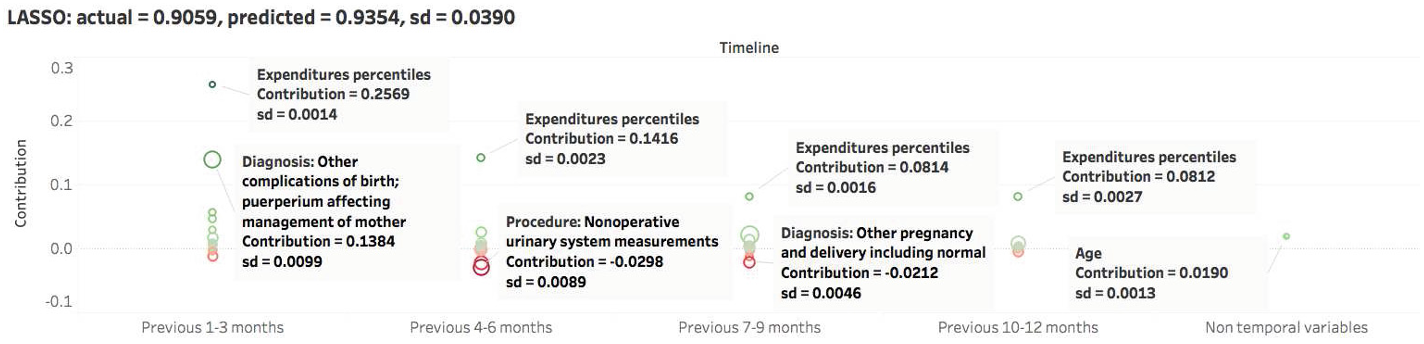 Above: LASSO provides consistent, clinical-ready variable contributions.
Detailed Performance
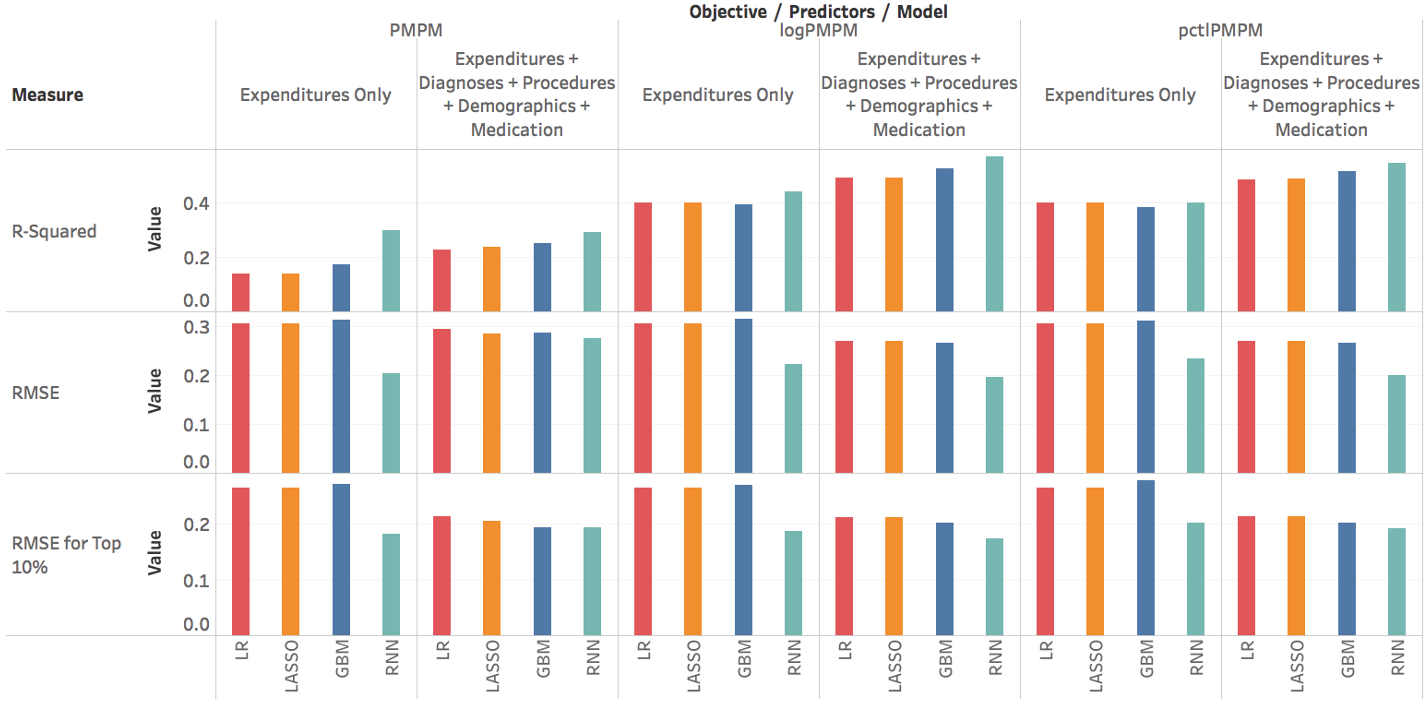
The models achieved an R-squared of ~0.7, which is remarkably high for behavioral/healthcare data. Interestingly, the prediction error for high-utilizers was actually lower than for the general population, suggesting that "high utilization" is a more predictable state than "random health maintenance."
Critical Analysis & Takeaways
The paper highlights a major hurdle for AI in the clinic: Reliability of Explanation.
- For Actuaries: RNNs are the tool of choice. They provide the most precise financial forecasts.
- For Clinicians: LASSO or GBM are superior. A doctor cannot intervene based on an RNN whose "attention" shifts randomly every time the model is re-trained.
Limitations: The study excludes pharmacy costs (often a huge driver for high-utilizers) and uses ICD-9 codes which are now legacy data. Future work must integrate Electronic Health Records (EHR) to provide the granular clinical detail required for truly "preventive" care.
Conclusion: Effective healthcare AI isn't just about the lowest RMSE; it's about the most stable "Why."