
Occupancy Detection: Can Machine Learning Outperform Expert Knowledge?
A Machine Learning Approach to Indoor Occupancy Detection Using Non-Intrusive Environmental Sensor Data
This paper presents a comparative study of eight machine learning (ML) algorithms for indoor occupancy detection using non-intrusive environmental sensors (temperature and humidity). By leveraging an IoT edge framework, the study identifies K-Nearest Neighbors (KNN) as a top performer, though it notes that classical expert-driven methods still maintain a slight edge in accuracy and auROC.
TL;DR
Indoor occupancy detection is vital for smart building energy efficiency. This research evaluates eight machine learning algorithms (from Random Forest to KNN) against a specialized manual analytical model. The findings? While ML allows for rapid deployment without needing a PhD in thermodynamics, the best ML model (KNN) still trails behind "expert-crafted" analytical solutions in accuracy and reliability (auROC).
The "Privacy vs. Utility" Dilemma
In the quest for smart buildings, the easiest way to see if a room is occupied is to use a camera. However, employees generally dislike being watched. This has pushed researchers toward non-intrusive sensors—specifically temperature and humidity.
The problem is that environmental data is "noisy" and slow-moving. A person entering a room doesn't instantly change the temperature by 5 degrees. Existing solutions that work well usually involve complex math (de-trending, smoothing, and fusion) designed by experts who understand the physics of heat. The authors ask: Can we skip the physics and just use raw ML?
Methodology: The IoT Edge Approach
The team deployed a Raspberry Pi with a "Sense Hat" in an office with three desks. They collected data for 37 days at one-second intervals. To establish a "Ground Truth," they used a camera (only for labeling purposes) to verify when people were actually present.
The Setup
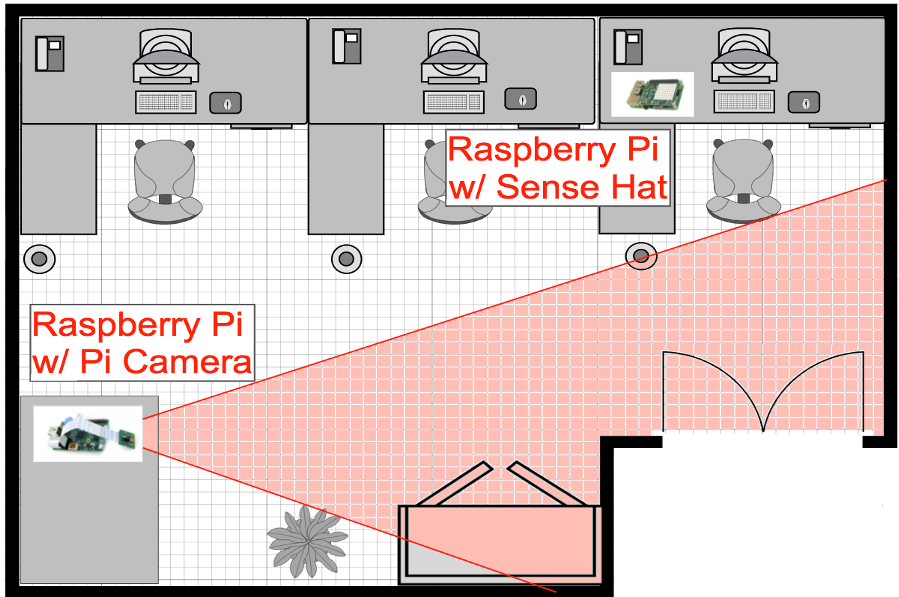
The researchers tested three variables:
- Resolution: Comparing 1-second, 1-minute, and 5-minute intervals.
- Features: Testing T, H, or a combination including barometric pressure.
- Algorithms: A mix of linear (LDA, LR) and non-linear (KNN, RF, Gradient Boosting) models.
Results: The Winner is KNN
Surprisingly, the simplest non-linear model, K-Nearest Neighbors (KNN), performed best when the data was downsampled to 5-minute intervals.
Key Performance Metrics
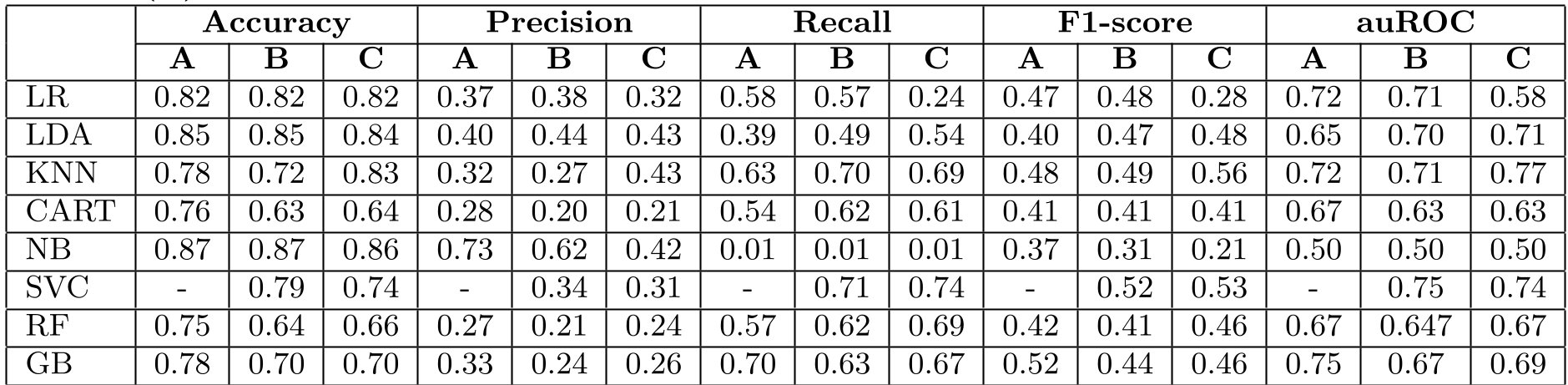
- Resolution Matters: High-resolution data (1-second) didn't necessarily help; it often led to overfitting or failure to converge (as seen with SVC).
- The "Expert Gap": The best ML model achieved an auROC of 0.77. However, the authors' previous work—which used manual signal processing—reached 0.82.
Comparison Table: ML vs. Classic Analysis
| Metric | KNN (Best ML) | Classic Analysis (Expert) |
|---|---|---|
| Accuracy | 0.83 | 0.87 |
| auROC | 0.77 | 0.82 |
| F1-Score | 0.56 | 0.66 |
Deep Insight: Why did ML "Lose"?
The study reveals a critical insight: Feature engineering based on physical properties is still superior to raw data classification.
When the authors tried to "help" the ML by providing the same de-trended data used in the expert model, the ML performance actually dropped. This suggests that standard ML algorithms like KNN or Random Forest might be losing the temporal nuances that an expert-designed fusion algorithm captures specifically for thermodynamics.
Conclusion & Future Outlook
This paper serves as a reality check for AI enthusiasts. While ML drastically reduces the "time-to-market" for smart building applications, it doesn't yet replace the precision of human-expert physical modeling for environmental data.
Limitations: The study was conducted in a relatively small office. Factors like air conditioning cycles or open windows could easily "trick" these models.
Future Work: The authors point toward Deep Learning and CO2 sensors as the next frontier to close the gap between automated ML and expert-level performance.