
MUSILYAS: Decoding the Soul of Greek Lyrics through Machine Learning
Machine Learning in Intangible Cultural Analytics: The Case of Greek Songs’ Lyrics
The paper introduces MUSILYAS, an innovative software tool designed for the automated musicological and lyrical analysis of intangible cultural heritage. Applying Natural Language Processing (NLP) and K-Means clustering to a corpus of Greek lyrics, the system successfully extracts semantic axes and thematic evolutions over time.
Executive Summary
TL;DR: This paper presents MUSILYAS (MUSIc Lyrics Analysis of Songs), a computational framework that leverages Natural Language Processing (NLP) and unsupervised learning to analyze the "Intangible Cultural Heritage" within song lyrics. By processing decades of work from the prolific Greek lyricist Costas Virvos, the researchers demonstrate how machines can identify deep-seated semantic clusters like "Homeland," "Poverty," and "Love" without human intervention.
Academic Context: Positioned at the intersection of Culturomics and Text Mining, this work acts as a bridge between sociology and informatics, providing a structured methodology for what the authors term "Lyrical Analytics."
The Challenge: Quantifying the Intangible
Cultural artifacts, specifically song lyrics, carry significant emotional and historical weight. Unlike material culture (architecture or tools), intangible heritage is fluid. The difficulty lies in:
- Scale: Manually analyzing thousands of songs over a 60-year span is nearly impossible for a single researcher.
- Subjectivity: Human analysts may bring biases to thematic categorization.
- Context: Understanding how creative output reflects the socio-political climate of its era requires a temporal-spatial mapping that traditional database searches cannot provide.
Methodology: The MUSILYAS Pipeline
The authors treat lyrics as structured text data, following a rigorous NLP workflow:
- Text Preprocessing: Normalization of the Greek language involving the extraction of word roots (stems) and the removal of semantically void "stop-words" (conjunctions, prepositions).
- Vector Space Modeling: Each song is represented as a point in a multi-dimensional space based on the frequency and weight of unique terms.
- Semantic Clustering: Utilizing the K-Means algorithm, the system groups songs into six fundamental "Semantic Axes."
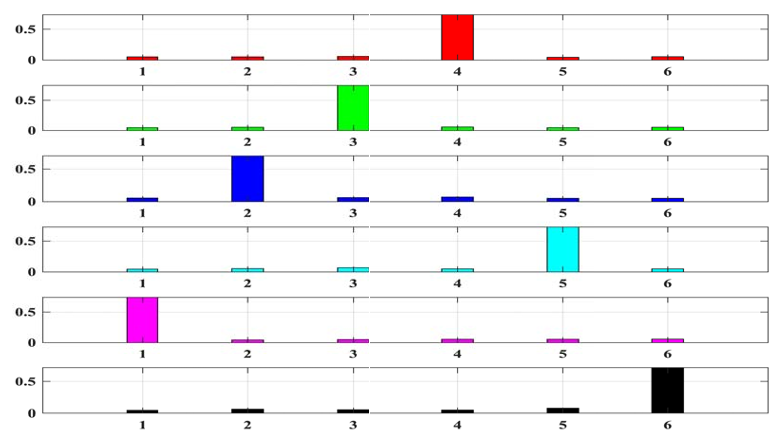 Figure 1: Representation of the centers of the recognized clusters, showing how different themes separate in the semantic space.
Experiments and Insights
The study focused on 447 songs by Costas Virvos, spanning 1950 to 2009. The algorithm successfully identified 1,250 unique terms that define his oeuvre.
Key Findings:
- Thematic Stability: The emergence of six clear axes: Love, Homeland, Foreign Land, Sea/Boat, Song, and Poverty.
- Temporal Evolution: By mapping the volume of songs per year (Fig 1 in paper) against these themes, the system allows researchers to see how major events in Greek history (migration, economic shifts) immediate influenced lyrical output.
- Hierarchical Organization: Using dendrograms, the researchers visualized the "semantic distance" between songs, revealing how certain sub-themes overlap.
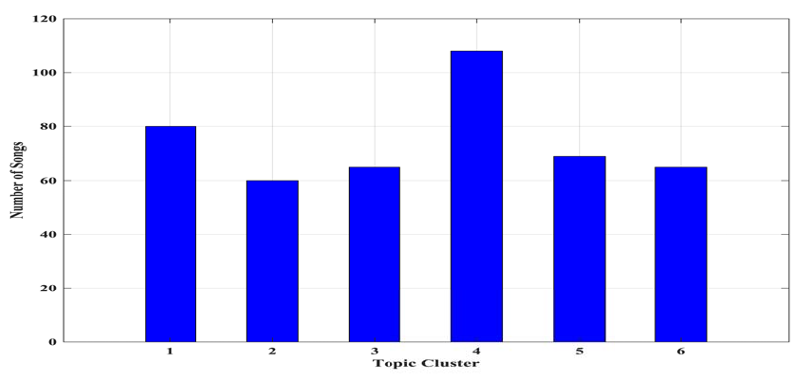 Figure 2: Hierarchical clustering (Dendrogram) demonstrating the semantic proximity of different lyrical works.
Critical Analysis & Conclusion
Takeaway
MUSILYAS moves the study of music from pure appreciation to Quantitative Cultural Analytics. It provides a "computational lens" for musicologists to handle vast datasets, turning art into a coordinate system of history and emotion.
Limitations
The current approach relies primarily on bag-of-words logic (stems). While effective for high-level clustering, it may miss the nuanced irony or metaphor prevalent in complex poetry. Furthermore, the analysis is purely textual, ignoring the melodic and rhythmic features that also carry cultural meaning.
Future Outlook
The authors suggest a roadmap towards Multimodal Analysis, where the audio features (pitch, tempo, orchestration) are analyzed alongside the lyrics. This would allow for a holistic "Fingerprint" of an artist's signature style and its impact on the collective consciousness.