
DistMult: Rethinking Multi-Relational Embeddings and Logical Reasoning
Machine Learning and Knowledge Graphs: Existing Gaps and Future Research Challenges
This paper introduces the DistMult model, a simple yet highly effective bilinear formulation for learning knowledge base (KB) embeddings. It achieves a new SOTA on Freebase link prediction, reaching 73.2% top-10 accuracy, while providing a unified framework that subsumes prior models like TransE and NTN.
TL;DR
The paper introduces DistMult, a streamlined bilinear embedding model for Knowledge Bases (KBs). By utilizing a diagonal matrix for relations, it simplifies the interaction between entities to a multiplicative process. Not only does this reach new SOTA performance in link prediction, but it also demonstrates that relation composition in latent spaces is best captured through matrix multiplication, allowing for efficient logical rule mining.
Background Positioning
In the landscape of 2014-2015 representation learning, models like TransE (translation-based) and NTN (Neural Tensor Network) were the dominant paradigms. This work serves as both a unifying framework and a SOTA-breaker, proving that "less is more"—a simplified bilinear model can outperform much more complex architectures by better capturing relational semantics.
Problem & Motivation: The Interaction Dilemma
Existing KB embedding methods differed largely in how they combined subject () and object () vectors via a relation ().
- TransE uses additive interactions: .
- NTN uses a massive tensor and a non-linear layer, which is expressive but prone to overfitting.
The authors questioned whether these complex designs were necessary and, more importantly, whether these embeddings captured compositional logic (e.g., if is the father of and is the father of , then is the grandfather of ).
Methodology: The Power of Diagonal Bilinear Forms
The core of the paper is the DistMult scoring function. While a general bilinear form uses , DistMult restricts to be a diagonal matrix.
1. Unified Framework
The authors show that almost all prior models can be viewed as variations of: Where contains linear and/or bilinear operators.

2. Multiplicative Composition
The most profound insight is how to represent the path of relations. If relations and imply , the authors argue that the composition should follow:
- Additive (TransE):
- Multiplicative (DistMult):
Experiments & Results
Link Prediction SOTA
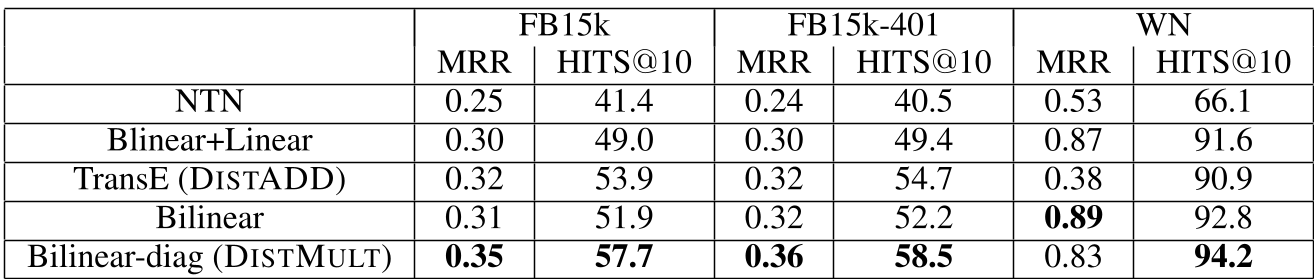
DistMult (Bilinear-diag) consistently outperformed TransE across multiple datasets. Using AdaGrad and proper entity vector normalization was found to be critical for these gains. On FB15k, DistMult reached 57.7% (MRR) compared to TransE’s 32%. With pre-trained entity vectors (EV-init), the HITS@10 skyrocketed to 73.2%.
Rule Extraction: Beyond Graph Search
The authors introduced EmbedRule, characterizing relation composition as matrix multiplication. Unlike traditional rule miners like AMIE (which count occurrences in the graph), EmbedRule scans the embedding space. This allows it to find rules that are statistically "thin" in the data but semantically "dense" in the latent space.
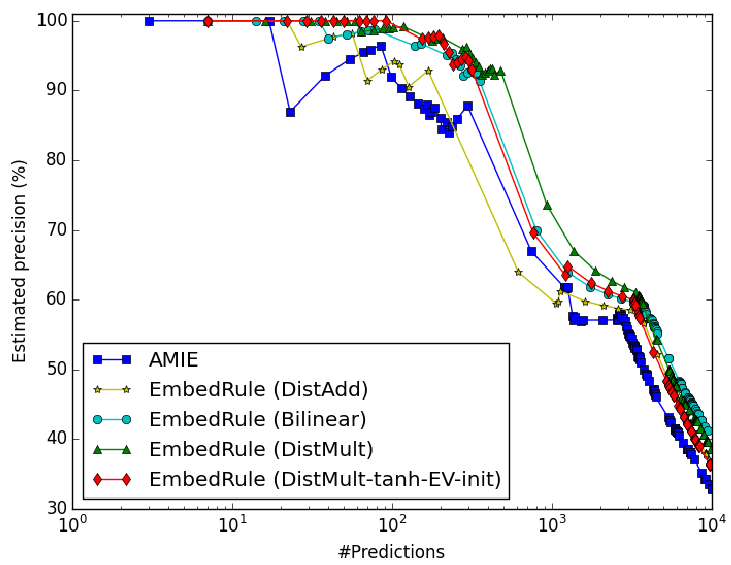
As seen in the figure, DistMult based extraction (red/green lines) consistently maintains higher precision than the discrete mining system AMIE (purple line) for length-2 rules.
Critical Analysis & Conclusion
Takeaway
The success of DistMult highlights that multiplicative interaction is a superior Inductive Bias for relational data compared to simple translation. It captures "interestingness" and compositional paths more effectively than additive models.
Limitations
The primary weakness of DistMult is its symmetry. Because is diagonal, is mathematically equivalent to . This means DistMult cannot naturally distinguish between (Paris, capital_of, France) and (France, capital_of, Paris).
Future Outlook
This work paved the way for models like ComplEx, which uses complex-valued embeddings to solve the symmetry issue while keeping the bilinear efficiency of DistMult. The idea of using matrix multiplication for path reasoning remains a cornerstone of modern Knowledge Graph reasoning.