
Deciphering the Human Eye: A Crowdsourcing Approach to Lighting Perception
15981_A machine learning approach for lighting perception analysis via crowdsourcing.
This paper presents a machine learning framework for analyzing human lighting perception by leveraging crowdsourcing and the Bradley-Terry model. The study introduces a method to quantify subjective impressions like "brightness" beyond simple physical luminance, identifying how demographic and environmental factors influence lighting preferences.
TL;DR
Can machine learning tell us if a room feels "bright" or "gloomy" better than a light meter? This paper from Panasonic researchers moves beyond simple physics (luminance) to model human lighting perception using large-scale crowdsourcing. By applying the Bradley-Terry model to thousands of pair-comparisons, they identified how age, ethnicity, and even your computer screen's height change how you perceive light.
Background: The Subjective Gap
For decades, lighting design relied on physical metrics like Feu (a formula for spatial brightness). However, these metrics are "one size fits all." They don't account for the fact that a 60-year-old might perceive a room differently than a 20-year-old, or that a user in a dark room perceives a screen image differently than one in a sunlit office.
The authors argue that true "lighting perception" is a combination of:
- Physical Stimuli: The actual light distribution.
- Analytical Factors: Personal attributes like age and ethnicity.
- Noise Factors: The environment and device used to view the lighting (crucial for remote studies).
Methodology: Crowdsourcing the "Perception Score"
The researchers bypassed the expensive, limited lab setup by using Crowdsourcing.
1. The Pair-Comparison Task
Participants were shown pairs of images representing different lighting environments and asked which felt "brighter" or "more comfortable."
2. The Bradley-Terry Model
To turn these subjective "this is better than that" votes into a quantifiable scale, they used the Bradley-Terry model. The probability that image is chosen over image is defined by: Where represents the "Perception Score."
3. Machine Learning & Factor Analysis
The team didn't just look at the average. They used clustering to find groups of people with similar perception patterns and then applied regression to see which "Analytical Factors" (like Age) and "Noise Factors" (like Browser type or Room Luminous) explained the variance.
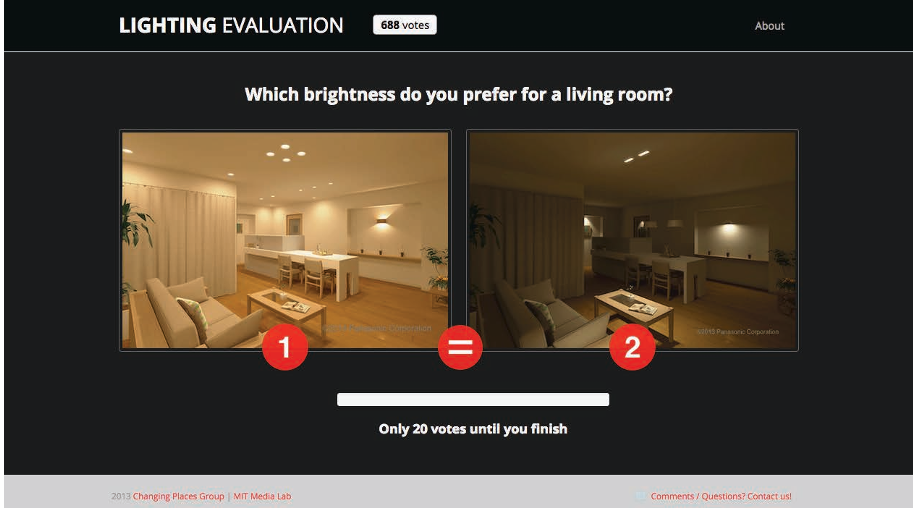 Figure: The framework for analyzing perception through crowdsourced data.
Key Insights: It's Not Just About the Bulbs
The study revealed fascinating correlations that traditional physics-based models miss:
- The Age Factor: Participants in the 26-30 age bracket showed significantly different perception estimates compared to older groups, suggesting that physiological aging of the eye directly impacts spatial brightness perception.
- The "Dark Room" Bias: Room luminosity (the environment where the participant was taking the test) was a significant "Noise Factor" (p < 0.05). If you are in a dark room, your perception of brightness in an image is amplified.
- Systematic Clustering: The researchers identified three distinct clusters of users. One cluster was highly sensitive to physical changes in light (Fp=15.1), while others were more influenced by individual demographic factors.
 Table: Analysis of Analytical and Noise factors across different user clusters.
Conclusion & Future Impact
The core contribution of this work is the validation of crowdsourcing as a legitimate tool for psycho-physical research. By accounting for "noise" (hardware and ambient light) using machine learning, we can collect data from thousands of diverse participants rather than just a dozen university students in a windowless lab.
Takeaway for the Industry: This paves the way for "Adaptive Lighting" in smart homes. Imagine a lighting system that doesn't just turn on, but adjusts its "spatial brightness" based on who is in the room—optimizing for an elderly resident's comfort versus a young adult's preference.
Limitations
While the study is robust, the authors acknowledge that display calibration remains a challenge. Different screens have different gamma curves, which acts as a persistent noise source in web-based perception studies. Future work involving mobile sensors to calibrate the viewing environment could refine these results even further.