
Beyond Cut-Points: Neural Networks for Precise Pediatric Activity Monitoring
A machine learning approach to measure and monitor physical activity in children
This paper presents a supervised machine learning framework utilizing Multi-Layer Perceptron (MLP) neural networks to classify physical activity (PA) types in children. By analyzing accelerometer data and direct observation (DO) codes, the method achieves a peak classification accuracy of 99.8% using ecologically valid features.
TL;DR
The global rise in childhood obesity necessitates precise, non-invasive monitoring of physical activity. This paper moves beyond inconsistent "cut-point" methods by using a Multi-Layer Perceptron (MLP) to classify children's activities. By combining accelerometer data from the hand and waist with an ecologically valid protocol, the researchers achieved a near-perfect 99.8% classification accuracy.
Executive Summary
Objective measurement of physical activity (PA) in children is notoriously difficult. Unlike adults, children move in short, intense bursts that traditional linear regression models (cut-points) often misclassify as sedentary. This study positions itself as a transition from "noisy" laboratory measurements to "free-living" intelligence, using machine learning to bridge the gap between high-precision equipment (like VO2 masks) and high-comfort wearables.
The Problem: The "Cut-Point" Controversy
For years, researchers have relied on "cut-points"—arbitrary boundaries of accelerometer counts—to categorize light, moderate, or vigorous activity. However, these boundaries vary wildly across studies.
- The Problem: Using different formulas for age and gender creates conflicting results.
- The Insight: Natural movement is non-linear. The authors argue that neural networks, which excel at non-linear parameter estimation, can model the complex patterns of "Free Play" and "Jogging" far more effectively than simple thresholds.
Methodology: The Architecture of Accuracy
The study utilized a specific MLP configuration optimized for small but complex datasets.
1. Feature Engineering & Dimensionality Reduction
Initially, the dataset was cluttered with redundant signals (left vs. right hand/waist). The authors merged these into Mean Hand Accelerometer Count (HAC) and Mean Waist Accelerometer Count (WAC). They also utilized Direct Observation (DO) codes as a powerful supervised signal.
2. The MLP Structure
To avoid overfitting while maintaining complexity, the authors used:
- Algorithm: Stabilized Newton Levenberg-Marquardt (ideal for small observation sets).
- Dimension: A single hidden layer with 4 units (3-4-4 architecture).
- Data Augmentation: Cubic spline interpolation was used to expand the initial dataset, providing more robust training cases for the network.
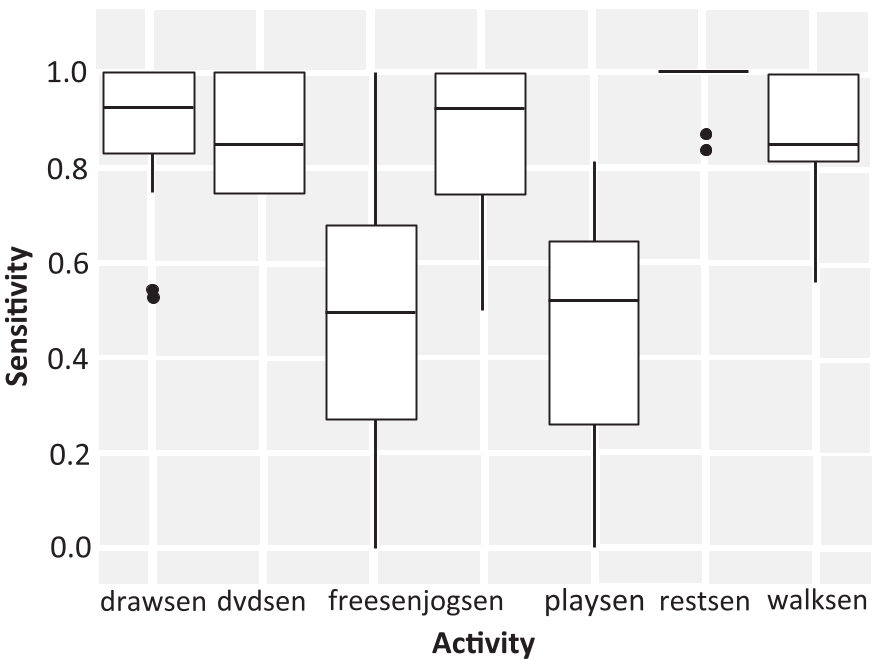 Fig 1: Sensitivity and specificity across different 4-activity combinations.
Experiments and Results
The researchers tested combinations of features to find the "Sweet Spot" of ecological validity (practicality in the real world).
- 2-Feature Pairs: Poor performance (approx. 74% max accuracy).
- Ecologically Valid 3-Feature Triplets (HAC, WAC, DO): This was the breakthrough. With interpolated data, accuracy shot up to 99.8%.
Comparison with Traditional ML
The MLP was pitted against other standards like Support Vector Machines (SVM) and Decision Trees (DT).
| Method | Accuracy | Kappa |
|---|---|---|
| MLP (Proposed) | 99.8% | 0.99 |
| k-Nearest Neighbor | 82.7% | 0.79 |
| Naïve Bayes | 79.5% | 0.76 |
| Support Vector Machine | 70.4% | 0.65 |
The MLP's ability to "fine-tune" decision regions through hidden layer weights allowed it to resolve overlaps between "Jogging" and "Free Play" that traditional distance-based algorithms (like k-NN) found confusing.
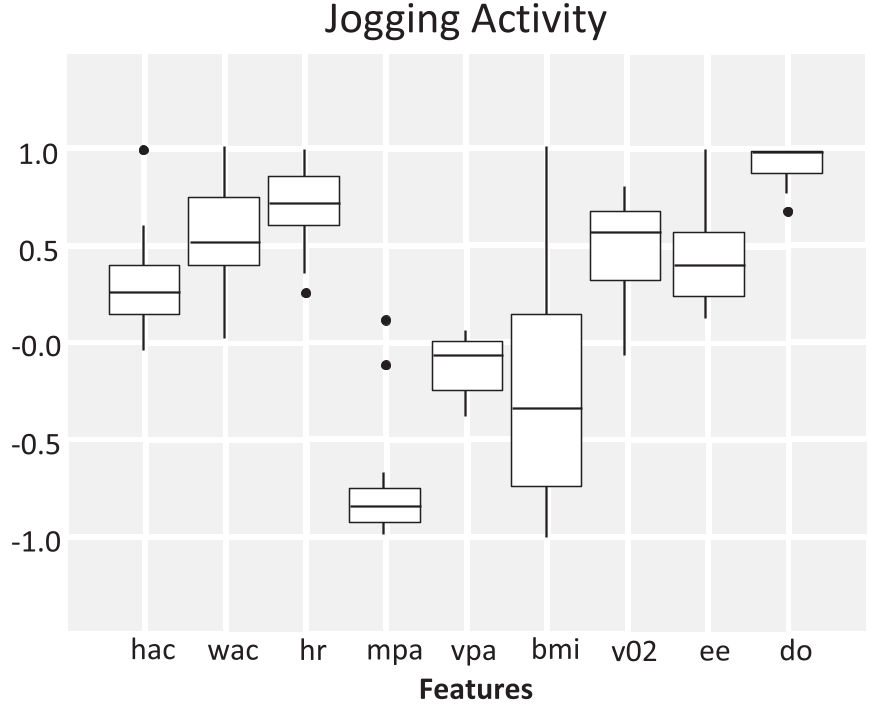 Fig 2: Statistical spread of features showing the separation between Drawing, Free Play, Jogging, and Walking.
Critical Analysis & Conclusion
The study’s success hinges on the Levenberg-Marquardt algorithm's efficiency in non-linear spaces. However, the authors honestly note a few limitations:
- Interpolation Dependency: Part of the high accuracy stems from generated (interpolated) data. Future work must validate this on a larger pool of raw, non-interpolated data.
- Observer Requirement: While HAC and WAC are automated, "Direct Observation" (DO) still requires a human or an expert system, which the pulse for future research (e.g., Deep Learning) seeks to automate.
Final Takeaway: By moving away from rigid thresholds and embracing the flexible landscape of neural networks, we can finally monitor pediatric health with laboratory-level precision in the comfort of a school playground.