
Intelligent Play: Leveraging ML to Combat Childhood Obesity Through Precise Activity Monitoring
A Machine Learning Approach to Measure and Monitor Physical Activity in Children to Help Fight Overweight and Obesity
This paper presents a supervised machine learning framework using Multilayer Perceptron (MLP) neural networks to classify physical activity (PA) types in children aged 10-11. Utilizing triaxial accelerometer data and direct observation features, the method achieves a high classification accuracy of 96% for distinguishing between sedentary, light, and vigorous activities.
TL;DR
With childhood obesity rates climbing globally, accurate monitoring of physical activity (PA) is no longer just a research goal—it's a public health necessity. This paper introduces a Multilayer Perceptron (MLP) approach that moves beyond flawed "cut-point" systems to achieve 96% accuracy in classifying children's movement. By optimized feature selection from wearable sensors, the researchers provide a reproducible blueprint for monitoring health-related behaviors in free-living environments.
The "Cut-Point" Crisis
For years, health researchers relied on "cut-points"—arbitrary thresholds in accelerometer counts used to categorize activity as light, moderate, or vigorous. However, these thresholds are notoriously inconsistent across different age groups and study protocols. For children, whose movements are naturally sporadic and intermittent, these static boundaries often fail, leading to significant misreporting of actual energy expenditure and sedentary time.
The authors argue that the solution lies not in better thresholds, but in Pattern Recognition. Artificial Neural Networks (ANNs) can "learn" the complex relationship between various physiological features and the actual intent of the movement.
Methodology: Beyond Simple Acceleration
The study utilized a dataset of 28 children engaging in seven distinct activities, ranging from DVD watching to jogging. The core innovation lies in their feature selection and activity pruning:
- Refining Classes: Initial trials showed that "Free Play" and "Playground" activities had significant overlap. By narrowing the focus to four distinct categories—Drawing, Free Play, Jogging, and Walking—the model achieved much higher class separability.
- Feature Combinations: Instead of relying solely on raw accelerometer counts (HAC/WAC), the researchers integrated Heart Rate (HR), BMI, and Direct Observation (DO) codes.
- Experimental Arch: They tested 2-feature, 3-feature, and 4-feature input layers to find the "Goldilocks zone" of complexity and accuracy.
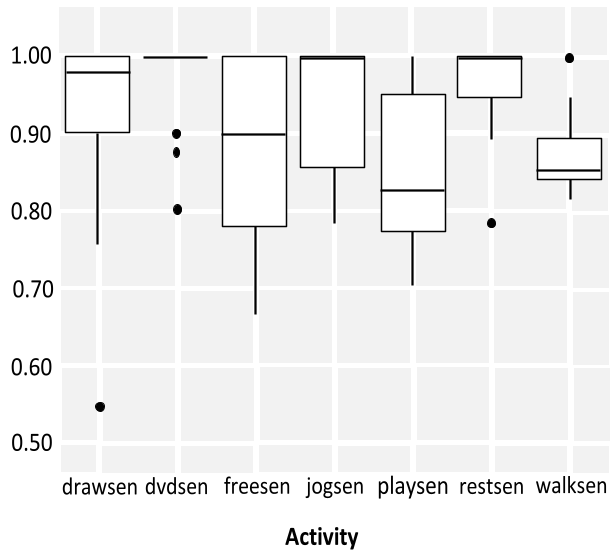 Figure 1: This plot illustrates the variance in classification performance across different activities. Note how sedentary activities like DVD watching show high specificity but varying sensitivity compared to more vigorous movements.
Results: The Power of Feature Fusion
The transition from 2-feature to 4-feature models showed a dramatic leap in performance. While simple pairs (like HR and HAC) only yielded ~74% accuracy, the 3-feature and 4-feature combinations consistently hit the 96% mark.
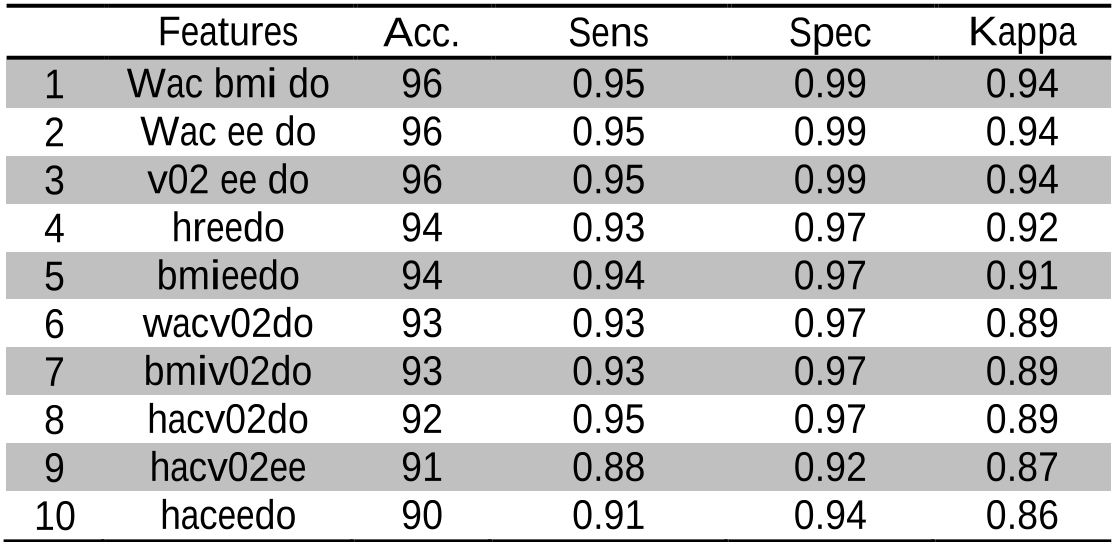 Table 1: Top-performing 3-feature combinations. The inclusion of Direct Observation (DO) and Waist Accelerometer Counts (WAC) was pivotal in achieving a 0.94 Kappa score.
The model was nearly perfect, with the only persistent error being a single record where "Jogging" was misclassified as "Free Play"—a testament to the high internal validity of the protocol.
Critical Insight: Why Does This Matter?
The real value of this research isn't just the 96% accuracy; it's the inductive bias of the model. By including BMI and VO2 estimates, the neural network adjusts its "expectations" of movement intensity based on the child's physical profile.
Limitations:
- Data Size: The removal of missing values reduced the participant pool, which might limit the generalizability to more diverse "free-living" scenarios.
- Interpolation: The use of cubic spline interpolation for missing data, while scientifically sound, introduces a layer of synthetic data that should be validated with larger real-world samples.
Conclusion
This paper bridges the gap between clinical data science and public health policy. By demonstrating that MLP networks can handle the "noise" of children's play, the authors pave the way for wearable devices that don't just count steps, but truly understand the quality of a child's active life. Future work exploring Support Vector Machines (SVM) or Deep Learning could further refine these results, making the fight against obesity more data-driven than ever.