
Fighting Childhood Obesity with MLP: A Data Science Approach to Activity Recognition
A Machine Learning Approach to Measure and Monitor Physical Activity in Children to Help Fight Overweight and Obesity
This paper presents a supervised machine learning framework using Multilayer Perceptron (MLP) neural networks to classify physical activity (PA) types in children aged 10-11. By utilizing triaxial accelerometer data and physiological features, the authors achieved a SOTA-level classification accuracy of 96% for identifying specific activity intensities.
TL;DR
Childhood obesity is a global crisis costing trillions annually. This paper introduces a robust Machine Learning pipeline that uses wearable accelerometer data and physiological features to monitor children's physical activity with 96% accuracy. By moving away from rigid "cut-points" toward a flexible Neural Network (MLP) architecture, the researchers provide a more reliable tool for public health monitoring.
The "Cut-Point" Crisis in Pediatric Research
For years, health researchers have relied on "cut-points"—arbitrary thresholds of accelerometer counts—to decide if a child is "active" or "sedentary." However, these thresholds are notoriously unreliable because children don't move like adults; their activity is sporadic, intense, and short-lived.
The authors argue that prior work failed (often yielding accuracies as low as 57%) because they didn't account for the feature overlap. For instance, "Free Play" in a playground often looks identical to "Jogging" or "Walking" when viewed through a single sensor.
Methodology: Beyond Simple Motion Sensing
The study utilized a dataset of 28 children performing seven types of activities. The core innovation lies in the iterative feature selection and activity refinement.
- Refining Activities: The authors discovered that sedentary activities (Drawing vs. Resting vs. Watching a DVD) were too similar for the model to distinguish. They streamlined the target classes to four: Drawing, Free Play, Jogging, and Walking.
- Multidimensional Features: Instead of just using motion, they integrated:
- HAC/WAC: Hand/Waist Accelerometer Counts.
- Physiological Data: Heart Rate (HR), VO2 (Oxygen consumption), and Energy Expenditure (EE).
- Contextual Data: BMI and Direct Observation (DO) codes.
Architectural Insight
The researchers tested various MLP (Multilayer Perceptron) configurations, specifically focusing on how the number of input features influenced the Kappa value (a measure of classification reliability).
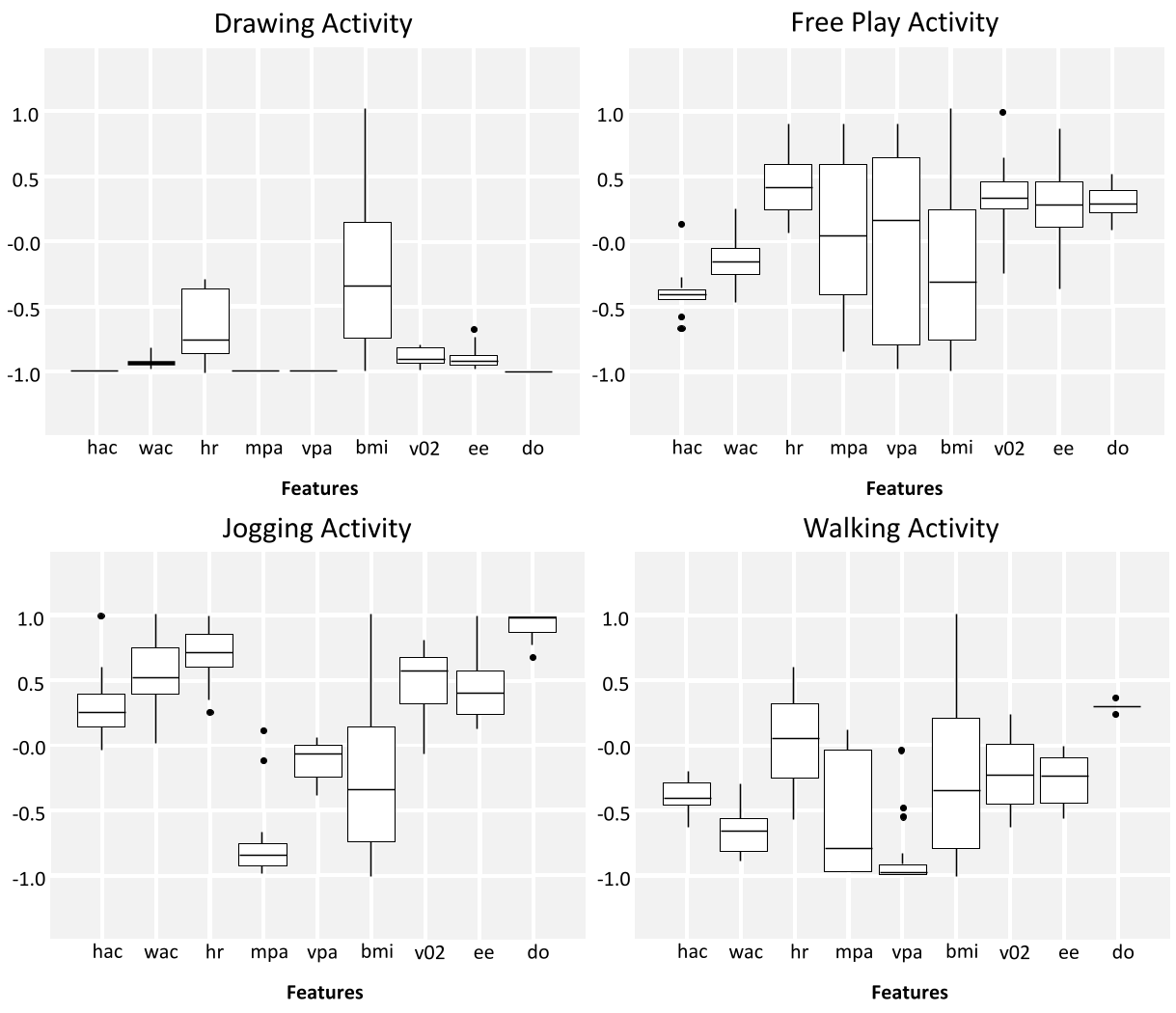 Figure 1: Boxplots illustrating the distribution and overlap of features like HR, BMI, and Accelerometer counts across different activity types.
Results: The Power of Feature Fusion
The transition from 2-feature pairs to 4-feature combinations was the turning point for the model's performance.
- 2-Feature Pairs: Performance was mediocre, rarely exceeding 70% accuracy.
- 3-Feature Combinations: Accuracy jumped to 96%. Combinations like
Wac + BMI + DOproved exceptionally strong. - 4-Feature Combinations: Stabilized the results, with almost all tested combinations exceeding 87% accuracy and the best hitting a consistent 96%.
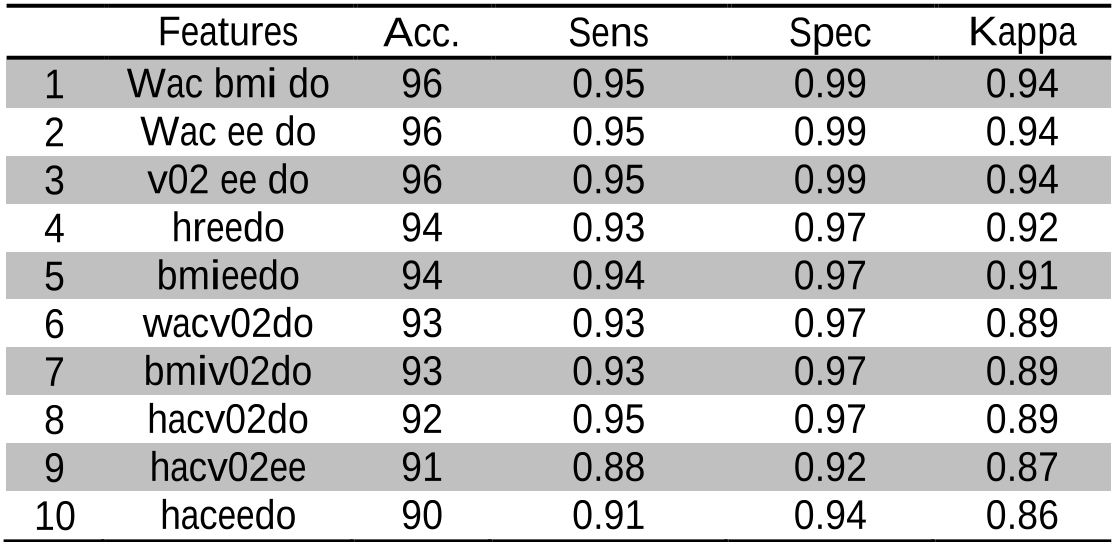 Figure 2: Top-performing 3-feature combinations showing the 96% accuracy threshold.
The "ceiling" of 96% was primarily due to a specific "Jogging" record being consistently misclassified as "Free Play," highlighting the inherent difficulty in separating structured exercise from high-intensity play in youth.
Critical Insight: Why This Matters
The true value of this work isn't just the 96% accuracy—it's the methodological rigor. By using cubic spline interpolation to handle missing sensor data and performing exhaustive permutation testing for feature selection, the authors provide a "reproducible data science methodology."
Limitations & Future Work
- Dataset Size: The study ended with 16 cases per activity after rigorous cleaning. Future models need larger, more diverse "big data" sets to generalize.
- Real-time Potential: While the MLP is efficient, the reliance on features like VO2 (which requires bulky equipment) makes it difficult for current consumer wearables. The next step is achieving this accuracy using only heart rate and triaxial accelerometry.
Conclusion
This research moves the needle for public health policy. By providing a reliable way to categorize intensity, we can finally move away from "best guesses" about children's health and toward data-driven interventions.