
URBOC: Empowering Mobile Users to Dictate Battery Life through Machine Learning
Machine learning for improving mobile user satisfaction
The paper introduces URBOC (User Request Based Optimization Component), an extension of the ENOrMOUS framework designed to optimize mobile energy consumption. It utilizes Machine Learning (Neural Networks and Data Mining) to predict user behavior and proactively manage power knobs (CPU, brightness, Wi-Fi) to meet specific user-defined battery life deadlines.
TL;DR
Mobile battery life remains a critical bottleneck for user satisfaction. While most operating systems use generic power-saving modes, researchers at the Polytechic University of Hauts-de-France have developed URBOC. This system doesn't just save energy—it listens to the user. By telling the device, "I need you to last until 4:00 AM," URBOC uses Neural Networks and the GSP (Generalized Sequential Pattern) algorithm to predict your next moves and aggressively tune hardware to meet that specific deadline.
Contextual Intelligence: The Missing Link in Power Management
Current power-saving techniques (like Android's "Battery Saver" or iOS's "Low Power Mode") are often "too little, too late." They are reactive, turning on only when the battery is low, and they treat every user the same.
The authors' core insight is that mobile devices are now "sensor hubs." By analyzing data from light sensors, accelerometers, and GPS, along with application usage patterns, a system can understand the context. If the system knows you usually watch a movie on Mondays at 10:00 AM but you've just requested the battery to last 5 hours longer than usual, it can proactively throttle background tasks or adjust the CPU before the battery even hits the "danger zone."
Methodology: How URBOC Predicts Your Next Move
The architecture of URBOC is built on three pillars: Data Collection, Prediction, and Optimized Actuation.
1. Behavior Prediction with GSP
The system uses the Generalized Sequential Pattern (GSP) algorithm. It tracks sequences of apps (e.g., if you open Gmail, you usually open Slack next). By choosing a sequence length (K-factor) of 2, URBOC achieves high accuracy in predicting the next app with minimal energy overhead (only ~2-4 W/s difference).
2. Multi-Tiered Optimization
When a user sets a target time, the system enters an "Optimizer Actuator" loop:
- Step A: Apply standard ENOrMOUS policies (subtle CPU/Brightness tweaks).
- Step B: Check if the target time is reachable.
- Step C: If not, trigger HOP (Hard Optimization Policies):
- Level 1: Kill unused hardware (Bluetooth/Mobile Data).
- Level 2: Disable all background applications.
- Level 3: Force "Minimal Configuration" (CPU at lowest clock speed, 10% brightness).
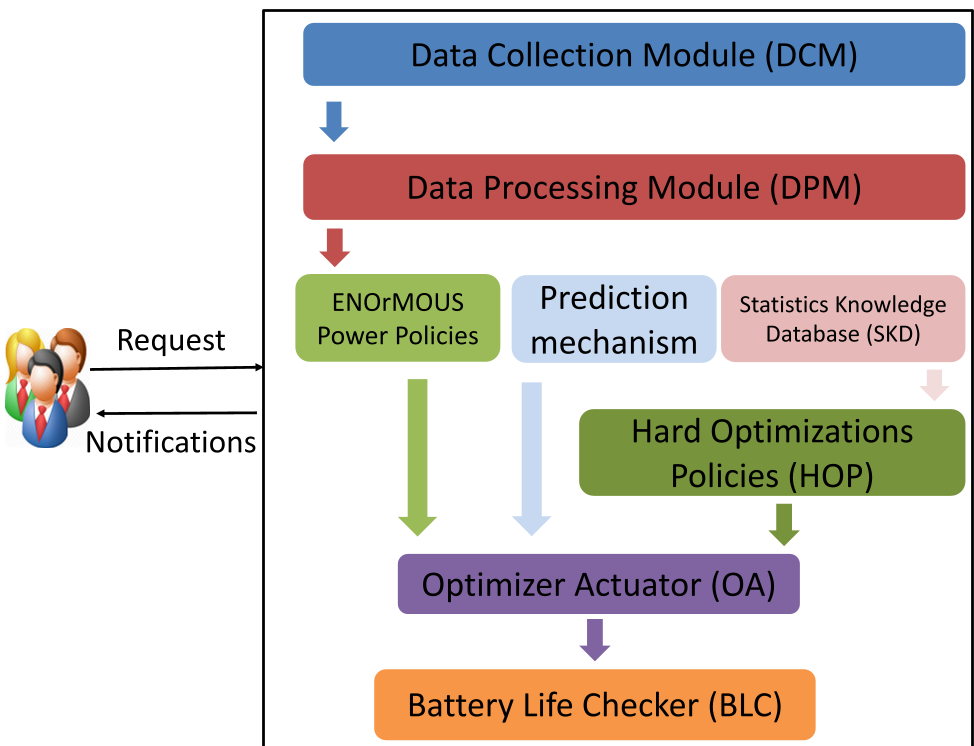 Figure 1: The URBOC architecture showing the flow from Sensor Probes to the Optimizer Actuator via a Logic Knowledge Base.
Experimental Battle: URBOC vs. The OS
Testing was conducted on a dual-core Intel i7 device using the Intel Energy Checker SDK. The researchers simulated common usage (Facebook, Sudoku, PowerPoint) and compared the default OS behavior against URBOC's intervention levels.
The results were striking:
- Baseline OS: Lasted about 13 hours total.
- URBOC Level 2 (HOP 2): Extended the autonomy by 7 hours over the baseline.
- CPU Throttling: The system successfully scaled the CPU from 2700 MHz down to 800 MHz as needed to meet the user's deadline.
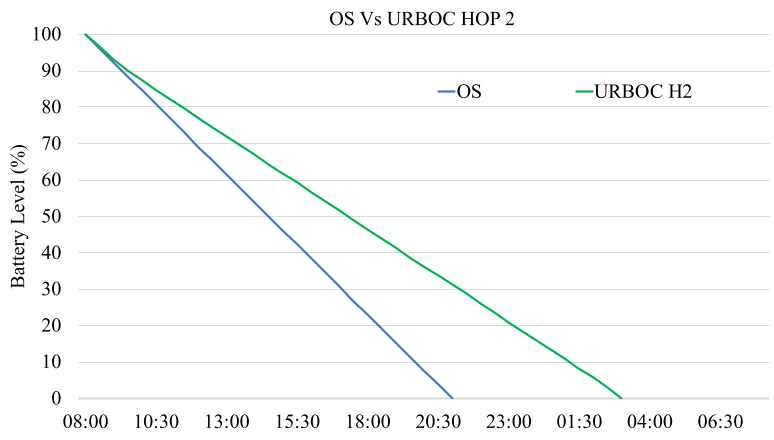 Figure 2: Performance comparison showing the dramatic extension of battery life when URBOC applies Hard Optimization Policies (HOP 2) compared to standard OS policies.
Critical Analysis: A User-Centric Future
URBOC proves that transparency and control are just as important as the underlying algorithms. By allowing the user to set a "Battery Deadline," it shifts the "satisfaction" metric from a vague "performance" score to a concrete "availability" guarantee.
Limitations & Future Outlook:
- Privacy: High-resolution sensor logging and app tracking raise significant privacy concerns that weren't the focus of this paper.
- Accuracy: The GSP algorithm depends on "habits." For users with chaotic, non-routine behavior, the prediction accuracy might drop, leading to aggressive (and perhaps annoying) throttling.
- Future Work: The authors aim to integrate geographical data and more sophisticated ML models (like SVMs or LSTMs) to further refine usage curves.
Conclusion
URBOC represents a sophisticated "energy contract" between the user and their device. It demonstrates that with the right Machine Learning backbone, our smartphones can stop being passive power consumers and start being proactive assistants that ensure they never die when we need them most.