
Neural Networks vs. National Budgets: A Control Theory Approach to Competitiveness
A machine learning model of national competitiveness with regional statistics of public expenditure
This paper proposes a neural network-based model to predict the State National Competitiveness Index of Mexican federal entities using public expenditure variables. By integrating systems theory with economic benchmarking, the authors demonstrate that a retro-propagated feedforward neural network can effectively capture the complex, non-linear relationship between regional budget allocation and institutional productivity.
Executive Summary
In the era of the Fourth Industrial Revolution, "competitiveness" is no longer just a static rank—it is a dynamic race to attract human capital and industry. This paper presents a pioneering machine learning approach to modeling the State National Competitiveness Index (IMCO) in Mexico using regional public expenditure statistics.
TL;DR: The researchers moved beyond traditional linear regression, applying a neural network rooted in control theory to predict how budget distributions impact a state's prosperity. This shift allows policy-makers to treat a nation as a "dynamic system" that can be tuned for optimal performance.
The Problem: Linear Tools for Non-Linear Realities
Policy makers traditionally look at public expenditure through a purely administrative lens. However, the connection between spending on "Personal Services" or "Public Investment" and the final "Competitiveness Index" is rarely a straight line.
Existing benchmarks are often:
- Static: They look at a snapshot in time.
- Fragmented: They fail to see how shifting funds from one category to another creates a ripple effect across the entire socio-economic system.
- Inflexible: Traditional statistical models struggle with the "uncertainty and dynamic nature" of regional development.
Methodology: The Neural Architecture of a State
The authors treat the state as a biological-style processor. They normalized ten dimensions of public expenditure (collected from INEGI) and fed them into a retro-propagated feedforward neural network.
The Core Mechanism
The model uses a single-layer structure to maintain interpretability—crucial for government transparency—while using a sigmoid transfer function to handle the non-linearities of social data.
 Figure 1: Conceptual representation of the neural network linking expenditure inputs to a competitive output.
The weights () assigned during training act as a "sensitivity analysis," showing which areas of spending are most pivotal to the model's prediction. The authors utilized MATLAB's Neural Network Training Tool, achieving convergence within 14 iterations.
Performance & Validation
The model was tested against the 31 Mexican states (excluding Mexico City due to data gaps).
SOTA Comparison: NN vs. Linear Model (LM)
The paper compares the Neural Network (NN) approach with a standard Linear Model (LM) built in R-Studio.
| Metric | Linear Model (LM) | Neural Network (NN) |
|---|---|---|
| R² Coefficient | 0.3811 | 0.3880 |
While the performance gap in seems small, the authors argue the qualitative advantage of the NN is massive. Because the NN is based on Control Theory, it can be plugged into "control blocks" (visualized in tools like Simulink) to simulate the outcome of policy changes before they are enacted.
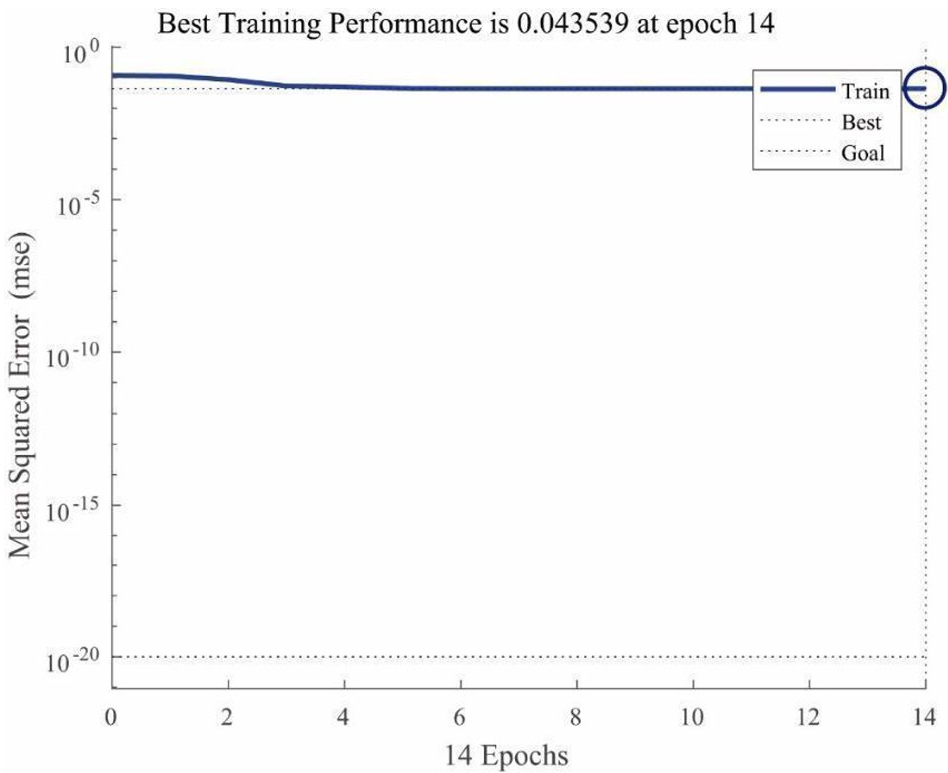 Figure 2: The asymptotic behavior of the error during the training iterations, demonstrating the model's convergence.
Critical Insights & Future Outlook
The true value of this work isn't just in the prediction (), but in the framework. By formalizing the link between spending and competitiveness via AI, we open the door to Optimal Resource Allocation.
Key Takeaways for the Future:
- Simulation over Intuition: Policy makers can use the weights derived from the NN to identify the "highest leverage" expenditure items for their specific region.
- Resource Redistribution: Instead of demanding larger budgets, the model suggests how to redistribute current budgets to move the needle on competitiveness.
- Limitations: The small sample size () is a bottleneck. Future iterations must integrate bigger data—such as real-time telecommunications and innovation clusters—to increase predictive power.
Conclusion
This paper serves as a bridge between Social Science and Artificial Intelligence. It transitions regional administration from a descriptive field into a mathematical, predictive, and eventually, an optimizable science.