
Beyond Outliers: Cracking Bitcoin Money Laundering with Active Learning
Machine learning methods to detect money laundering in the bitcoin blockchain in the presence of label scarcity
This paper investigates Anti-Money Laundering (AML) detection in the Bitcoin blockchain using the Elliptic dataset. It proposes an Active Learning (AL) framework that achieves supervised-level performance (reaching an illicit F1-score of ~0.82) while utilizing only 5% of the available labels.
Executive Summary
TL;DR: This study tackles the critical "label scarcity" problem in cryptocurrency forensics. It demonstrates that traditional unsupervised anomaly detection is largely ineffective for Bitcoin Anti-Money Laundering (AML) because criminals stay "under the radar." However, by using Active Learning (AL), the authors prove that we can match state-of-the-art supervised performance using only 5% of the labels, providing a scalable roadmap for human-in-the-loop AML systems.
Background: Published at ICAIF '20, this work serves as a reality check for the field, moving away from "toy" synthetic datasets to the real-world Elliptic dataset, one of the largest labeled Bitcoin transaction networks.
The "Outlier" Fallacy in AML
Most practitioners assume that money laundering is synonymous with "anomalous behavior." The intuition is simple: illicit transactions should look different.
However, the authors' UMAP visualization (a dimensionality reduction technique) reveals a sobering truth. In the Bitcoin ecosystem, illicit transactions are not outliers. They are buried deep within clusters of legitimate activity. Criminals are experts at obfuscation, mimicking the statistical signatures of miners, exchanges, and wallet providers to blend into the "nominal" distribution.
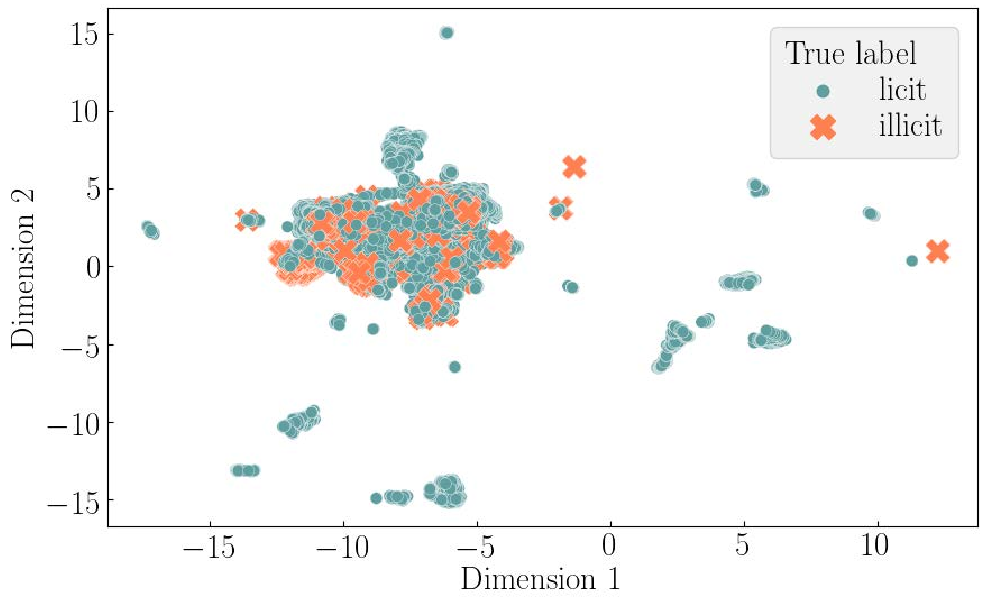 Figure: UMAP projection showing that illicit transactions (red) overlap heavily with licit ones (blue), rendering standard distance-based anomaly detection useless.
Methodology: The Power of Active Learning
Since unsupervised methods fail and full supervision is too expensive, the authors propose an iterative Active Learning loop:
- Warm-up Phase: Use a strategy like Random Sampling to find the first few illicit examples.
- Hot Learner Phase: Once an illicit case is found, switch to a supervised query strategy like Uncertainty Sampling.
- Expert Feedback: The model asks an analyst to label the most "confusing" instances (those close to the 0.5 probability boundary).
- Model Update: The classifier (Random Forest or XGBoost) is retrained on the newly expanded labeled pool.
The core insight here is that the model doesn't need more data; it needs better data—specifically, the points that define the boundary between "mimicry" and "legitimacy."
Experimental Results
The benchmark against seven common anomaly detection algorithms (LOF, KNN, Isolation Forest, etc.) showed disastrous results for the unsupervised approach, with F1-scores barely crossing 0.15.
In sharp contrast, the Active Learning setup reached near-optimal performance with astonishingly few samples:
- Efficiency: Achieved an F1 of 0.82 with only 1,500 labels (out of 30,000).
- Resilience: In highly imbalanced scenarios (0.5% illicit rate), AL significantly outperformed random sampling, which is crucial since real-world fraud is like finding a needle in a haystack.
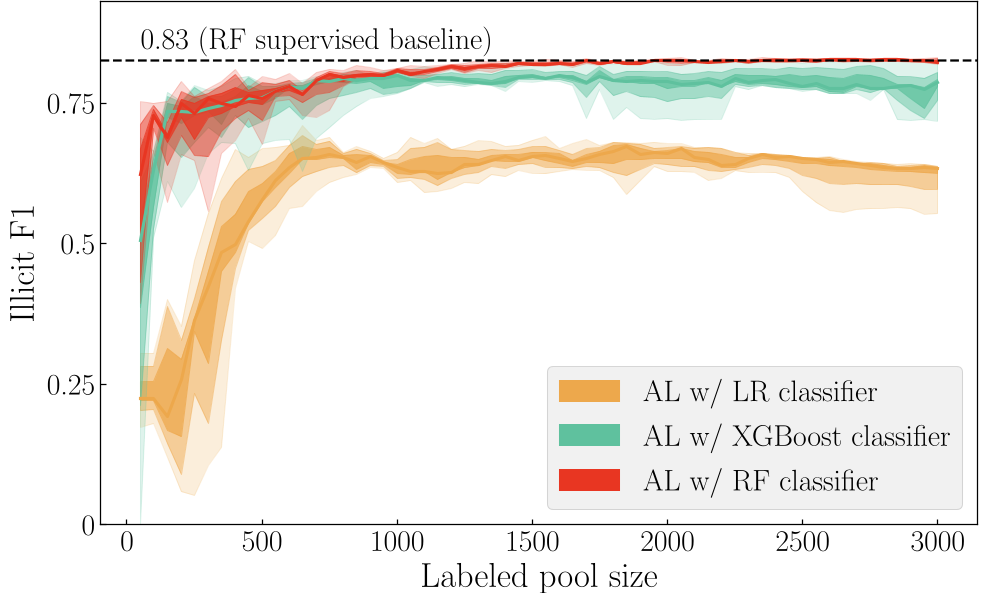 Figure: Active Learning vs. Labeled Pool Size - Notice the rapid convergence to the baseline (dashed line) at very low label counts.
Critical Analysis & Future Outlook
While the results are impressive, there are two key considerations for the future:
- Concept Drift: The authors noted a performance dip around time-step 43 (related to a dark market shutdown). AML models must be robust to sudden shifts in the "illicit distribution."
- The Human Element: Active Learning assumes an "oracle" (analyst) who is always correct. In practice, expert fatigue and labeling errors can introduce noise into the loop.
Takeaway for the Industry: Stop relying solely on anomaly detection. The future of Bitcoin AML lies in Semi-Supervised and Active Learning systems that empower human analysts to focus only on the most informative, high-risk transactions.