
Decoding the Silence: Protocol Analysis in mm-Wave Networks via Machine Learning
Machine Learning Based Network Analysis Using Millimeter-Wave Narrow-Band Energy Traces
The paper introduces a protocol-level monitoring tool for 60 GHz mm-wave networks that utilizes machine learning and narrowband energy traces. The framework combines template matching with an Explicit Duration Hidden Markov Model (EDHMM) to classify IEEE 802.11ad frames without requiring full physical layer decoding, achieving high accuracy in packet type identification and network diagnosis.
TL;DR
Researchers have developed a way to "spy" on 60 GHz wireless protocols like IEEE 802.11ad without actually decoding the data bits. By feeding narrowband energy traces into a specialized Explicit Duration Hidden Markov Model (EDHMM), they can identify packet types (DATA, ACK, Beacons) and diagnose link failures like antenna misalignment and blockage with high precision, even when the devices themselves remain "black boxes."
The Problem: The High Cost of "Seeing" 60 GHz
Millimeter-wave (mm-wave) networks offer massive bandwidth, but they are notoriously fragile. A single hand wave or a slightly misaligned antenna can kill a link. Unfortunately, diagnosing these issues in Commercial Off-The-Shelf (COTS) devices is nearly impossible because:
- Decoding Complexity: Sniffing a 2 GHz wide channel requires massive processing power.
- Privacy/Encryption: Most data is encrypted, meaning headers and payloads are unreadable to external observers.
- HMM Limitations: Standard Hidden Markov Models assume that the time spent in a state (like "transmitting data") follows a geometric distribution, which is physically incorrect for networking protocols with fixed frame sizes.
Methodology: Beyond Simple Thresholds
The authors' insight is that while we can't see the content of the packet, the energy signature and timing are unique fingerprints.
1. Template Matching for Beacons
Instead of complex signal processing, the system uses Pearson’s correlation to find Beacons. Since Beacons have a fixed, distinctive shape, a simple sliding window correlation can pinpoint the start of a "data burst" even in a sea of noise.
2. The EDHMM Core
Standard HMMs are "memoryless," making them prone to "flickering" between states if a single sample is noisy. The EDHMM explicitly models the duration of a state (e.g., an ACK is always shorter than a maximum aggregate DATA frame). This adds a "temporal logic" to the machine learning, forcing it to look for patterns that make sense within the 802.11ad protocol rules.
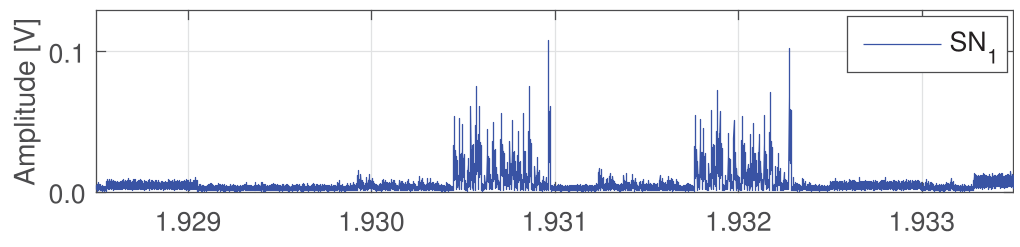 Figure: The framework correctly identifies sequences (DATA, ACK, IFS) where standard HMM produces erroneous state transitions.
3. Adapting to Reality (Runtime K-Means)
Outdoor and indoor environments are non-stationary—users move, and gain control adjusts. The framework uses a runtime K-means clustering algorithm to update the expected energy levels for "Idle," "Data," and "ACK" states for every burst, ensuring the ML model doesn't go "blind" when the signal fluctuates.
Experimental Results: Seeing from Multiple Angles
The team tested their system using Sivers IMA converters and USRP software-defined radios.
- Accuracy: In controlled tests, the packet counts matched internal device drivers perfectly.
- Blockage Detection: By comparing traces from two sniffers at different locations, the system can distinguish between "Hard Blockage" (link completely cut) and "Soft Blockage" (intermittent interference), as well as identify when the link is struggling to re-align via Beam Refinement (BR) sequences.
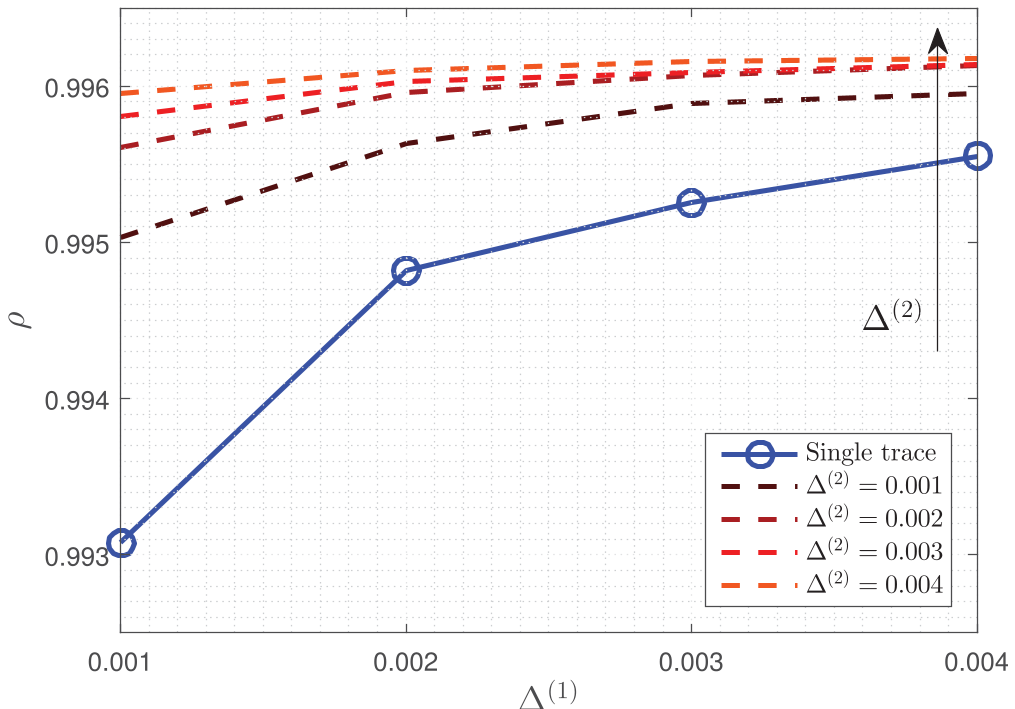 Figure: Jointly processing multiple sniffers (SN1 & SN2) allows for correction of bias and much higher decoding accuracy than a single measurement point.
Deep Insight: Why This Matters for 6G
The true value of this work lies in Inductive Bias. By baking the "rules of the protocol" into the structure of the Hidden Markov Model (via the EDHMM), the authors have created a tool that is far more robust than a "pure" black-box neural network. This "physically-aware" ML approach is likely the future of network management, where we need to monitor massive amounts of data with minimal overhead.
Conclusion
This protocol analyzer bridges the gap between simple energy detection and full-blown signal decoding. It allows network admins to say, "The link is slow because the antennas are misaligned," rather than just "the signal is weak." While it has limitations—specifically when channel fluctuations are faster than the burst duration—it represents a sophisticated leap in non-intrusive network telemetry.