
Architecting Reactive AI: Leveraging the Actor Model for Real-Time Healthcare Analytics
A Machine Learning Platform in Healthcare with Actor Model Approach
This paper introduces a novel Machine Learning platform for healthcare based on the Actor Model, utilizing the Akka framework to provide an abstraction layer for big data processing. It achieves real-time activity recognition for elderly patients using passive RFID sensors, successfully implementing an adaptive training pipeline that bridges historical and live data.
TL;DR
With the surge of Big Data in digital health, the challenge has shifted from "how to store data" to "how to process it immediately." This paper proposes a Machine Learning platform built on the Actor Model, providing a high-level abstraction that masks the complexities of concurrency and scalability. By treating every system component—from sensors to ML trainers—as an independent "Actor," the platform enables seamless, real-time activity tracking for elderly patients with high precision.
The Concurrency Crisis in Big Data
Most developers building Machine Learning pipelines for healthcare face a daunting wall of technical debt: managing distributed threads, handling race conditions, and integrating various Big Data frameworks. The primary motivation here is to provide a "Level of Abstraction."
The author argues that programmers should focus on application logic rather than the plumbing of scalability. By moving away from synchronous "Request-Response" cycles (which block threads and limit throughput) toward a "Fire-and-Forget" messaging paradigm, we can build systems that are truly reactive to patient needs.
Methodology: The Actor-Based Pipeline
The core of the system is the Actor: a fundamental unit of computation that includes processing, storage, and communication. The platform is structured into three macro layers:
- Input Management: Monitoring raw datasets (Producers).
- Request Routing: Handling data flow (Consumers).
- Analysis Core: The brain of the system, split into Trainers (model creation) and Predictors (inference).
System Architecture
The following diagram illustrates how data flows from source devices through the actor pipeline to generate real-time insights:
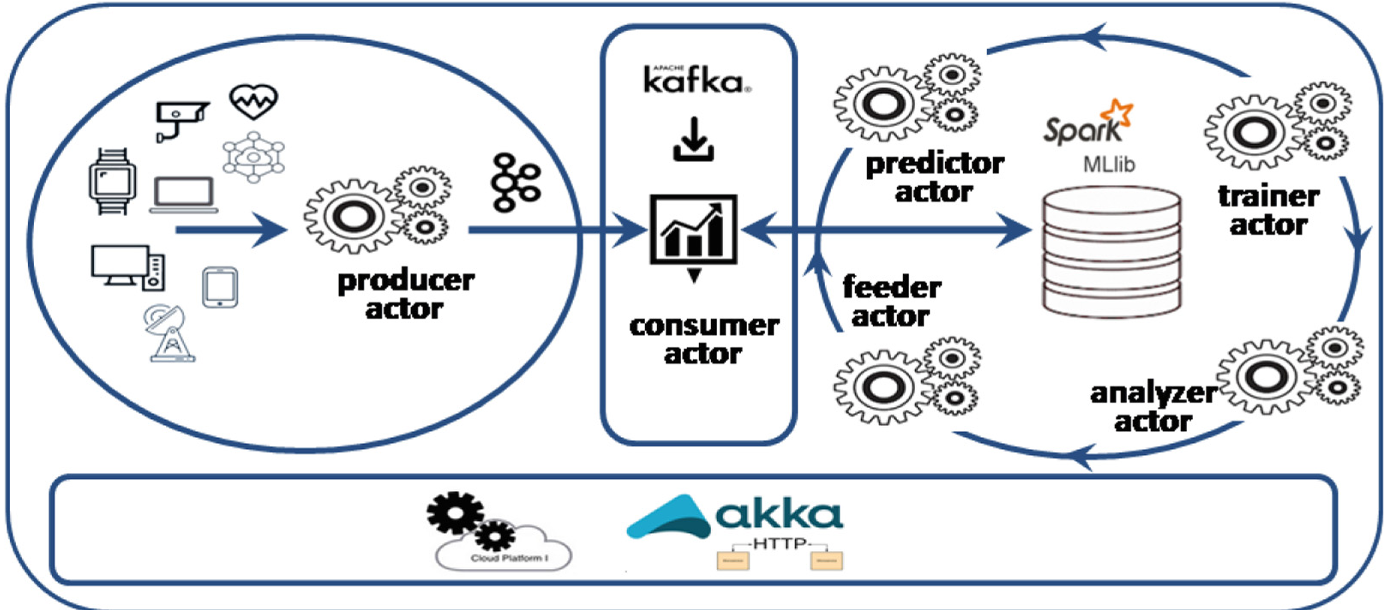
Key features of this architecture include:
- Independence: Actors perform behaviors without side effects on others.
- Asynchrony: Use of the "Tell Principle" to ensure non-blocking communication.
- Adaptive Learning: The system is not static. Every processed message enriches the training set, allowing the "Trainer" actor to periodically redeploy optimized models to the "Predictor."
Experimental Results: Healthcare Case Study
To prove the platform's efficacy, the author conducted a study on Activity Recognition for elderly patients using batteryless RFID sensors. The goal was to classify patient states: Sitting on bed, Sitting on chair, Lying, or Ambulating.
Comparing three primary ML algorithms, the results showed a clear winner in the Decision Tree paradigm for this specific sensor data:
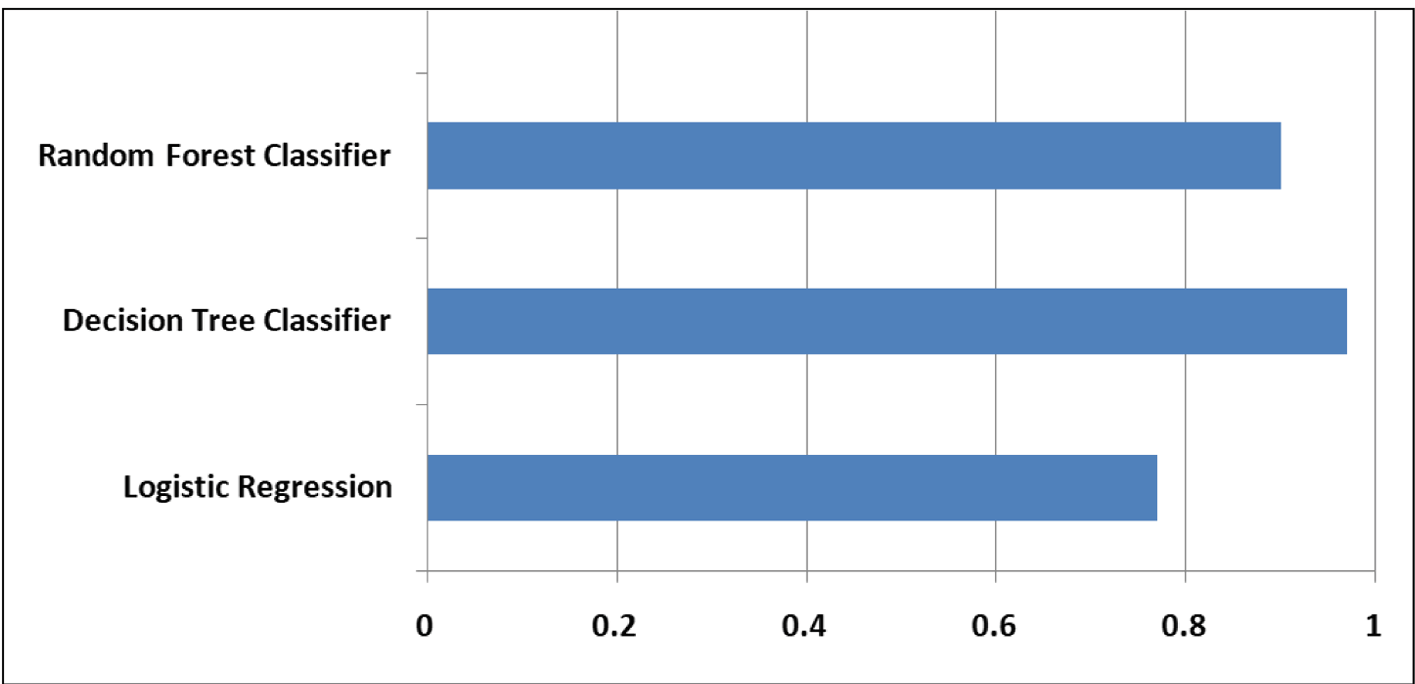
- Decision Tree Classifier: Achieved the highest overall accuracy (~95%).
- Random Forest: Performed reliably but slightly trailed the Decision Tree in specific categories.
- Logistic Regression: Struggled with classifying "Sitting on chair" vs "Lying," likely due to the linear nature of the model failing to capture complex RFID signal phases.
Detailed Performance (Confusion Matrix)
The robust classification suggests that the Actor-based pipeline successfully preserved data integrity and timing—critical for high-frequency sensor streams.
Critical Insight & Conclusion
The true innovation here isn't just the ML model—it’s the architectural harness in which the model resides. By using the Actor Model, the platform achieves a state of "adaptive mutation," where the system evolves its accuracy based on the continuous influx of real-time data.
Limitations: While effective, the paper notes that the current testing was done on a controlled dataset. The next frontier for this platform is "High Throughput Stress Testing"—evaluating how the actor hierarchy holds up under massive data streaming from thousands of devices simultaneously.
For practitioners in the Medical IoT (IoMT) space, this work serves as a blueprint for building systems that are not just "smart," but fundamentally resilient and scalable.