
Machine Learning Independent of Population Distributions: Why "Forward Modeling" is the Future of Robust Sensing
Machine Learning Independent of Population Distributions for Measurement
The paper proposes a robust machine learning framework for measurement tasks that remains independent of changing population distributions. By shifting from direct estimation () to a maximum likelihood approach based on an invariant measurement process model (), the method achieves state-of-the-art accuracy in scenarios with significant distribution shift.
TL;DR
In the world of high-precision measurement (like olfactory sensing or astronomy), traditional Machine Learning often fails because it overfits the distribution of the objects it saw during training. This paper introduces a framework that focuses purely on the invariant physics of the sensor. By modeling how a sensor reacts to a stimulus (Forward Model) and "searching" for the best stimulus during inference, the researchers achieved an 85% accuracy in gas detection where traditional models barely hit 17%.
The "Measurement Trap": Why Direct ML Fails
Most practitioners approach sensing as a standard supervised learning problem: (sensor output) goes in, (target value) comes out. We train a model to approximate .
However, there is a hidden danger: Bayes' Rule. The posterior we learn is inextricably tied to —the probability of certain values occurring during the calibration phase. If your thermometer was calibrated using data from the Sahara, it will perform poorly in the Arctic, not because the physics of mercury changed, but because the statistical "prior" of temperatures is different.
The Core Insight: Invariance of the Measurement Process
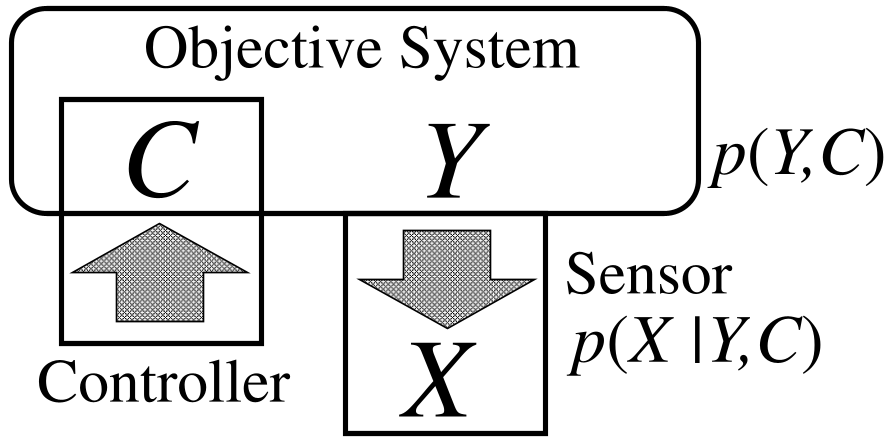
The authors argue that while (the environment) is volatile, (the sensor's internal mechanism) is invariant.
Instead of forcing a model to learn the "inverse" mapping, they propose:
- Calibration Phase: Train a model to predict the sensor output . This is a "Forward Model" that captures the pure physics of the measurement process.
- Measurement Phase: When we see a new , we don't "predict" . Instead, we search for the that would most likely produce that given our physical model:
Evidence of Robustness
The researchers tested this across three domains: simulations, UCI benchmarks, and real-world olfactory (smell) sensing.
Breaking the "Straightforward" Approach
In simulations where researchers increased the distribution shift (), the error of standard Linear Regression (LR) and Neural Networks (NN) exploded. In contrast, the proposed "Measurement-Independent" approach (represented as in the table below) remained virtually flat.

Real-World Application: Olfactory Sensing
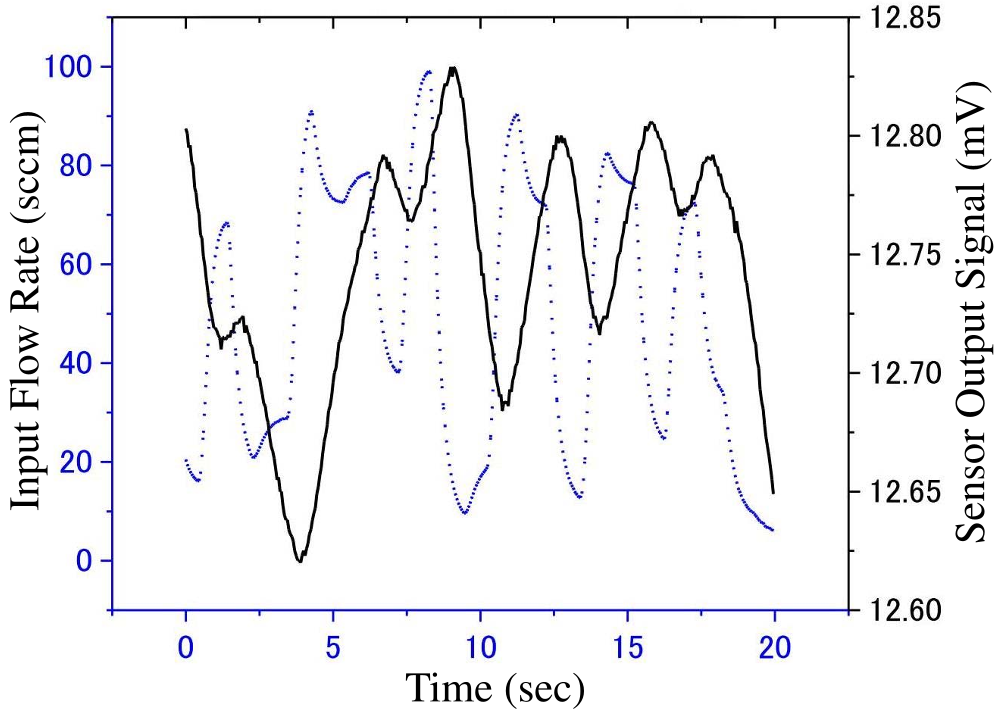
The most striking result came from a Membrane-type Surface Stress Sensor (MSS). In a setup without expensive mass flow controllers—meaning the air flow was chaotic and unpredictable—the standard k-Nearest Neighbor (kNN) approach failed completely (17.5% accuracy). The proposed algorithm, by correctly modeling the sensor's response to flow trajectories, maintained an 85% accuracy.
Critical Analysis & Takeaways
- The Power of Simplicity: Interestingly, in many benchmarks, Linear Regression using the proposed principle outperformed complex Neural Networks. This is because complex models often overfit the training distribution, essentially "baking in" the bias that this paper seeks to avoid.
- The Cost of Inference: The drawback is that inference is no longer a single "pass" through a network. It requires an optimization step (a line search). However, for most physical measurements where is a scalar (like temperature, concentration, or distance), this search is computationally negligible.
- Future Impact: This framework is a call to action for AI in the physical sciences. If we want AI that works outside of controlled lab environments, we must stop training models to "guess" the answer and start training them to "understand" the measurement process.
Conclusion
This paper provides a mathematically grounded and practically validated path toward Unbiased AI in Measurement. By respecting the causal direction of data generation (Stimulus Sensor Output), we can build systems that are truly robust to the messiness of the real world.