
Hybrid Intelligence: Bridging Ontologies and Machine Learning for Real-Time Healthcare
Combined Machine Learning and Semantic Modelling for Situation Awareness and Healthcare Decision Support
2020-01-01
Summary
Problem
Method
Results
Takeaways
Abstract
This paper introduces a holistic IoT-based remote health monitoring framework that integrates Semantic Web technologies (Ontologies and SWRL) with Machine Learning (Fast Decision Tree). The system, designed for elderly and chronic patients, achieves a self-evolving knowledge base by using ML to generate new reasoning rules from historical medical alerts.
## TL;DR
The quest for "Active and Assisted Living" (AAL) for the elderly faces a technical bottleneck: how to move from simple sensor monitoring to intelligent, self-evolving clinical decision support. This paper presents a framework that merges the **logic-based precision of Ontologies** with the **pattern-recognition power of Machine Learning (ML)** to create a system that not only monitors vital signs but also "learns" new medical rules autonomously.
## The Interoperability Crisis in E-Health
Modern healthcare sits in a "knowledge age" where volume is no longer the issue—interpretation is. Prior work in remote monitoring often utilizes one of two silos:
1. **Rule-Based Systems**: Highly interpretable but brittle. They cannot handle the "unknown unknowns" of complex patient contexts without manual data engineering.
2. **Machine Learning**: Formidable at prediction but often "black boxes" that lack the semantic structure required for medical interoperability (e.g., sharing data across different hospital systems).
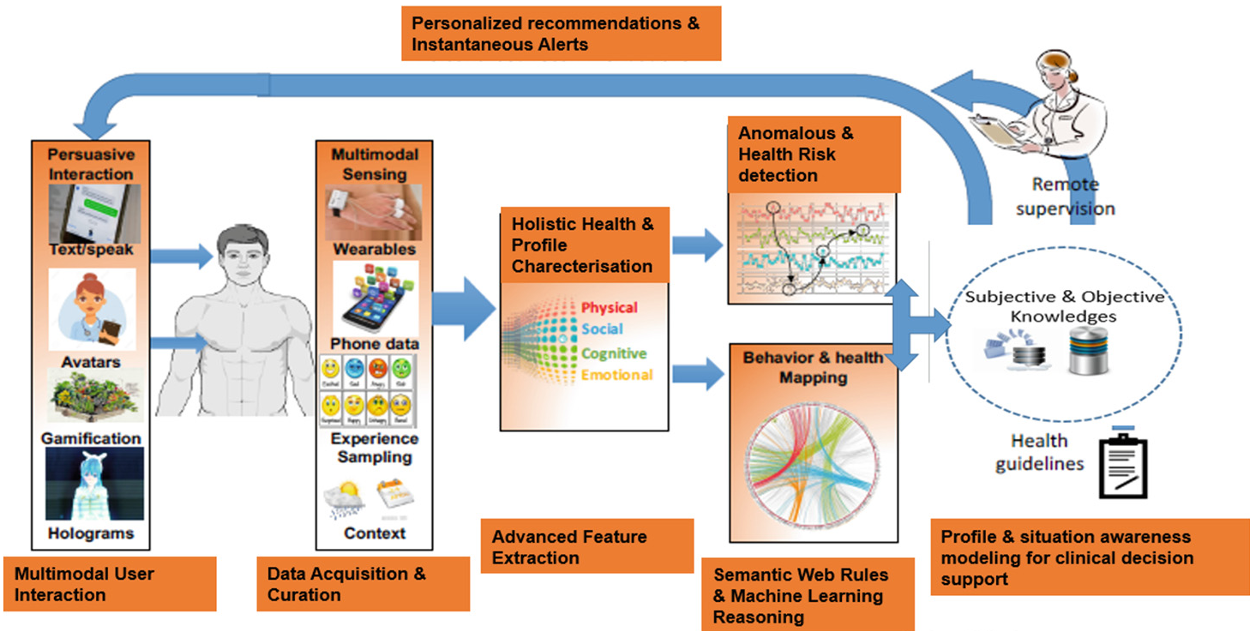
The authors argue that a truly ubiquitous health system must be **situation-aware**, meaning it understands the "why" behind an alert by combining objective medical textbooks with subjective patient context.
## Methodology: The Symbiosis of Logic and Learning
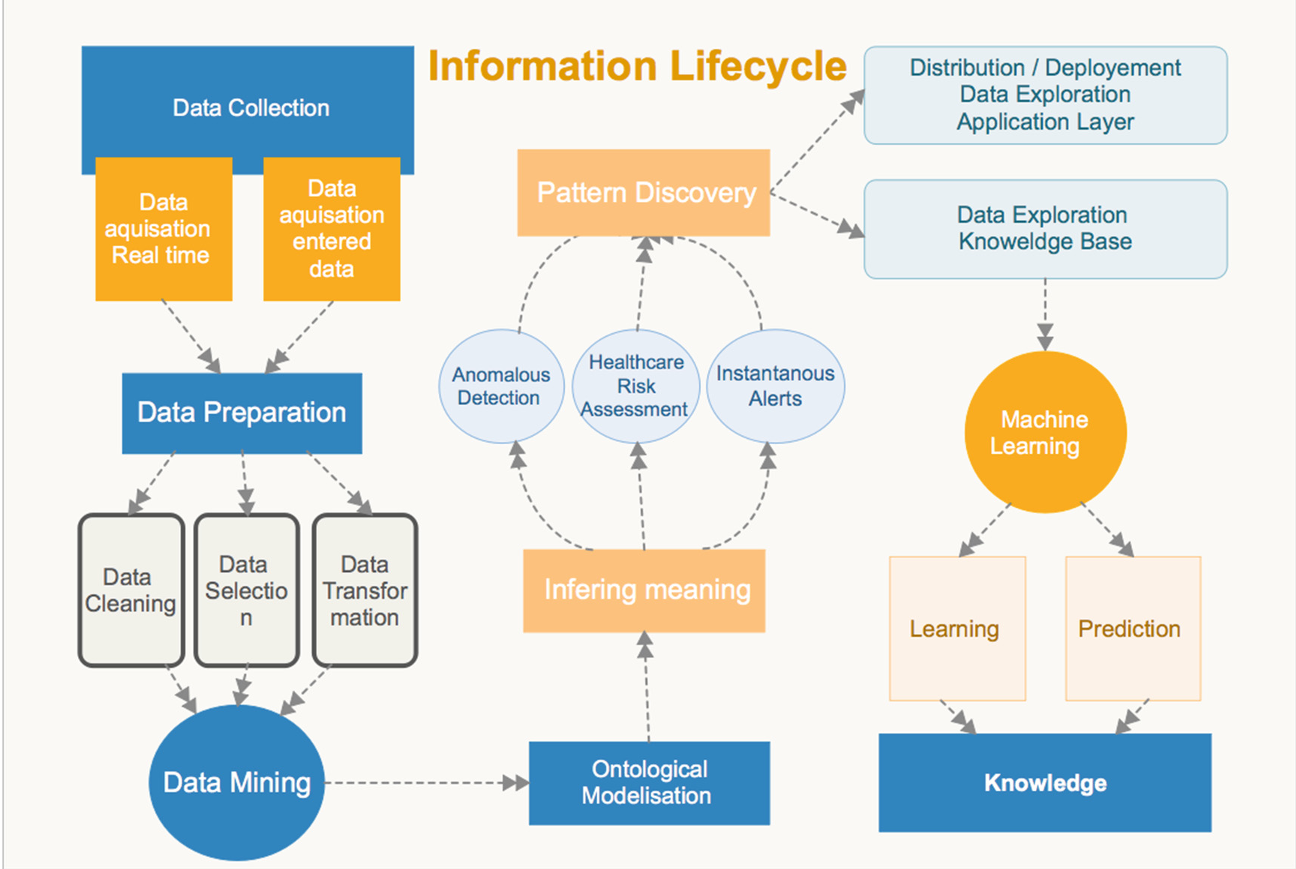
The core of the proposal is a multi-layered architecture that treats information as a dynamic lifecycle: from raw sensor data to structured knowledge.
### 1. Semantic Foundation (The Ontology)
Instead of reinventing the wheel, the authors utilize a "Best-of-Breed" approach by merging three standard ontologies:
* **ICNP**: For nursing terminologies and patient states.
* **SSN/SOSA**: For the underlying IoT sensor infrastructure.
* **FOAF (Friend of a Friend)**: For personal and social context.
### 2. The Feedback Loop (ML + SWRL)
The innovative "secret sauce" is the interaction between the **Reasoner Engine (RE)** and the **ML Engine (MLE)**.
* The RE uses **SWRL (Semantic Web Rule Language)** to apply primary medical knowledge (e.g., "If Temp > 38°C, then Fever").
* The MLE uses a **Fast Decision Tree (FDT)** algorithm to analyze patterns in the alerts generated. If the FDT identifies a recurring cluster of symptoms leading to an emergency, it synthesizes a *new* rule.
* This new rule is converted back into SWRL and injected into the Knowledge Layer, effectively allowing the system to "study" its own performance and evolve.
## Performance and Clinical Relevance
To validate this, the researchers applied the **Fast Decision Tree** algorithm to the University of Queensland vital signs dataset.
One significant result was the discovery of a complex rule for **SpO2 (Oxygen Saturation)**. While a simple system might only look at the SpO2 percentage, the proposed system learned that an emergency case (Alarm: `SpO2 LOW PERF`) is actually a multi-variate condition involving:
* **Perfusion Indicator (Perf)** < 0.5
* **Airway Volume (AWV)** < 3749.05
* **Non-invasive Blood Pressure (NBP)** < 105
By formalizing this into a SWRL rule, the system ensures that future detections are handled with clinical-grade precision rather than simple thresholding.
## Critical Analysis & Future Outlook
The primary value of this work is its **Hybrid Architecture**. By using Fast Decision Trees—which are computationally efficient and highly interpretable—the authors solve the "black box" problem of ML in medicine. The logic remains transparent and verifiable by medical staff.
**Limitations**: While the logic is sound, the "subjective knowledge" (individual patient history) requires high-quality initial EHR data. Furthermore, the transition from an ML-generated tree to a formal SWRL axiom still requires a degree of "Translation Logic" that needs robust testing in real-world clinical environments.
**Future Work**: The authors aim to scale this to larger samples of the elderly population. The real test will be how the system handles the "noise" of real-world IoT environments where sensors may fail or provide intermittent data.
### Key Takeaway
This research shifts the paradigm from **Monitoring** to **Anticipating**. By enabling ontologies to learn from data via ML, we move closer to a future where healthcare software acts not just as a recorded log, but as a proactive digital caregiver.