
Beyond Genres: Harnessing Soft Computing for Intuitive Music Emotion Recognition
Machine Learning and Soft Computing Methodologies for Music Emotion Recognition
The paper presents a hybrid framework for Music Emotion Recognition (MER) using five acoustic features (intensity, rhythm, key, harmony, spectral centroid). It evaluates both supervised learning (SVM, MLP, Bayesian Networks) and unsupervised soft computing (Fuzzy C-Means, Rough Fuzzy C-Means) to facilitate emotion-based music retrieval and playlist generation.
TL;DR
Music is fundamentally a language of emotion, yet many retrieval systems still rely on static metadata. This paper introduces a framework that extracts acoustic "DNA"—intensity, rhythm, harmony—and uses Soft Computing (Fuzzy Logic) to categorize songs into emotional quadrants. By moving away from hard labels, the system enables more nuanced playlists where "Sad" and "Relaxing" tracks can coexist based on mathematical emotional proximity.
The "Fuzziness" of Human Emotion
Classical Music Information Retrieval (MIR) often treats emotion as a classification problem: is this song "Happy" or "Angry"? However, human perception is rarely binary. A song might be "mostly happy" with "pockets of nostalgia."
The authors identify a major bottleneck in prior work: the inability to handle the ambiguous boundaries between emotional states. They leverage the Thayer Model (Arousal vs. Valence) but recognize that a song's position in this space is often probabilistic rather than fixed.
Methodology: Calculating the Emotional Signature
The framework operates in two distinct modes: supervised classification for known datasets and unsupervised clustering for unlabeled libraries.
1. Feature Engineering
The system extracts five core acoustic factors:
- Intensity: Calculated via Mean Energy () and its standard deviation to measure loudness regularity.
- Rhythm: Tempo and beat regularity using onset detection.
- Key: Determining major vs. minor scales (Major is typically associated with positive valence).
- Harmony & Spectral Centroid: Analyzing overtones to distinguish between "bright" and "dark" timbres.
2. The Power of "Rough" Logic
The core innovation lies in the use of Rough Fuzzy C-Means (RFCM). Unlike standard clustering, RFCM acknowledges a "negative domain"—data points that clearly do not belong to a cluster—while allowing others to maintain multi-class memberships.
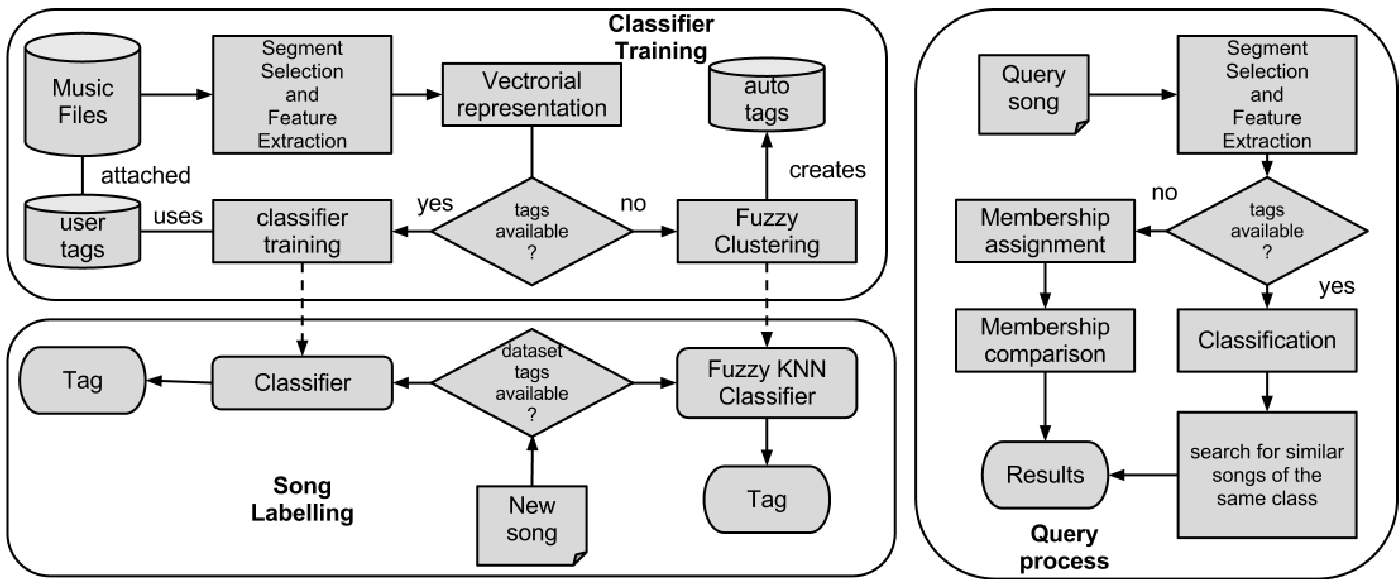 Figure 1: The dual-path architecture allowing for both manual labeling and automated emotional suggestion.
To assign a new song to a mood, they use a weighted k-Nearest Neighbor membership formula: This ensures that the "strength" of an emotion is influenced by its most similar neighbors in the feature space.
Experiments and Insights
The researchers tested their approach on a dataset across four classes: Angry, Happy, Relax, Sad.
Performance Comparison
While supervised models like SVM (72% accuracy) provided strong baseline classification, the RFCM clustering (66.14%) proved highly effective for discovery.
| Classifier | TP Rate | Precision | Recall |
|---|---|---|---|
| Bayes | 65% | 66% | 65% |
| SVM | 72% | 73% | 72% |
| MLP | 70% | 70% | 70% |
The Qualitative "Aha!" Moment
The most interesting result wasn't just accuracy, but the playlist quality. In a query for a "Sad" song by De André, the system returned other "Sad" tracks alongside "Relaxing" tracks by Yann Tiersen. While technically a "misclassification" in a rigid system, these tracks shared the same low-arousal acoustic profile, making them perfect for a user's actual mood.
Critical Analysis & Future Outlook
Takeaway: This work demonstrates that Fuzzy Similarity is often more useful for end-users than "Perfect Classification." By allowing transitions between related emotional states (e.g., Happy ↔ Relax), the system mimics human browsing behavior better than traditional tags.
Limitations: The dataset used (100 songs) is small by modern standards. Furthermore, the acoustic features are "hand-crafted." Modern deep learning (like CLAP or Jukebox) could likely extract even more subtle emotional cues.
Future Work: The authors suggest moving toward Fuzzy Relational Neural Networks, which could allow the system to explain why a song feels "Angry" through human-readable IF-THEN rules—a significant step forward for Explainable AI (XAI) in the arts.