
RVFL Networks: Revolutionizing Leaf Wetness Prediction via High-Efficiency Soft Sensing
Machine Learning Based Soft Sensing Tool for the Prediction of Leaf Wetness Duration in Precision Agriculture
This paper introduces a soft-sensing framework for predicting Leaf Wetness Duration (LWD) in precision agriculture by leveraging Random Vector Functional Link (RVFL) networks. By mapping meteorological data to wetness levels, the method allows for the replacement of expensive physical sensors with high-efficiency machine learning models.
TL;DR
Leaf Wetness Duration (LWD) is a "silent killer" in agriculture, directly linked to the spread of plant diseases. This paper proposes a transition from expensive, high-maintenance physical sensors to Soft Sensing powered by Random Vector Functional Link (RVFL) networks. By using randomized neural architectures, the authors achieve SOTA-level accuracy in predicting LWD from standard weather data while reducing training time by over 10x compared to traditional ensemble methods.
The Motivation: Why Physical Sensors Fail the Scalability Test
In precision agriculture, the presence of free water on canopy surfaces (caused by dew, fog, or rain) is a primary catalyst for fungal and bacterial infections. Historically, growers relied on electronic sensors to monitor this. However, these devices face several "real-world" hurdles:
- Maintenance Overhead: Sensors must be moved frequently to account for crop growth and removed during harvest.
- Signal Noise: Corrosion and sensor angle often lead to data inaccuracies.
- Cost: Full-scale deployment across large vineyards is economically prohibitive.
The authors' insight is clear: if we can correlate LWD with easily accessible meteorological data (temperature, humidity, solar radiation), we can treat the LWD sensor as a Soft Sensor—using a model to "virtually" sense what a physical device would.
Methodology: The Power of Randomization
The heart of this study lies in the comparison of various Machine Learning (ML) architectures. The standout performer is the Random Vector Functional Link (RVFL) network.
Why RVFL?
Unlike standard Neural Networks that use backpropagation (which is iterative and slow), RVFL networks:
- Initialize the input-to-hidden layer weights randomly and keep them fixed.
- Include direct connections from the input to the output layer to maintain linear patterns.
- Compute the output weights using a simple closed-form solution (Least Squares/Ridge Regression).
The authors evaluated four architectural "flavors":
- Single-layer RVFL: The baseline randomized model.
- Multi-layer (mRVFL): Stacked hidden layers for deeper abstraction.
- Deep RVFL (dRVFL): Concatenates features from all intermediate layers into the final output.
- Ensemble Deep RVFL (edRVFL): Combines multiple deep sub-networks to improve robustness.
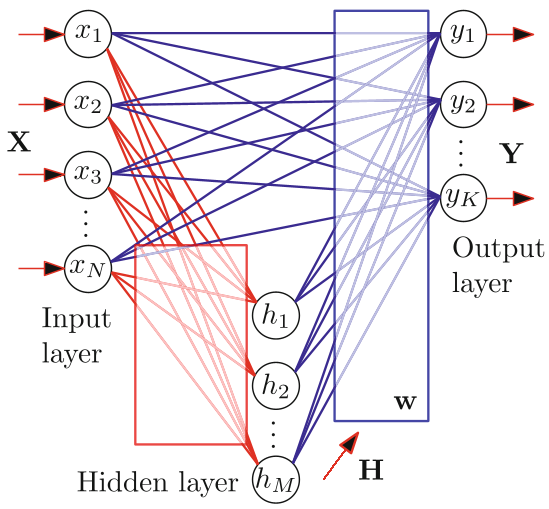 Figure 1: Comparison between Single-layer, Multi-layer, and Deep RVFL structures.
Experimental Results: Precision Meets Speed
Using a 6-year real-world dataset from the AFarCloud project, the team benchmarked RVFL against 18 other models, including Random Forest (RF), XGBoost, and Support Vector Regression (SVR).
Key Findings:
- Accuracy: The dRVFL model achieved the highest R² score (0.608), outperforming complex ensembles like XGBoost.
- Efficiency: While Random Forest took ~0.2 seconds to train per partition, RVFL variants completed the task in 0.012 to 0.05 seconds.
- Linear Limitations: Simple linear models (Lasso/Ridge) failed to capture the non-linear interaction between radiation, wind speed, and humidity, confirming that LWD is a complex multi-parametric problem.
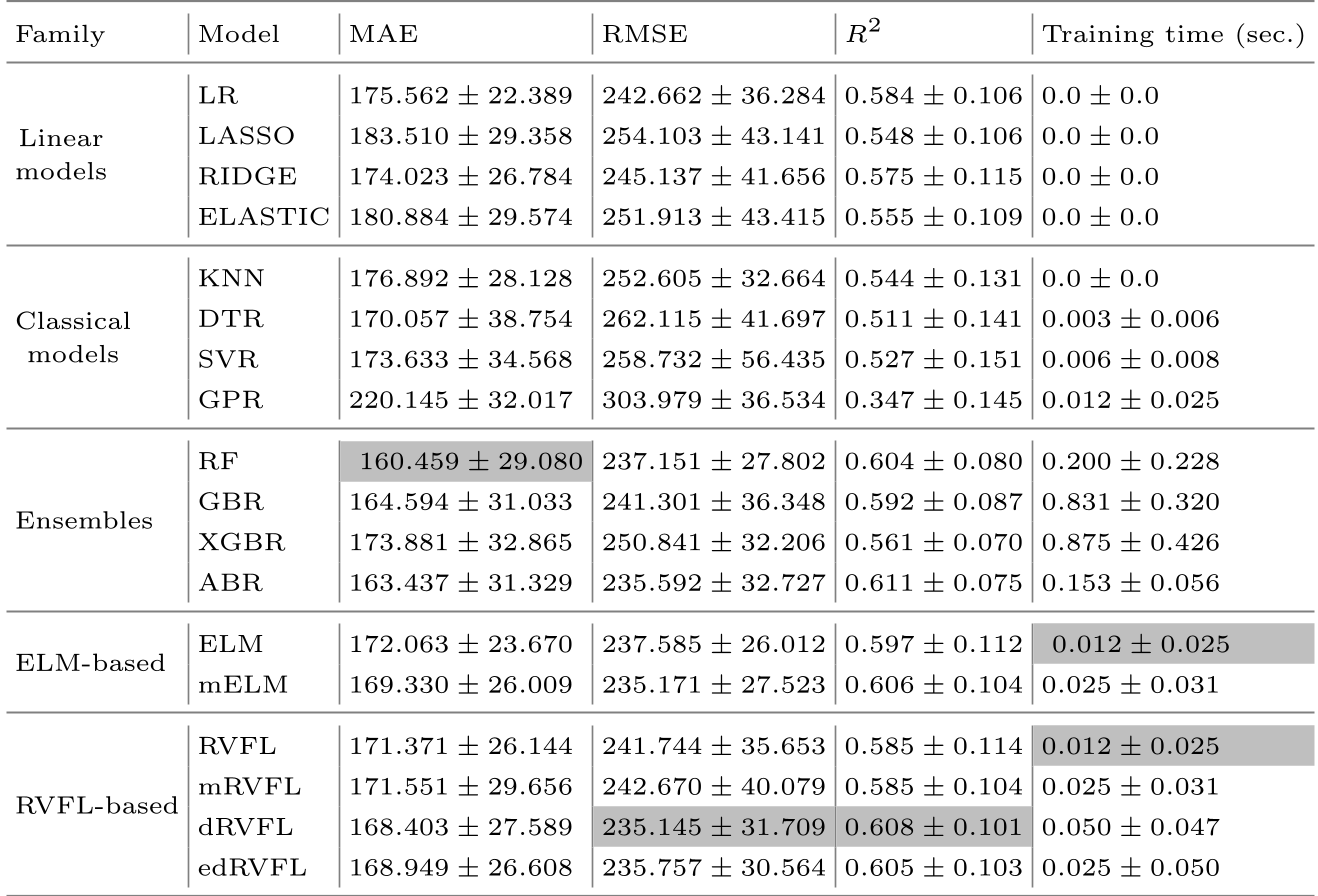 Table 1: Performance comparison showing RVFL dominance in R² and Training Time.
Critical Insight: The "Soft Sensing" Paradigm Shift
The true value of this work isn't just a high R² score; it's the methodology of deployment.
- Phase 1: Deploy physical sensors temporarily (e.g., one season) to collect ground truth.
- Phase 2: Train an RVFL model using local weather station data.
- Phase 3: Remove the sensors and rely entirely on the ML model.
This "Train-and-Remove" strategy drastically reduces the Total Cost of Ownership (TCO) for digital farming systems.
Conclusion and Future Outlook
The study proves that randomization-based neural networks are not just theoretical curiosities but practical tools for resource-constrained IoT environments.
Future Work: The authors suggest moving toward Explainable AI (XAI) to understand which weather factors (e.g., dew point vs. wind speed) influence leaf wetness most heavily. Integrating topographical data could also allow these models to generalize across varied terrains without needing a new "Phase 1" data collection period.
Takeaway for the Industry: If you are building agricultural IoT, stop struggling with sensor maintenance and start investing in randomization-based soft sensing.