
Decoding Student Success: A Data Mining Approach to Educational Behavior
A Machine Learning Approach to Identify the Correlation and Association among the Students' Educational Behavior
This paper presents a Machine Learning and Data Mining approach to analyze student educational behavior using a dataset of 1,000 instances from universities in Bangladesh. By employing the Apriori algorithm for Association Rule Mining and Chi-Square tests for correlation, the study identifies critical socio-economic and behavioral factors—such as social media usage and family background—that significantly impact academic performance.
TL;DR
Is a student's GPA determined by their intelligence or their environment? This research analyzes 1,000 students using Association Rule Mining and Machine Learning to prove that academic success is a cocktail of early education consistency, limited social media exposure, and family dynamics. Using the Apriori algorithm, the study extracts high-confidence rules that predict a student's performance based on their daily habits.
Problem & Motivation: Beyond the Gradebook
In the context of Bangladesh’s evolving education landscape, a paradox exists: literacy rates are climbing, yet student performance stability is wavering. The authors argue that current educational systems are "dumb"—they store data but don't understand it.
The core intuition here is that educational behavior (how much time you spend on Facebook, what your mother does for a living, your history in high school) is a better predictor of university success than isolated test scores. The challenge lies in identifying which of these 32+ variables actually matter in a sea of noise.
Methodology: The Core Engine
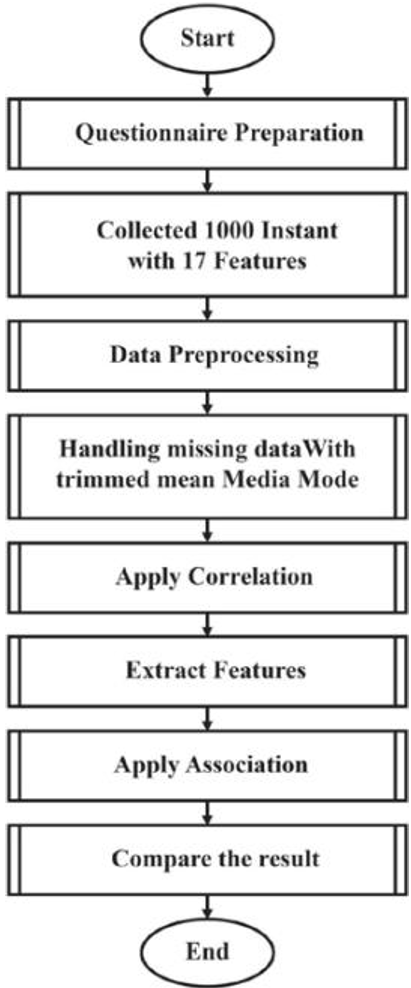
The researchers followed a rigorous pipeline: Data Collection -> Preprocessing -> Correlation Analysis -> Association Rule Mining.
1. System Architecture
The study utilized a structured flow to move from raw survey data to actionable intelligence.
2. Identifying Rules with Apriori
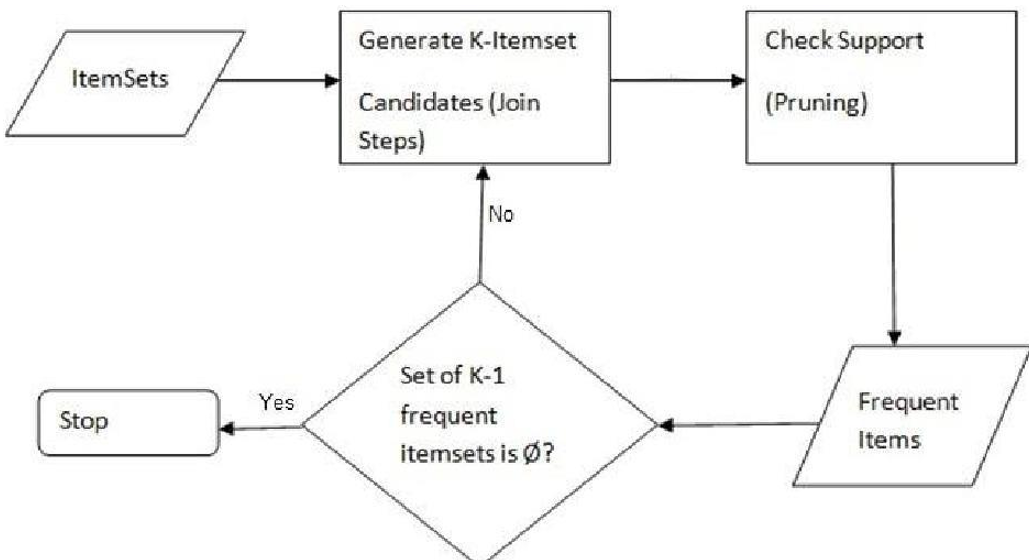
The heavy lifting is done by the Apriori Algorithm. Unlike standard classification which predicts a target Label (A or B), Association Rule Mining finds "if-then" relationships. The researchers looked for rules with a Support of 0.5 (occurring in 50% of the data) and a Confidence of 0.95 (95% accuracy when the condition is met).
Key Findings & Visual Evidence
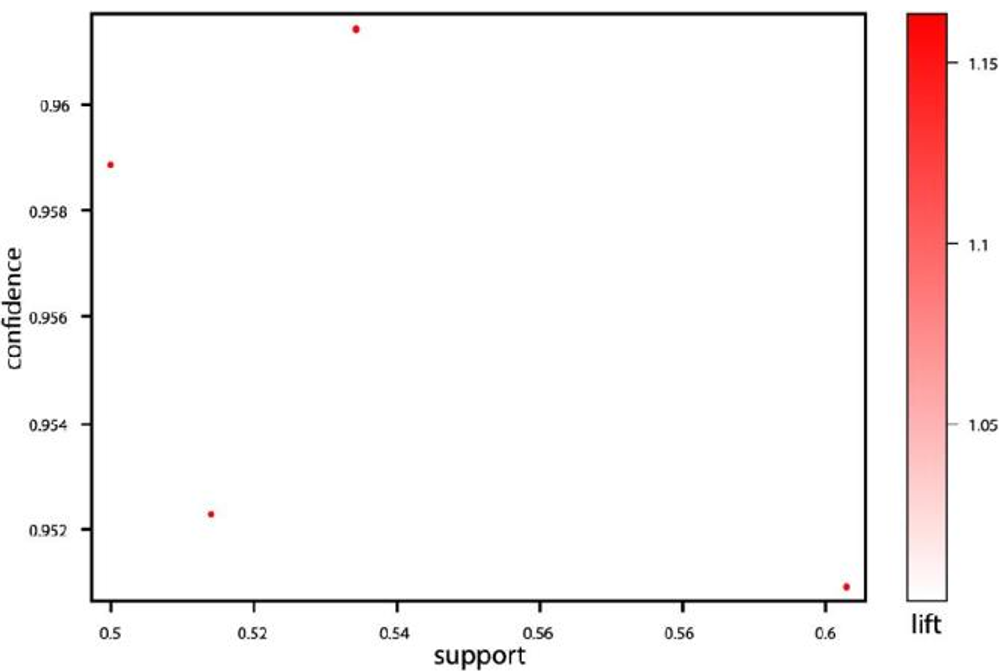
The study revealed four "Golden Rules" for student success. A major highlight is the correlation between early academic excellence (JSC/SSC) and university performance.
| Rule | Antecedent (If) | Consequent (Then) | Confidence |
|---|---|---|---|
| 1 | High JSC and High HSC GPA | High SSC GPA | 96.1% |
| 2 | High JSC GPA and Medium Family Income | Uses Smartphone | 95.1% |
The Scatter Plot below visualizes the distribution of these rules, showing how "Lift" (the strength of the rule) correlates with Support.
The "Digital Distraction" Factor
The data suggests a tipping point:
- Top Students: Average <10 hours/week on social media.
- Average Students: Spend ~20 hours/week on study-related tasks but significantly more on social media.
- Family Impact: Students with mothers who are housewives often performed better, likely due to increased domestic supervision and support.
Critical Analysis & Conclusion
Takeaway
This paper shifts the focus of Educational Data Mining from purely "academic metrics" to "lifestyle metrics." It proves that high-confidence association rules can empower educators to intervene before a student fails.
Limitations
The study acknowledges that the Trimmed-mean function used for missing data might introduce automated biases. Furthermore, the dataset is localized to specific regions in Bangladesh, which may limit the generalizability of certain socio-economic rules to Western contexts.
Future Outlook
The next step for this research is the development of an Intelligent Early Warning System—a real-time dashboard for universities to flag students whose social media usage and study patterns deviate into the "danger zone" identified by the Apriori rules.