
Cracking the LacI Code: A Machine Learning Approach to Protein-DNA Binding
Machine learning study of DNA binding by transcription factors from the LacI family
This study investigates the DNA-binding specificity of 1,372 transcription factors from the LacI family using Naive Bayes and Logistic Regression classifiers. By analyzing 4,484 DNA binding sites, the authors demonstrate that nucleotide patterns at specific site positions can be accurately predicted using only a small subset of key amino acid residues.
TL;DR
Researchers from the Kharkevich Institute have decoded the specific "language" used by the LacI transcription factor family to recognize DNA. By applying Naive Bayes and Logistic Regression to thousands of protein-site pairs, they discovered that binding specificity isn't a chaotic mess; instead, it's governed by a handful of "key" amino acid positions (often just 1 to 3) that act as the primary drivers for DNA recognition.
Background: The Elusive Recognition Code
For decades, biologists have searched for a "Rosetta Stone" for DNA-protein interactions. While we have high-resolution X-ray structures, a universal code has remained elusive. Interactions are often specific to certain families. This study pivots from looking for a universal rule to meticulously mapping the rules within a single, large family: LacI.
The Challenge of "Biological Noise"
One major hurdle in genomic ML is phylogenetic bias. Closely related proteins have nearly identical sequences, which can lead to artificial inflation of accuracy if the training and test sets are too similar.
- The Solution: The authors used a cluster-based 10-fold cross-validation, ensuring that similar protein sequences were never split between training and testing.
- Weighting: They applied the Gerstein-Sonhammer-Chotia algorithm to down-weight overrepresented motifs, ensuring the model learned general features rather than just memorizing common sequences.
Methodology: Feature Selection as a Discovery Tool
The core of the paper lies in Feature Selection. If you have 87 positions in a protein alignment, which ones actually "talk" to the DNA?
- Mutual Information (MI): A fast statistical way to see if knowing an amino acid at position X reduces uncertainty about a nucleotide at position Y.
- Greedy Forward Selection: A more intensive approach where the algorithm starts with zero features and keeps adding the one that improves the model's prediction the most.
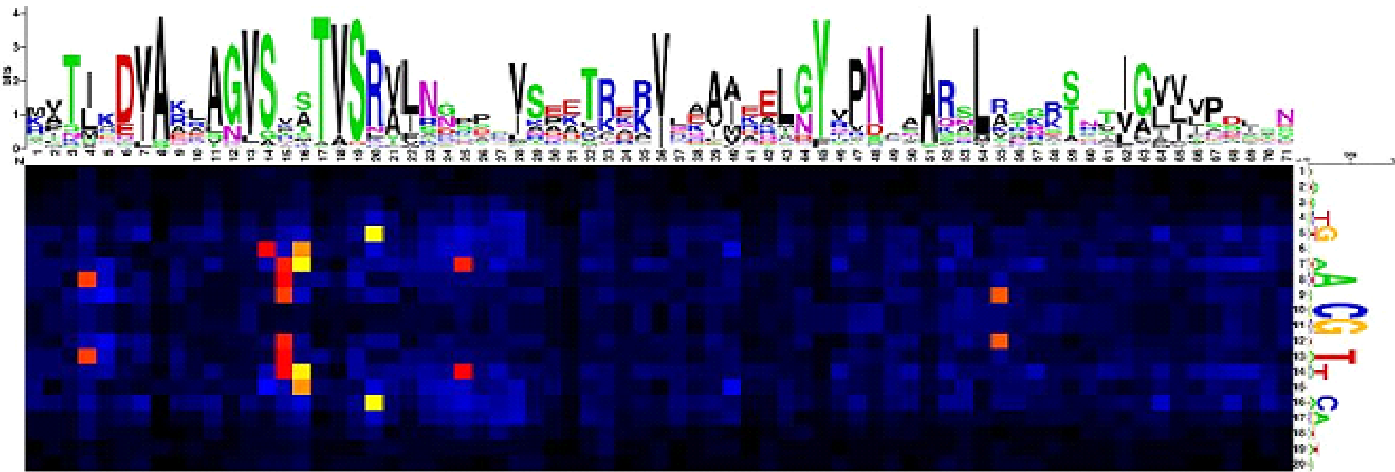 Figure 1: Heat map showing the mutual information between amino acid positions (horizontal) and DNA site positions (vertical).
Key Results: Less is More
The most striking finding was the Overfitting Curve. As the models added more amino acid positions to their input, the prediction quality (log-likelihood) initially spiked and then plummeted.
Case Study: Site Position 9
For DNA position 9, the models reached peak performance using exactly three amino acid positions: 55, 15, and 5.
- Naive Bayes and Logistic Regression both converged on these same positions.
- Adding a 4th or 5th position introduced noise, proving that the biological signal is highly concentrated.
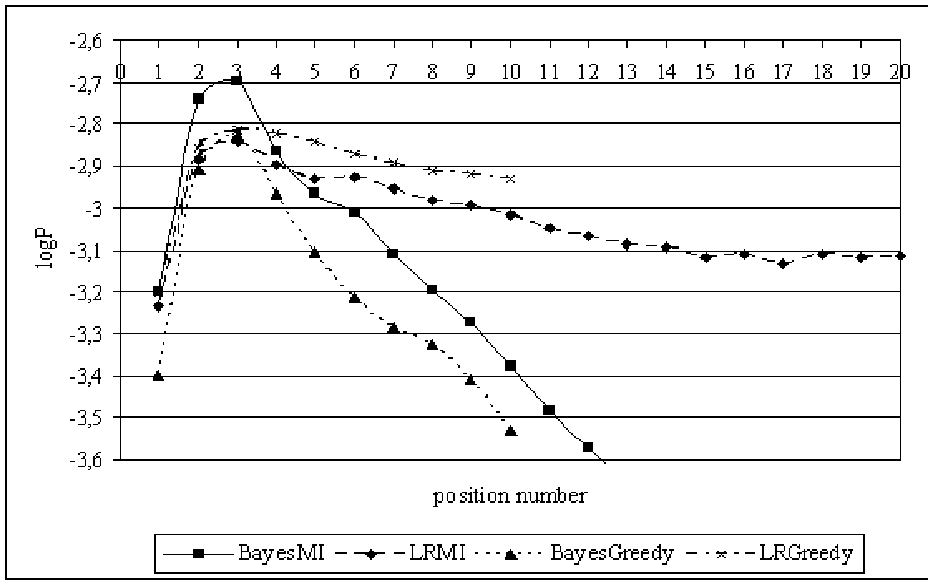 Figure 2: Peak accuracy is reached early (at 3 positions) before the model begins to overfit to the training data.
The Stability of the Code
The authors checked the "stability" of these selections. Across different random splits of the data, the same positions kept popping up. For example, for DNA position 5, amino acid position 20 was selected 100% of the time. This consistency serves as a "computational proof" of a physical contact in the protein-DNA complex.
Critical Insight: Why This Matters
This research demonstrates that we don't always need "Black Box" deep learning to solve genomic mysteries. By using interpretable models like Logistic Regression and Naive Bayes, the authors didn't just predict if a protein would bind; they identified how it binds.
Takeaway for Future Research:
- The "code" is sparse. We should focus on high-information contact points rather than whole-sequence embeddings.
- The methodology facilitates "Sanity Checks" against known X-ray structures, bridging the gap between bioinformatics and structural biology.
Limitations
The study notes that SVMs (Support Vector Machines) performed poorly, likely due to the linear kernels used and data sparseness. Future work might benefit from non-linear kernels or larger datasets from different transcription factor families to see if these sparse "key positions" are a universal feature of bacterial regulation.