
Intelligent WiFi Troubleshooting: Turning Commodity APs into Expert Diagnosticians
On the Employment of Machine Learning Techniques for Troubleshooting WiFi Networks
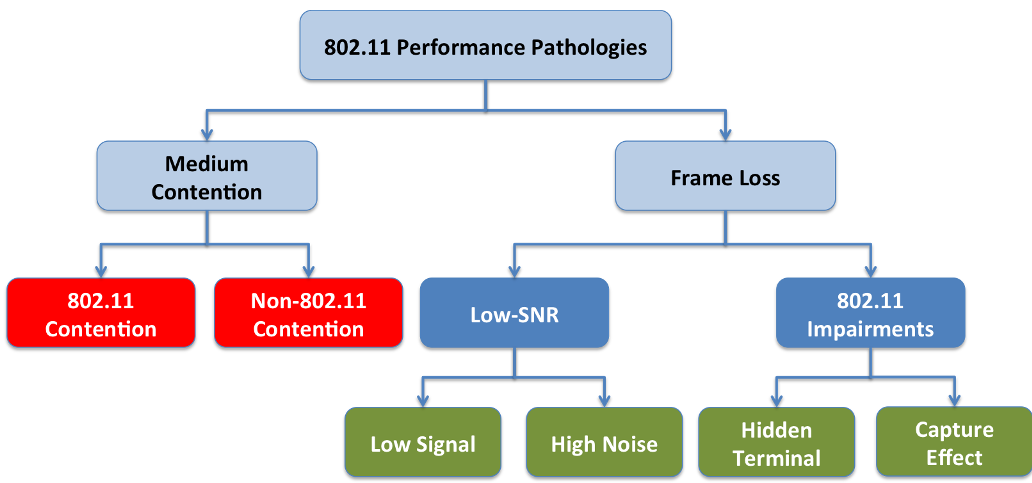
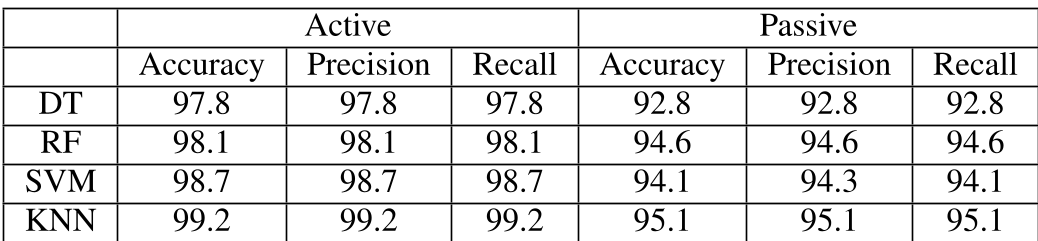
This paper presents an intelligent diagnostic framework for WiFi networks that uses MAC-layer metrics (NCA and FDR) and machine learning to identify five common pathologies: 802.11 Contention, Non-802.11 Interference, Low SNR, Hidden Terminal, and Capture Effect. By fine-tuning classification algorithms like K-Nearest Neighbors (KNN), the authors achieve up to 99.2% accuracy in active probing and 95.1% in low-overhead passive monitoring.
TL;DR
WiFi underperformance is a source of frustration for millions, yet diagnosing the root cause—be it a microwave oven, a hidden terminal, or simple congestion—usually requires an expert. This paper introduces a machine-learning-based framework that enables standard Access Points (APs) to self-diagnose five major WiFi "pathologies." By monitoring MAC-layer metrics, the solution achieves near-perfect diagnostic accuracy (99.2%) with active probing and high performance (95.1%) even in a "passive" mode that adds zero network overhead.
The "Black Box" of Wireless Performance
Why is your WiFi slow? For home users, the wireless medium is a black box. A drop in speed could be caused by:
- Contention: Too many neighbors on the same channel.
- Non-802.11 Interference: Your microwave oven or a wireless camera is "jamming" the frequency.
- Hidden Terminals: Two devices can't see each other but both talk to the AP simultaneously, causing collisions.
- Capture Effect: A dominant signal drowning out a weaker one.
Current troubleshooting often relies on high-level metrics like "signal bars," which are notoriously misleading. Professional tools require expensive sniffers or intensive "active" tests that slow down the network further.
The Core Insight: NCA and FDR
The researchers identified two fundamental levers of 802.11 performance:
- Channel Access Availability: Can the device even get a turn to speak?
- Frame Delivery Efficiency: When it speaks, does the message get through?
They formalized these into two key metrics: Normalized Channel Accesses (NCA) and Frame Delivery Ratio (FDR). By looking at how these metrics change across different Modulation and Coding Schemes (MCS), the framework can "fingerprint" a problem. For example, in a "Low SNR" scenario, both NCA and FDR drop as the system struggles with retransmissions; in 802.11 Contention, FDR stays high (transmission is successful), but NCA drops (the device is waiting for a clear channel).
Methodology: Active vs. Passive Detection
The paper introduces two ways to gather these fingerprints:
- Active Probing: This involves sending "packet trains" at various speeds to see where the link breaks. It is incredibly accurate but creates temporary congestion.
- Passive Monitoring: This is the "secret sauce." It taps into the Minstrel rate control algorithm already running in the WiFi driver. Since Minstrel naturally probes different speeds to find the best throughput, the framework simply "listens" to these statistics, diagnosing the network without sending a single extra bit of data.
Results: KNN Takes the Crown
The authors tested four classic Machine Learning models: Decision Trees, Random Forests, SVMs, and K-Nearest Neighbors (KNN).
After fine-tuning the hyperparameters (using 5-fold cross-validation to prevent overfitting), KNN emerged as the winner.
Key takeaways from the experiments:
- Active Accuracy: 99.2% — Virtually perfect detection across all five pathologies.
- Passive Accuracy: 95.1% — Sufficient for most real-world automated troubleshooting.
- Confusion Matrix Insight: The only minor "confusion" occurred between Hidden Terminal and Capture Effect. This makes sense as they are physical cousins (both involve collisions due to visibility issues).
Future Outlook: Toward Self-Healing Networks
This work demonstrates that complex RF troubleshooting doesn't require complex hardware. By implementing these ML models directly on OpenWrt-based routers, we move closer to "Self-Healing WiFi."
Limitations & Next Steps
Currently, the model assumes only one pathology is happening at a time. The authors note that the next frontier is multi-label classification, allowing the system to say, "You have 30% low signal AND 70% microwave interference." This level of granular insight would allow routers to make real-time decisions, such as switching channels or adjusting transmission power, to maintain optimal performance.
Summary by Senior Academic Tech Editor. Source: Syrigos et al., University of Thessaly.