
Beyond the Text Box: How Children Navigate the Real-World Chaos of Machine Translation
Machine Translation Usage in a Children’s Workshop
This paper presents an ethnographic study of "KISSY," a multilingual workshop where children (ages 8-14) use Machine Translation (MT) to collaborate on clay animation projects. The study identifies how participants navigate MT failures, particularly focusing on the challenges faced by low-resource language users (Khmer).
TL;DR
Researchers conducted a field study at the Kyoto Intercultural Summer School of Youth (KISSY) to see how children from Japan, Korea, and Cambodia collaborate using Machine Translation (MT). They found that while MT often fails—especially for low-resource languages like Khmer—users spontaneously build a "multimodal" communication bridge using gestures, image searches, and human intervention to keep the project alive.
The "Laboratory vs. Reality" Gap
Most MT research happens in controlled environments focusing on BLEU scores and linguistic accuracy. However, in a face-to-face workshop where kids are building clay animations, a mistranslation isn't just a linguistic error; it's a "collaboration blocker." The authors argue that we must understand the human side of error recovery—how do 10-year-olds react when the screen shows them gibberish?
Methodology: The KISSY Workshop
The study observed two teams using the KISSY Tool, a specialized web application powered by the Language Grid.
- Participants: Mixture of Japanese, Korean, and Cambodian children.
- The Task: Collaborative clay animation (scenario, modeling, and filming).
- The Challenge: The Khmer-to-Japanese/Korean translation quality was significantly lower than English-based pairs, creating an asymmetric participation environment.
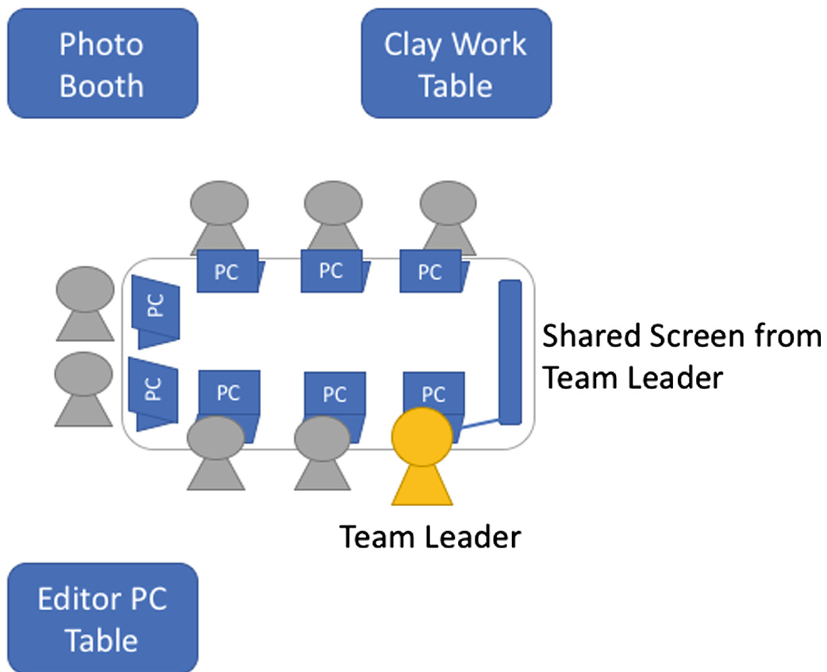 Figure: The workspace layout where children balance physical clay work with digital MT chat interfaces.
Key Findings: The Coping Taxonomy
The researchers observed three distinct strategies used by children to survive MT failures:
1. Alternative Channels and Gestures
When the MT tool outputted nonsensical phrases, children instinctively turned to physical cues. If a team leader’s instruction was mangled in translation, they would switch to pointing at the shared screen or using "common" words like "Okay" or "Sushi" that transcend the MT interface.
2. The Cultural Context Bridge
Language is more than words; it's shared culture. When a Japanese child described a clay block as "Anko" (red bean paste), the Cambodian child was lost because the translation was "something made by Japanese."
- The Solution: Use a web browser to show pictures. Seeing a photo of the food provided immediate clarity where 100 sentences of text might have failed.
3. Exploiting "Pivot" Languages
A fascinating observation was how staff supported Cambodian children. Because Khmer-Japanese translation was poor, staff would switch the interface to English, read the more accurate English translation, and then manually explain it in Khmer. This "Self-Pivoting" shows that even imperfect second-language skills can act as a "sanity check" for MT.
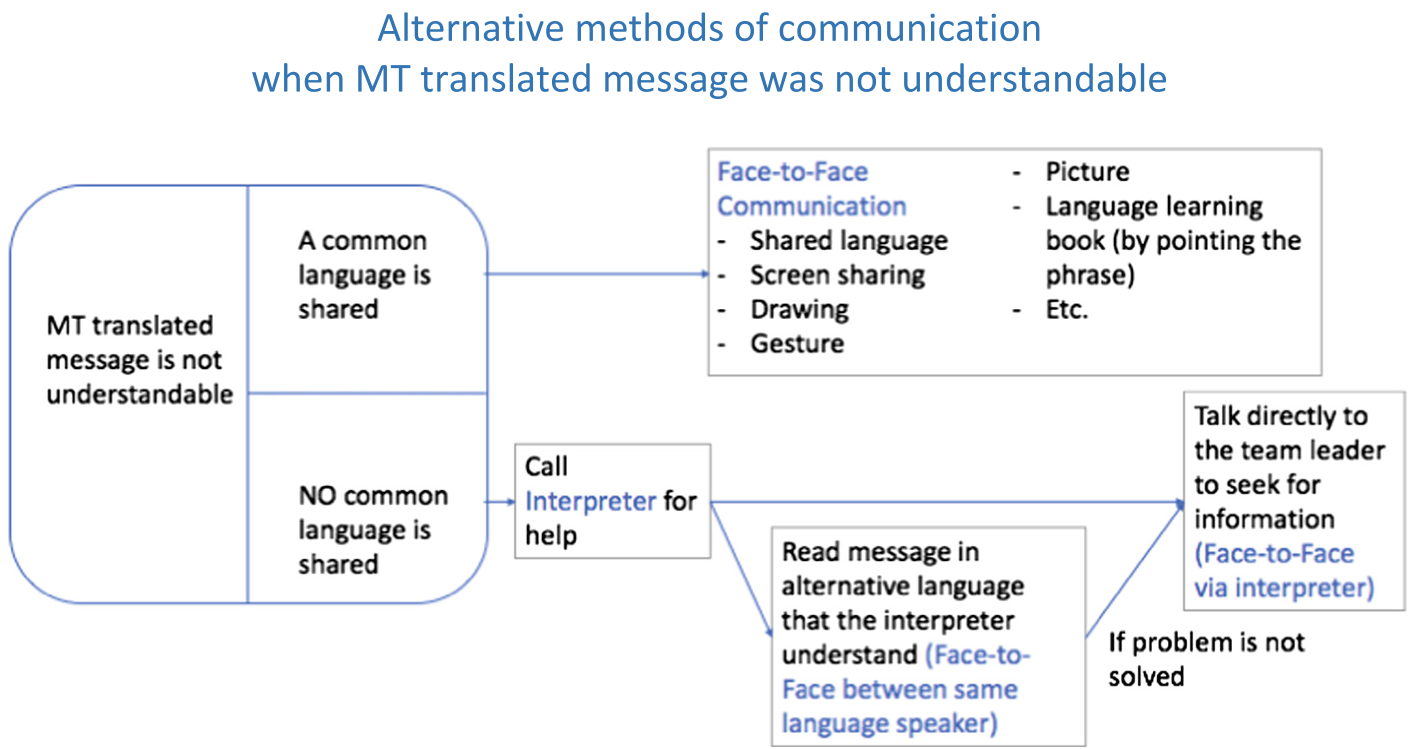 Figure: The structural flow of how users transition from MT to human-mediated communication.
Deep Insights: The "Low-Resource" Tax
The study highlights a hard truth: Participation Inequality. Cambodian children (low-resource language users) faced a higher "translation tax." They were forced to wait longer for human interpreters and often felt shy asking for help when the MT was incomprehensible. This suggests that "Universal Translation" is currently a myth for minority languages, leading to social exclusion in collaborative tasks.
Future Design Implications
The authors propose a "Methodology Shift" for MT tools:
- Image Browser Integration: Stop treating translation as text-only. Embed image searches directly in the chat to clarify cultural objects.
- Parallel Translation Display: Show translations in the primary and a secondary (high-resource) language simultaneously to allow for cross-verification.
- Interpreter Call via Latency Monitoring: If a user is inactive for too long (potentially due to a translation block), the system should automatically alert a human facilitator.
Conclusion
This ethnographic work reminds us that in the real world, Machine Translation is just one tool in a larger communication toolbox. For AI to truly facilitate collaboration, it needs to understand the context of the physical environment and the limitations of its own linguistic models.
Takeaway for Researchers: When designing for multilingualism, don't just fix the model; fix the interface to allow for human backup and multimodal fallback.