
Hybrid Hydro-Intelligence: Bridging the Gap Between Neural Networks and Numerical Fluid Models
Machining of ZrO2 ceramics with PCD and CBN cutting tools
This research collection from Szent István University presents a new hybrid modeling paradigm for groundwater systems by explicitly combining numerical finite difference methods with Artificial Neural Networks (ANN). The approach leverages ANN's site-specific predictive accuracy to effectively constrain and "correct" physical-based numerical models, addressing long-standing issues of parameter uncertainty.
TL;DR
Researchers at Szent István University and the University of Arizona have developed a hybrid paradigm that integrates the "learning" power of Artificial Neural Networks (ANN) with the physical rigor of numerical groundwater flow models. By treating ANN predictions as constraints in a finite-difference matrix, they achieved an 82% reduction in prediction error for complex aquifer simulations.
Background Positioning
In the landscape of hydrological modeling, we usually see a binary choice: Numerical Models (grounded in Darcy’s Law but plagued by uncertain parameters like transmissivity) or Empirical Models (ANNs that are highly accurate at specific wells but lack spatial "physics" between wells). This work is a "theoretical bridge," creating an overdetermined system where AI-derived state variables act as anchors for physical equations.
Problem & Motivation: The Transmissivity Trap
The central nightmare for groundwater engineers is parameter uncertainty. Transmissivity—how easily water moves through an aquifer—can vary by an order of magnitude over just a few meters.
- The Problem: Numerical models require these "guessed" parameters for every single cell in a grid.
- The Paradox: ANNs can predict water levels (heads) at monitoring wells with 4-5x better accuracy than numerical models, but they can't tell you what's happening between the wells.
The authors' intuition was simple: Why not use the ANN's superior "well-side" accuracy to force the numerical model's "grid-side" physics into alignment?
Methodology - The Core
The paper formalizes the problem by modifying the standard matrix equation of flow: where is the matrix of aquifer properties, is the vector of unknown heads, and represents boundary conditions.
The Re-Equilibration Strategy
- Generate ANN Anchors: Run ANNs for specific monitoring locations to get highly accurate "known" values ().
- Overdetermine the System: Append these equations to the original physical equations.
- Optimization: Use a weighted Least Squares approach (Method 2) to ensure the physical grid "equilibrates" toward the high-accuracy ANN points without distorting the global hydraulic gradient.
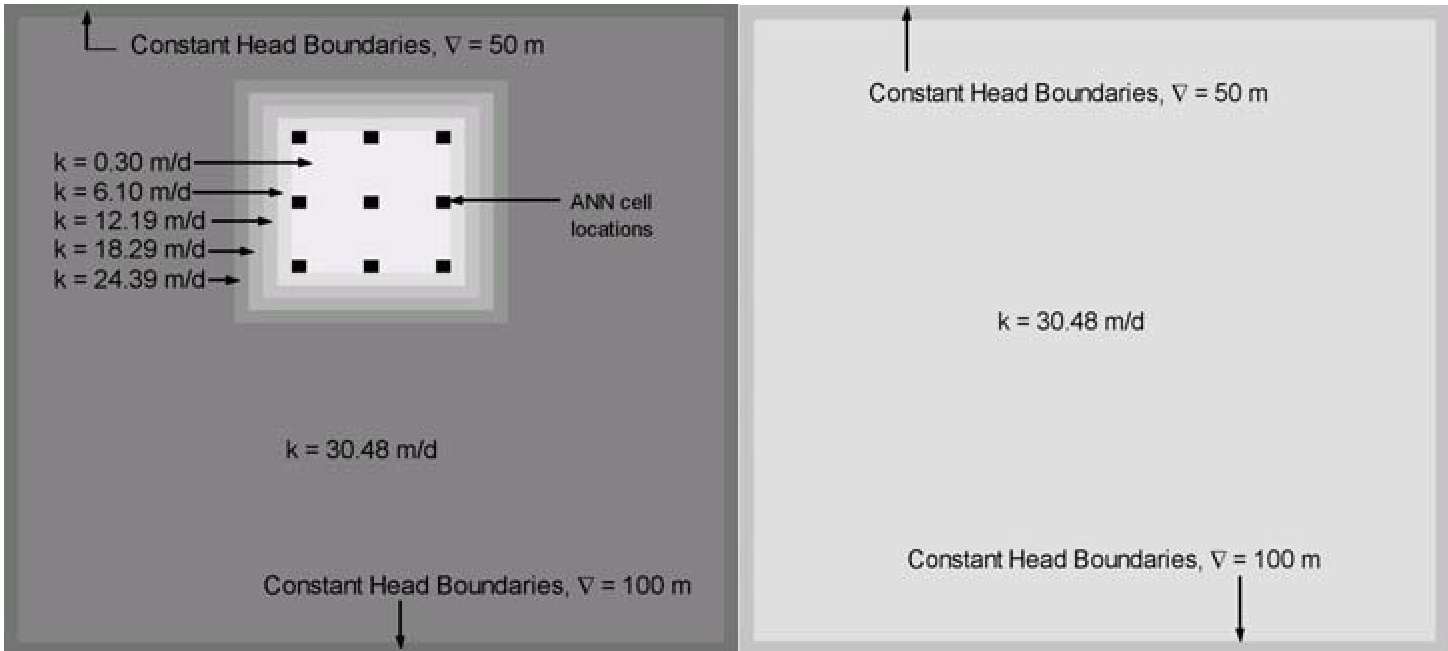 Figure 1: The "Twin Model" approach uses a heterogeneous hydraulic conductivity field (Model R) as the "real" world and a simplified homogeneous field (Model S) to test the hybrid correction.
Experiments & Results
The team tested this on a 51x51 grid. They biased nine ANN locations toward regions of high subsurface complexity to see if the hybrid model could "pull" the inaccurate homogeneous model back toward reality.
Performance Comparison
| Scenario | Mean Absolute Error (m) | Max Error (m) |
|---|---|---|
| Standard Numerical | 0.22 | 0.43 |
| Hybrid (ANN Error = 0.2) | 0.04 | 0.10 |
| Hybrid (ANN Error = 0.6) | 0.21 | 0.37 |
Key Finding: The accuracy is non-linear. As shown in the table below, if the ANN is very accurate (error ratio 0.2), the hybrid model is revolutionary. However, if the ANN is only slightly better than the numerical model (error ratio 0.8), the hybrid system actually performs worse because it introduces conflicting constraints that the physics cannot satisfy.
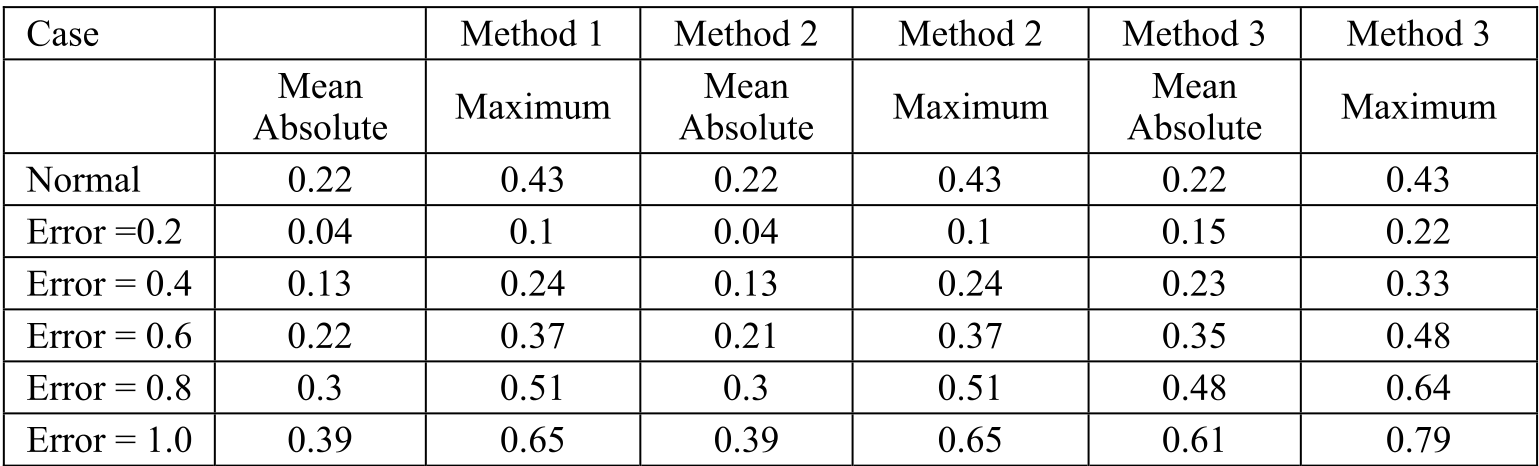 Figure 2: Comparative performance of least squares vs. linear programming methods at varying ANN error thresholds.
Critical Analysis & Conclusion
Takeaway
The research confirms that an overdetermined system can preserve the physical structure of a hydraulic surface while incorporating discrete high-accuracy data. It essentially provides a mathematical way to perform "real-time correction" of static models.
Limitations
The primary risk is the Error Threshold. The authors discovered that if the ANN predictions have an error ratio above 0.5 (relative to the numerical model), the global solution degrades. This implies that a hybrid model is only as strong as its most accurate "anchor." Furthermore, this study primarily focused on steady-state flow; transient (time-varying) systems will require significantly more complex cross-correlation of time scales.
Future Outlook
This paves the way for "Smart Watersheds" where monitoring networks aren't just for logging data, but are designed to optimize the convergence of massive, otherwise-unreliable numerical simulations.