
HiPIMS: Re-engineering Iron Nitride Thin Films for Superior Soft Magnetism
Study of magnetic iron nitride thin films deposited by high power impulse magnetron sputtering
This study investigates the deposition of magnetic iron nitride (Fe-N) thin films using High Power Impulse Magnetron Sputtering (HiPIMS) compared to direct current magnetron sputtering (dc-MS). The research demonstrates that HiPIMS produces films with a unique globular nanocrystalline microstructure and superior soft magnetic properties (lower coercivity) by leveraging highly ionized plasma conditions.
TL;DR
This research explores the application of High Power Impulse Magnetron Sputtering (HiPIMS) to the fabrication of iron-nitride (Fe-N) magnetic thin films. By comparing it to conventional dc-MS, the authors demonstrate that HiPIMS effectively "slows down" nitrogen reactivity through gas-rarefaction, resulting in a globular nanocrystalline microstructure and significantly improved soft magnetic properties (lower coercivity).
Problem & Motivation: The Sputtering Bottleneck
Magnetic nitrides, particularly Fe-N compounds, are crucial for tribological coatings and magnetic storage devices. However, using standard direct current magnetron sputtering (dc-MS) often leads to:
- Columnar Microstructures: These can introduce unwanted anisotropy and defects.
- High Coercivity: Nitrogen incorporation often triggers a sharp increase in coercivity (), ruining the "soft" magnetic behavior needed for efficient switching.
- Stress and Defects: Conventional sputtering adatoms lack the mobility to form dense, low-defect lattices.
The authors hypothesized that the unique plasma environment of HiPIMS—boasting a plasma density two orders of magnitude higher than dc-MS—could solve these issues.
Methodology: Harnessing Ionized Flux
The experimental setup used a pure Fe target in an atmosphere. The core difference lies in the power delivery:
- dc-MS: Continuous 100W power.
- HiPIMS: High peak power (33.3 kW) delivered in short pulses (), creating a highly ionized flux of metal ions.
The "Gas-Rarefaction" Insight
A pivotal discovery in this work is that even at the same nitrogen partial pressure (), HiPIMS films contained less nitrogen than dc-MS films. This is attributed to gas-rarefaction: the high momentary temperature near the target during a pulse causes the reactive nitrogen gas to expand and move away, reducing the volume of gas available for reaction.
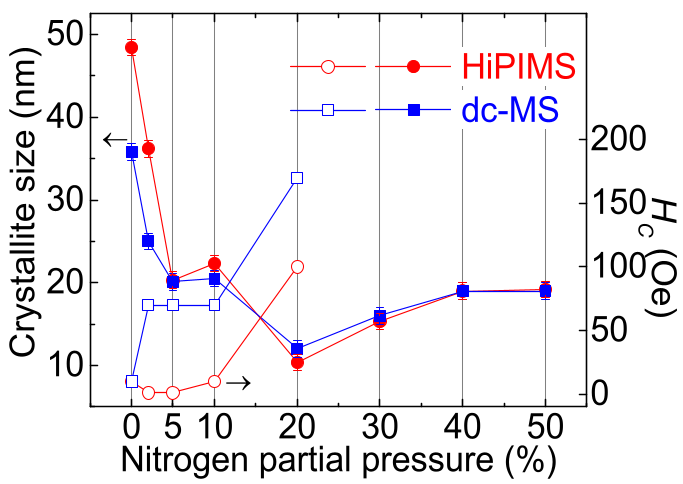 Figure 1: Comparison of crystallite size and coercivity between HiPIMS and dc-MS.
Results: Soft Magnetism and Microstructure
The experimental results provided clear evidence of HiPIMS's superiority:
1. Superior Magnetic Softness
As shown in the M-H loops, pure Fe films start at Oe. When nitrogen is added:
- dc-MS: jumps immediately to 70 Oe.
- HiPIMS: remains negligible or stays near 10 Oe for nitrogen pressures up to 10%. This indicates that HiPIMS films are significantly "softer," which is essential for magnetic sensors and heads.
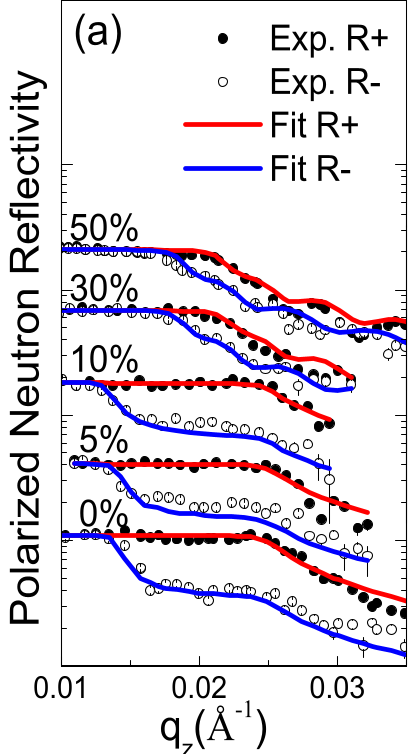 Figure 2: M-H loops showing the delayed increase in coercivity for HiPIMS samples.
2. From Columns to Gloves
AFM imaging revealed that while dc-MS produces standard columnar growth, the highly ionized flux in HiPIMS increases adatom mobility. This causes repeated nucleation, leading to a globular nanocrystalline microstructure that is denser and more uniform.
3. Nitrogen Concentration
Using SIMS and X-ray Absorption Spectroscopy (SXAS), the authors quantified that nitrogen incorporation is consistently lower in HiPIMS. This "impeded reactivity" allows for finer control over the phase transition from to the various nitride phases ().
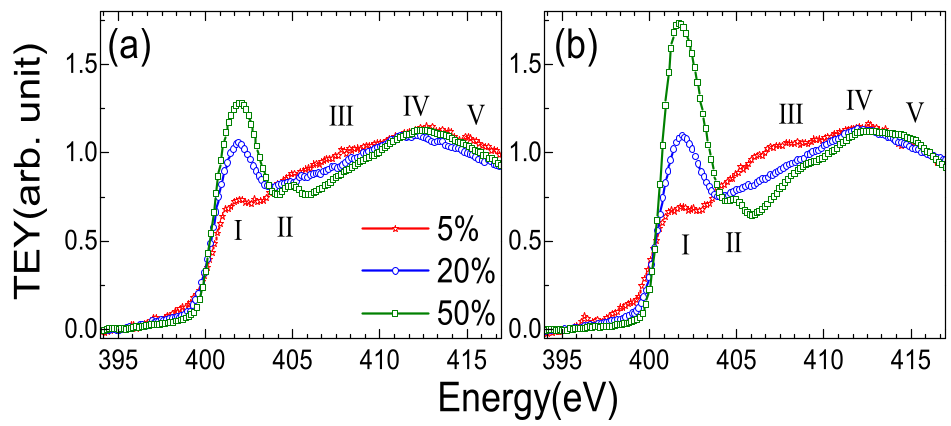 Figure 3: SXAS data confirming lower nitrogen concentration in HiPIMS samples compared to dc-MS.
Critical Analysis & Conclusion
Takeaway: This work proves that HiPIMS is not just for hard coatings (like TiN) but is a game-changer for magnetic materials. By leveraging gas-rarefaction and high ion energy, researchers can produce Fe-N films that are denser, softer, and more structurally uniform.
Limitations: While the paper explains that nitrogen reactivity is reduced, more study is needed to decouple the effects of ion bombardment energy versus the gas-rarefaction temperature gradient.
Future Outlook: The ability to maintain soft magnetic properties while incorporating nitrogen opens doors for developing high-saturation, corrosion-resistant magnetic layers for next-generation Spintronics and high-frequency electronics.