
Mailbook: Repurposing Email as a Privacy Shield for Social Media
Mailbook: privacy-protecting social networking via email
This paper introduces Mailbook, a decentralized P2P social networking architecture that leverages free email services and OpenDHT to ensure user privacy. By integrating a (k, n) threshold dispersal algorithm with encrypted email storage (ES2), the system achieves robust data availability and privacy without relying on untrusted central service providers.
TL;DR
Mailbook is a decentralized P2P social network that eliminates the "Big Brother" central server by fragmenting and encrypting user data across multiple free email services. By combining OpenDHT for discovery and a (k, n) threshold dispersal algorithm for storage, it achieves high data availability even when peers are offline, all while keeping private data out of the hands of untrusted providers.
The Motivation: The "Big Brother" Paradox
In the era of Facebook and MySpace (the context of this work), users face a fundamental trade-off: social connectivity in exchange for total surveillance. Traditional OSNs are centralized; even if they anonymize data, skilled attackers can re-identify users.
Previous P2P social networks (like PeerSoN or Safebook) tried to solve this but stumbled on three critical hurdles:
- The Availability Dilemma: If a friend is offline, their profile data is often inaccessible.
- The Storage Burden: Expecting mobile or home users to host large volumes of encrypted data is unrealistic.
- The Bootstrapping Problem: Finding friends in a decentralized web without a central directory is difficult.
The authors of Mailbook ask a clever question: What if we use the world's most reliable, free, and ubiquitous decentralized infrastructure—Email—as our storage backbone?
Methodology: The Architecture of Mailbook
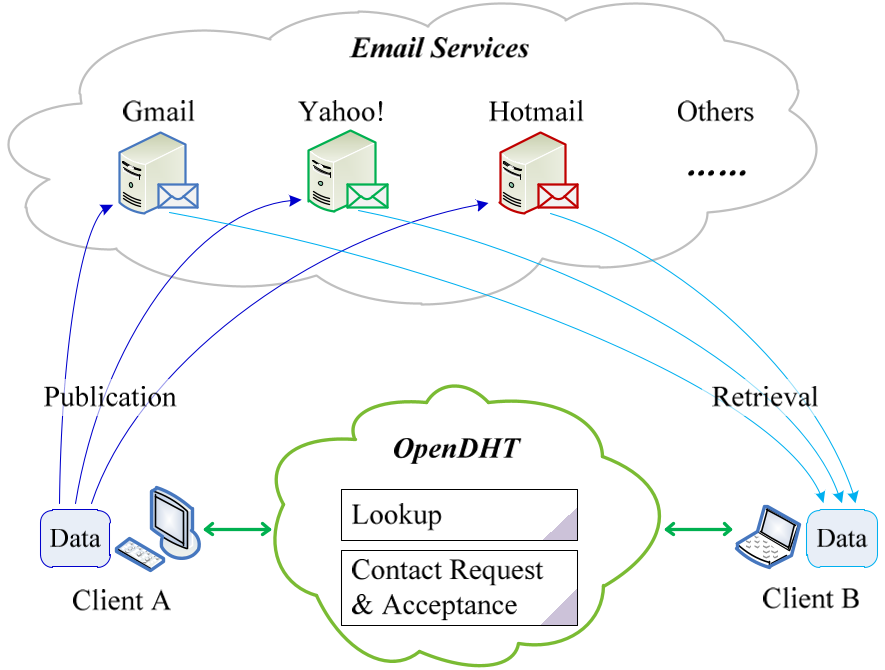
Mailbook's innovation lies in its Email-based Storage Service (ES2). Instead of storing a photo or a post on a friend's hard drive, the system treats email accounts as "dispersed storage nodes."
1. Data Dispersal Logic
To prevent any single email provider (like Google or Yahoo) from seeing the user's data, Mailbook employs a (k, n) threshold scheme.
- A data unit is encrypted (AES).
- It is fragmented into n codewords (e.g., 6).
- The shards are sent as attachments to different email services.
- Only k shards (e.g., 3) are needed to reconstruct the original data.
2. Identity and Discovery via OpenDHT
Mailbook uses OpenDHT for "handshaking." Users register a hashed version of their email as an ID. When Alice wants to add Bob, she sends a contact request through the DHT. They then exchange public keys and the login info for the "storage" email accounts they've set up.
3. The Math of Security
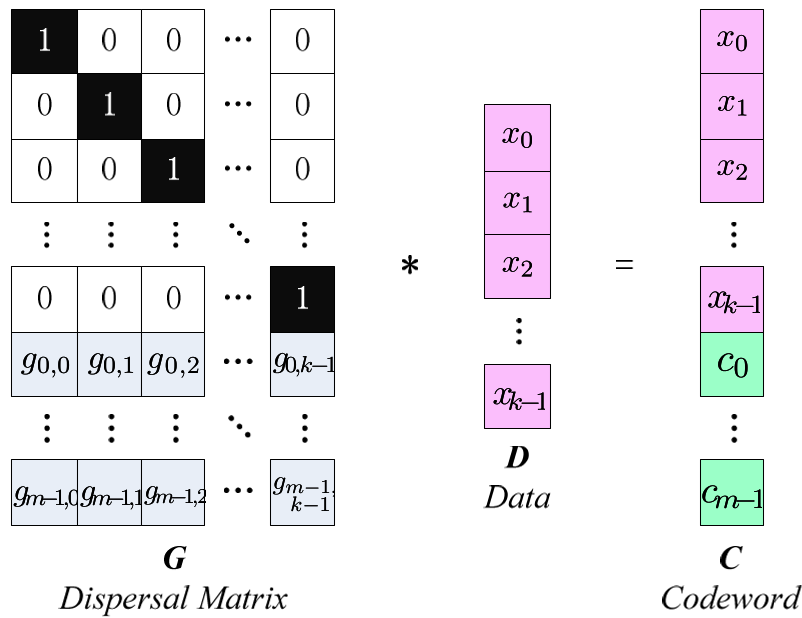
The system uses a dispersal matrix derived from the Vandermonde matrix over . This ensures that as long as a subset of email services is accessible, the user's social life remains online.
Experiments & Results
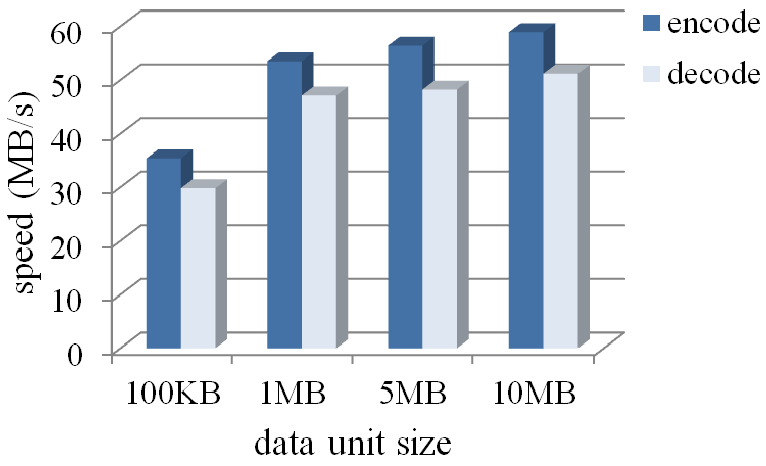
The researchers evaluated Mailbook on a standard dual-core platform to simulate a mobile user's experience.
- Computational Efficiency: The encoding/decoding speed averaged 50MB/s. This means even a large 10MB photo album can be processed in under 0.2 seconds—negligible overhead for the user.
- Latency: The "bottleneck" isn't the complex math or the email servers; it’s simply the user's own upload/download speed. This proves that repurposing email protocols like POP3/IMAP4 for social data is practically viable.
Critical Insight: Hiding in Plain Sight
The genius of Mailbook is its Inductive Bias toward using existing legacy systems. By treating Email not as a messaging tool, but as a distributed, high-availability database, the authors solved the "offline peer" problem that plagues most P2P networks.
Limitations:
- Vendor Terms: Most email providers have "Fair Use" policies that might be triggered by high-frequency automated attachments.
- Setup Friction: Asking a user to create 3-6 email accounts to "start" a social network remains a high barrier to entry.
Conclusion
Mailbook is a fascinating look at decentralized design. It reminds us that privacy doesn't always require building a new internet from scratch; sometimes, it just requires a clever reconfiguration of the tools we already have.
Takeaway for the Future: As we move toward Web3, the Mailbook philosophy of using "Cloud Diversity" to avoid vendor lock-in remains a gold standard for resilient system design.