
The Minority Rule: How Small Elites Monopolize Social Opinion
Majority vote and monopolies in social networks
The paper investigates the "power of the elite" in social networks through a local majority voting model. By analyzing various real-world datasets (e.g., Facebook, Twitter, Slashdot), the authors identify that a small "rich-club" elite of size (where is the number of edges) can form a monopoly and control the collective decision of the entire network, especially when granted a small influence factor.
TL;DR
Can a tiny group of people control the opinion of an entire nation? According to a study published in ICDCN, the answer is a resounding yes. Using a local majority voting model, researchers found that an elite group—defined as the "rich-club" of high-degree nodes—only needs to be as large as the square root of the total number of connections () to potentially control the majority. By exercising a small amount of extra influence, these elites can effectively "monopolize" the network's final decision.
Background: The Social Influence Loop
We don't form opinions in a vacuum. Before a vote, we talk to friends, family, and colleagues. We are also influenced by "elites"—politicians, celebrities, and publicists. This paper seeks to isolate and measure this social influence. It asks: What is the minimum size of an elite group required to sway 50% of the population to their side?
Methodology: Simulating the Monopoly
The researchers modeled social networks as graphs where nodes update their opinions in rounds based on the majority of their neighbors.
Two critical behaviors were tested:
- Reversible Mode ("Fair Play"): Elite members can be swayed by the majority opinion of their neighbors.
- Irreversible Mode ("Hardline"): The elite never changes its mind; they only exist to influence others.
Additionally, they introduced an Influence Factor (). If a node has an influence factor of 2, its vote counts double during its neighbors' decision-making process.
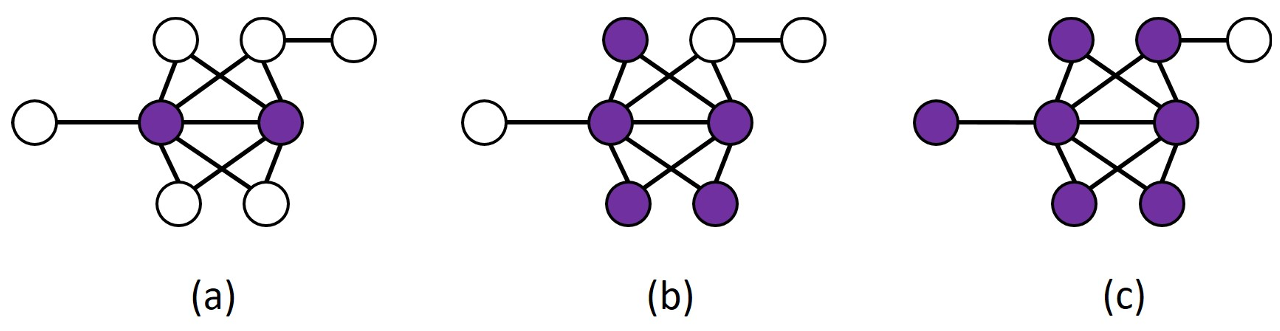 In the figure above, a two-node elite (dark purple) manages to flip the majority of the network through iterative rounds of influence.
Key Insight: The Power of
While one might assume an elite must grow linearly with the population to maintain control, the data suggests otherwise. Across networks like Facebook, Twitter, and Youtube, the required elite size to achieve a monopoly is consistently tied to (the square root of the total edges).
Disproportionate Power
The study highlights that the elite are not just "influential"—they are structurally dominant.
- Low Influence Requirements: For an elite of size , an influence factor between 4 and 8 was enough to win in all tested real-world networks.
- Saturation Point: Interestingly, there is a "point of diminishing returns." After a certain influence level, giving the elite more weight doesn't allow them to shrink their group size any further.
Real Networks vs. Random Models
One of the most profound findings is that real social networks are far more susceptible to elite control than theoretical models like Erdős–Rényi (ER) or Preferential Attachment (PA).
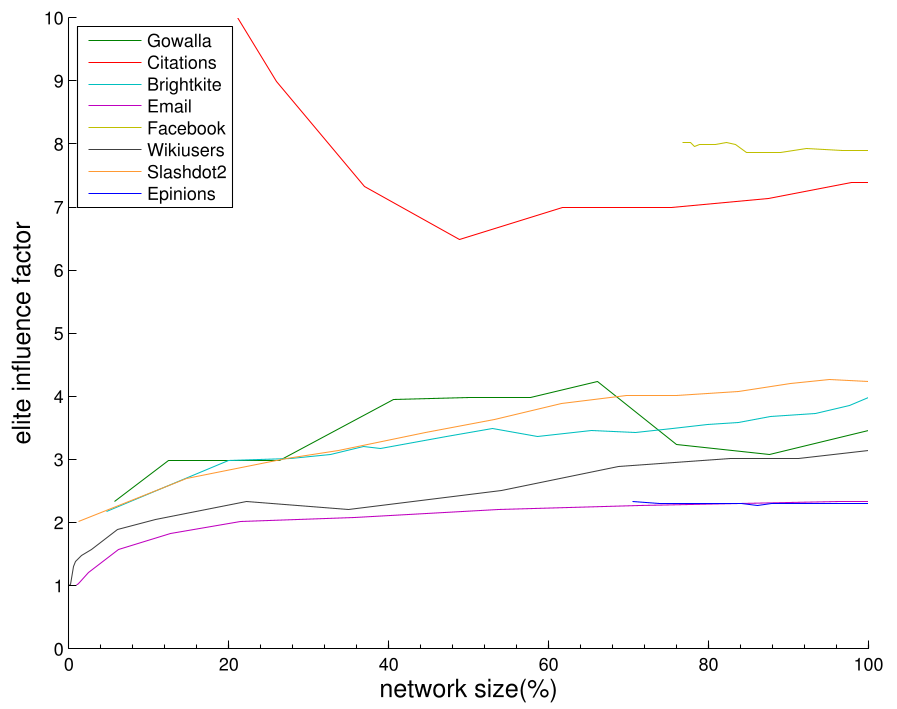 In real networks (shown above), the influence factor required for a elite stays constant over time, meaning as society grows, the elite’s relative power remains stable.
In contrast, in the Erdős–Rényi and PA models, the influence required for a small elite to win grows super-linearly as the network expands. This suggests that the specific "core-periphery" structure of real social networks—where high-degree nodes are densely connected to each other—is what grants elites their enduring power.
Critical Analysis & Conclusion
Takeaway
The study proves that "Majority Illusion" (where a minority appears to be the majority) is not just a fluke but a structural inevitability in well-connected social graphs. The elite's power is rooted in their Stability (they talk to each other) and Influence (they talk to many others).
Limitations
- Binary Opinions: The model uses a simple "Yes/No" system. Real-world opinions are far more nuanced and are rarely updated in perfectly synchronous rounds.
- Selection of Elite: The paper uses the "rich-club" (node degree) as a proxy for elite. While effective, "elite" status in the real world might also involve wealth, media access, or institutional authority not fully captured by graph edges.
Future Outlook
As digital social networks continue to densify, the "cost of control" for elites may actually decrease. Understanding these mathematical thresholds is vital for identifying social vulnerabilities to misinformation and the disproportionate impact of coordinated minoritarian campaigns.