
Make New Friends, but Keep the Old: The Science of Social Recommendations
Make new friends, but keep the old: recommending people on social networking sites
This paper investigates "people recommendation" on social networking sites, evaluating four distinct algorithms in an enterprise environment (IBM's Beehive). The study demonstrates that social network-based methods (like "Friend-of-Friend") excel at re-connecting known offline contacts, while content-based similarity effectively surfaces novel "weak ties."
TL;DR
Connecting with people is fundamentally different from buying a book. This seminal research by Jilin Chen et al. explores how enterprise social networks can use algorithms to balance two goals: helping you find colleagues you already know (maintaining "strong ties") and introducing you to valuable strangers with similar expertise (building "weak ties"). By comparing social-graph methods against content-based matching, the study reveals that while we trust people our friends know, our most "interesting" new connections often come from shared content.
Problem: The "Friending" Friction
In traditional recommender systems, if a movie recommendation is bad, you simply turn it off. In a social network (especially an enterprise one like IBM's Beehive), "friending" involves social risk. Users ask themselves: Will this person think I'm a stalker? Do I have a legitimate reason to reach out?
Existing methods often ignored these social dynamics. This paper addresses the gap by testing how different data sources—social links vs. shared tags—influence a user's willingness to hit that "Connect" button.
Methodology: The Four Contenders
The researchers deployed four distinct flavors of recommendation, each with a specific "logic" or insight:
- Content Matching: "We both talk about Python and AI; we should be friends." (Uses TF-IDF on profile and post text).
- Content-plus-Link (CplusL): "We talk about the same things AND have a mutual acquaintance." (Boosts content scores if a path exists).
- Friend-of-Friend (FoF): The Facebook classic. "3 of your friends are friends with Alice."
- SONAR: The Corporate Crawler. Aggregates org charts, patent databases, and co-authorship records to find "hidden" existing relationships.
Key Insights: Precision vs. Discovery
The results revealed a fascinating trade-off between utility and novelty:
1. The "Trust" of the Social Graph
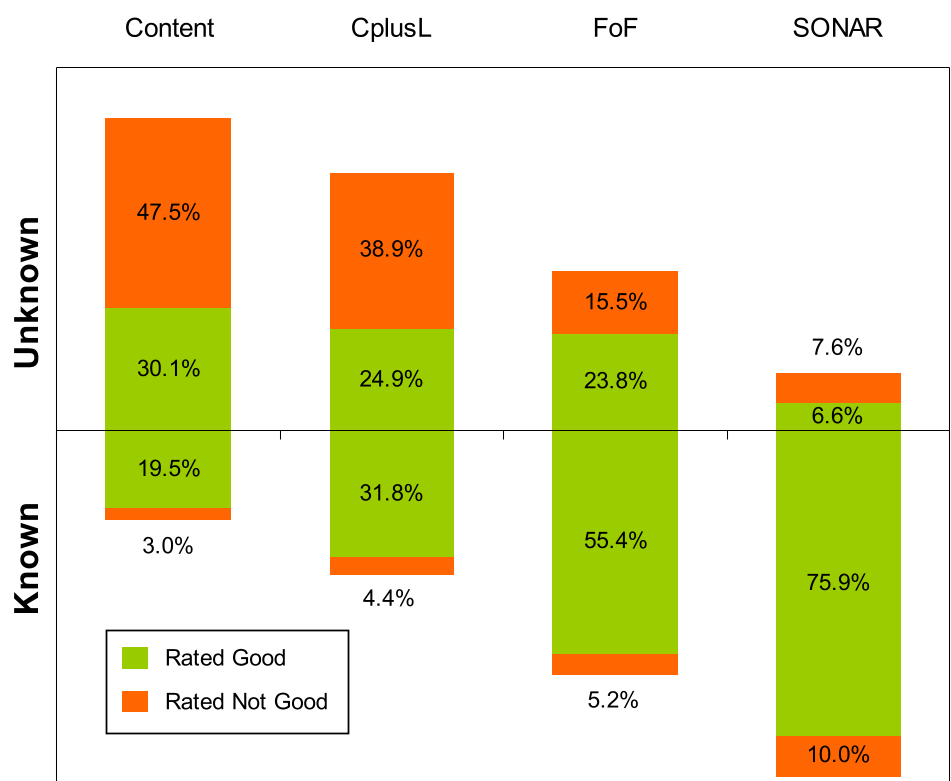
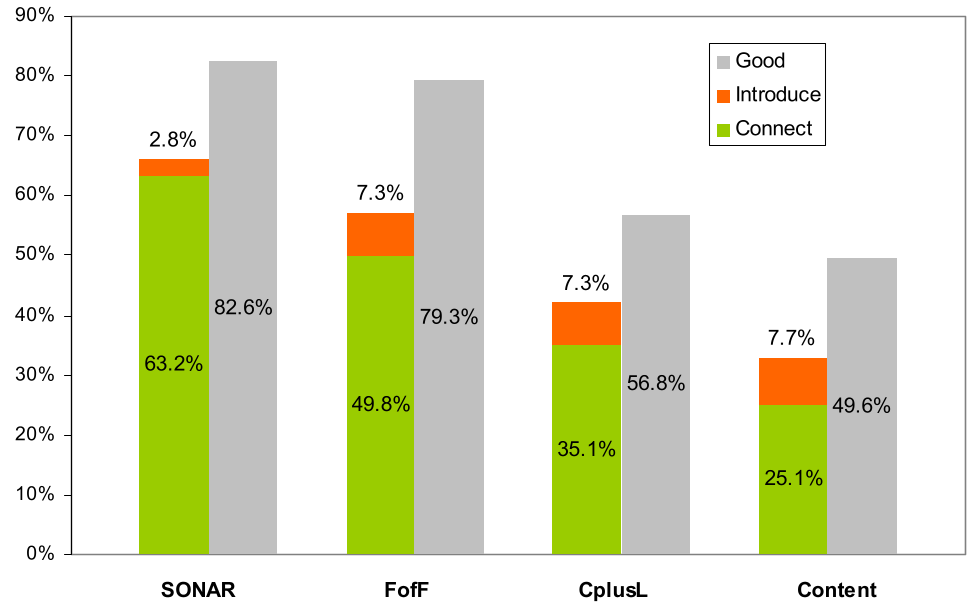
SONAR and FoF were the "precision" winners. Users rated over 80% of SONAR recommendations as "good." Why? Because SONAR was excellent at finding people the user already knew but hadn't added yet. In social networking, "good" often equals "familiar."
2. The "Serendipity" of Content
If the goal is to expand your horizons, Content Matching is king. While it had a lower overall success rate, it produced the highest volume of "Good + Unknown" connections. It helped users discover "weak ties"—people they didn't know but should know based on shared interests.
3. The Power of "Why"
A critical finding was the necessity of explanations. Users were far more likely to connect with a stranger if the system said, "You both have co-authored 2 papers" or "You share interest in Java and HCI." Without a "legitimate reason," the social friction remains too high.
Results & Real-World Impact
The field study of 3,000 users proved that a simple widget can change organizational behavior:
- Network Growth: Users receiving recommendations saw a 13% increase in their friend list compared to the control group.
- Engagement: The presence of the recommender actually increased general site activity (page views) by nearly 14%, suggesting that finding people acts as a "gateway drug" to consuming more content.
Critical Analysis & Future Value
While the paper is a classic in HCI, modern readers should note its focus on enterprise contexts. In a corporate setting, the "Org Chart" is a powerful signal that doesn't exist on public platforms like Twitter or TikTok.
The Takeaway: For product designers, the "Make new friends, but keep the old" proverb is a technical roadmap. Start with Graph-based (FoF) algorithms to satisfy the user's need for familiarity and trust. As the user's network matures, phase in Content-based discovery to prevent the "filter bubble" and encourage the cross-pollination of ideas across the organization.
Future Outlook
The next frontier, hinted at by the authors, is using these people-recommenders as a backbone for Content Recommendation. If the system knows who you should know, it can better filter the overwhelming "firehose" of status updates and documents by prioritizing what your most relevant "weak ties" are reading.