
Making Sense of Meaning: Why Social Context is the Soul of Media Semantics
Making sense of meaning: Leveraging social processes to understand media semantics
This position paper introduces the concept of Emergent Semantics, arguing that media meaning is an evolutionary product of social interaction rather than a static detection task. It leverages large-scale social networks (Flickr, YouTube) to redefine multimedia computing through three pillars: community discovery, information flow, and semantic diversity.
TL;DR
This seminal position paper by Hari Sundaram challenges the multimedia community to stop viewing semantics as a static "detection" problem. Instead, it proposes that meaning is an emergent, evolutionary artifact of human social interaction. By analyzing media-rich social networks, the author demonstrates that communities, information flow, and semantic diversity are the true drivers of how we "understand" images and video.
The "Static Semantics" Fallacy
In traditional multimedia research, the goal is often simplified to finding a function such that . We assume that if we have enough training data, we can "solve" the concept of "Beauty" or "Home."
However, Sundaram points out three fatal flaws in this assumption:
- Semantic Instability: What "Beauty" looked like in 1920 is vastly different from 2024. The relationship between the symbol and the feature vector is not fixed.
- Concept Emergence: New terms (like "pwn" or "vibe") appear, and transient events (like specific festivals) create momentary semantics that didn't exist before.
- Contextual Collapse: A tag like "Yamagata" could refer to a town, a singer, or a painter. Without knowing the social context of the uploader, a universal classifier is bound to fail.
Methodology: From Classifiers to Social Processes
The paper advocates for a transition from "Detectors" to "Social Instrumented Analysis." The core methodology is split into three strategic areas:
1. Community Discovery through "Mutual Awareness"
Instead of just seeing a social network as a graph for dense sub-graph extraction, Sundaram uses Mutual Awareness. A community isn't just a group of people; it’s a group that interacts bi-directionally (comments, trackbacks).
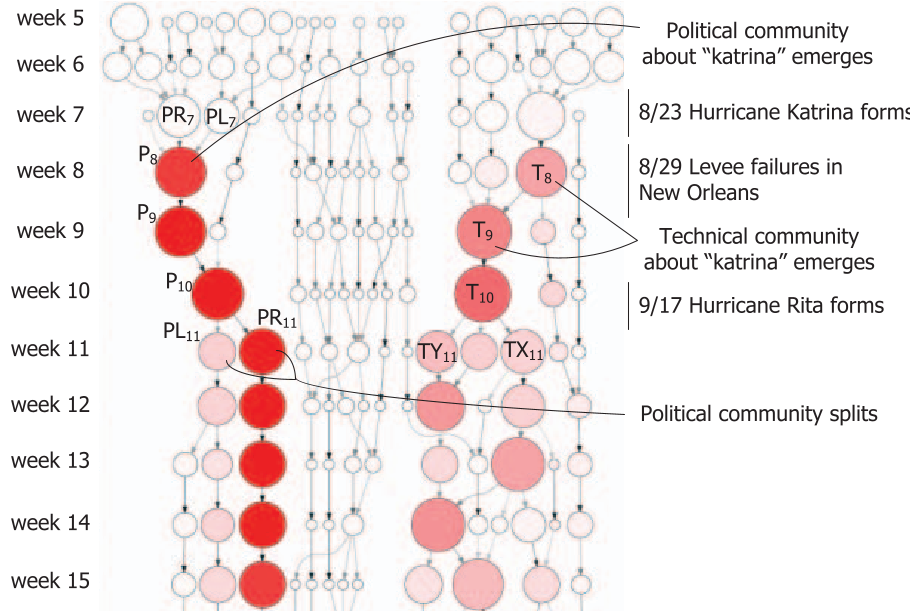 Figure 1: Evolution of communities surrounding the "Katrina" query, showcasing how social groups diverge into political and technological discussions.
2. Information Flow and Validation
How does a message spread? The author analyzes the probability and delay of responses based on network topology and "the strength of weak ties." Crucially, they validated this social data by correlating blog dynamics with stock market activity, proving that social "meaning" has predictive power in the physical world.
3. Solving Semantic Diversity (The Death of the Classifier)
With millions of possible tags, we hit a Power-Law problem: most tags have too few images to train a Support Vector Machine (SVM) or Neural Network.
The Solution? Do away with classifiers. The proposed framework uses:
- Global Knowledge: Low-level visual features.
- Personal Knowledge: How an individual typically tags their photos.
- Social Trust: Finding "neighbors" in the social graph who see the world similarly.
Analysis: Why This Matters Today
While this paper was written in the era of Flickr and early YouTube, its insights are more relevant than ever in the age of Generative AI and Foundation Models. We see the same issues today: models trained on static snapshots of the internet struggle with "hallucinations" because they lack the real-time social context of evolving human language.
The "Emergent Semantics" perspective suggests that we shouldn't just build larger models; we should build models that can listen to the social pulse.
Critical Takeaways
- Semantics is not a state; it’s a process. Meaning evolves through interaction.
- Social Trust is a Filter. In an ocean of diverse data, we rely on people "who typically agree with us" to pin down specific meanings.
- Validation is Key. Numerical metrics of networks are useless unless they correlate with human action (like stock market moves).
Conclusion
Sundaram’s work is a powerful reminder that "Meaning" does not live in the pixels of an image or the bytes of a video. It lives in the space between people. As we move toward more autonomous AI, integrating these social processes will be the difference between a machine that "detects" and a machine that "understands."