
Building Autonomous Societies: A New Blueprint for Secure P2P Collaboration
Making Societies in Peer-to-Peer (P2P) Overlay Networks
The paper proposes a novel framework for "Making Societies" within Peer-to-Peer (P2P) overlay networks using a Role-Based Access Control (RBAC) model. It introduces centralized and distributed coordination schemes to manage secure object sharing and member autonomy through the mapping of local roles to abstract society roles.
TL;DR
In the landscape of P2P overlay networks, the transition from simple file-sharing to complex collaboration requires a robust social structure. This paper introduces a framework for organizing "Societies"—logical groups of peers that share resources securely using Role-Based Access Control (RBAC). By decoupling local objects from society roles, the authors provide a mechanism for peers to join, leave, and collaborate through both centralized and distributed coordination.
Problem & Motivation: The Centralization Paradox
Peer-to-Peer (P2P) networks are designed to be decentralized, yet most social applications (SNS) built upon them still rely on centralized coordinators to manage who can see what. This creates a single point of failure and limits the autonomy of individual peers.
The core challenge is: How can multiple, autonomous peers share private resources (databases, programs) without losing control over them? Current SOTA methods often force a "binary" choice: either keep your data private or give up total control to a group admin. The authors argue for a "Society" model where access rights are granular and temporary.
Methodology: The Architecture of Digital Societies
1. The Role-Based Abstraction
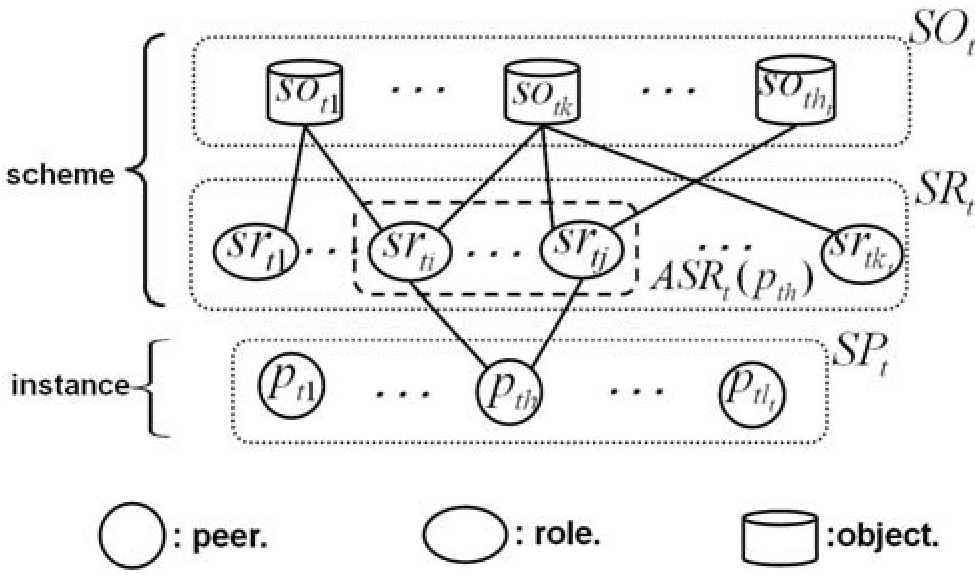
The paper utilizes the RBAC model, where access rights (permissions) are bundled into "Roles." The innovation lies in the two-layer mapping:
- Local Layer: Peers manage their
Local ObjectsandLocal Roles. - Society Layer: Abstract
Society ObjectsandSociety Rolesare defined.
This allows a user to play a "Secretary" role in a society without needing to know that the "Schedule" object they are editing actually resides on Peer A’s hard drive.
2. Resource Sharing Modes
To handle how local objects "transmigrate" into the society, three policies are proposed:
- Grant: You keep ownership but let the society use it.
- Donate: You hand over ownership to the society.
- Rent: You provide access for a specific time window.
3. Distributed Membership: Invitation vs. Nomination
In the absence of a central server, how does a society grow? The paper outlines two distributed protocols:
- Invitation-based: A trusted member "Invites" a new peer. Depending on the society's strictness, this may or may not require a vote.
- Nomination-based: A member "Nominates" a peer, triggering a negotiation phase where the society evaluates the "Service Roles" the new peer offers (e.g., "I'll join if I can be an Assistant, and I'll share my Computer resource").
Experiments & Results: Negotiation and Agreement
The paper focuses on the logical consistency of their protocols. They define different Agreement Conditions for distributed groups:
- All: Unanimous consent required.
- Majority: >50% of peers must agree.
- Weighted Majority: High-trust peers have more "vote weight" in the membership decision.
By utilizing these conditions, the system ensures that society roles are redefined dynamically as peers leave, preventing "zombie" access rights.
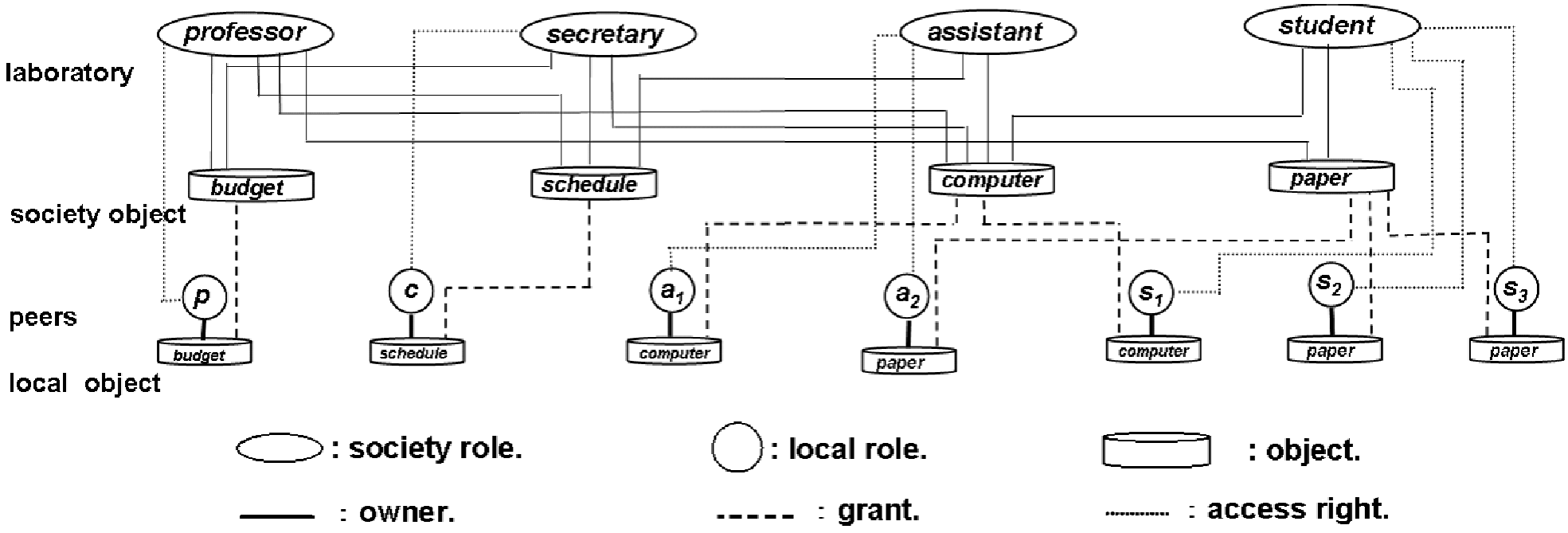 Figure: An example of a "Laboratory Society" where professors, assistants, and students share objects like budgets and papers through mapped roles.
Critical Analysis & Conclusion
Takeaway
The "Making Societies" framework is a significant step toward autonomous digital organizations. It successfully applies rigorous access control logic to the fluid, often chaotic environment of P2P networks.
Limitations & Future Work
- Scalability of Voting: While the paper discusses weighted majorities, the communication overhead of broadcasting "Join/Leave" requests in massive P2P networks (millions of nodes) remains a challenge.
- Trust Verification: The model assumes peers act according to the protocol once roles are granted. Integrating Zero-Knowledge Proofs (ZKP) or Trust Scores could further harden the society against malicious actors.
In summary, this research provides the "social contract" logic necessary for the next generation of decentralized collaborative platforms.