
Making Phishing Warnings Personal: The Psychology of Persuasion
Making Warning Messages Personal: A Big 5 Personality Trait Persuasion Approach
This paper introduces a personalized phishing warning system that leverages the Big 5 Personality Trait model and social media digital traces. By tailoring warning text sentiments and incorporating familiar social network profile pictures (Cialdini’s persuasion principles), the approach seeks to increase user compliance and mitigate the "negligence" problem in cybersecurity.
TL;DR
Phishing attacks succeed not just because of technical sophistication, but because of user neglect. This research proposes a radical shift: instead of static pop-ups, use the Big 5 Personality model and social media data to create "personalized" warnings. By matching the tone of a warning to your personality and showing you a friend's face as a recommendation source, the system turns a dry security alert into a persuasive social nudge.
Problem & Motivation: Why We Ignore Warnings
Most security warnings are ignored because they lack relevance. Current systems treat all users as a monolith. The authors argue that if a user doesn't feel like the "intended recipient" of a warning, they won't act.
The core insight here is that Cybersecurity is a behavioral problem, not just a technical one. To bridge the gap, the researchers look toward human-related theories—specifically how personality traits like Neuroticism or Extraversion dictate how we perceive risk and authority.
Methodology: The Framework of Persuasion
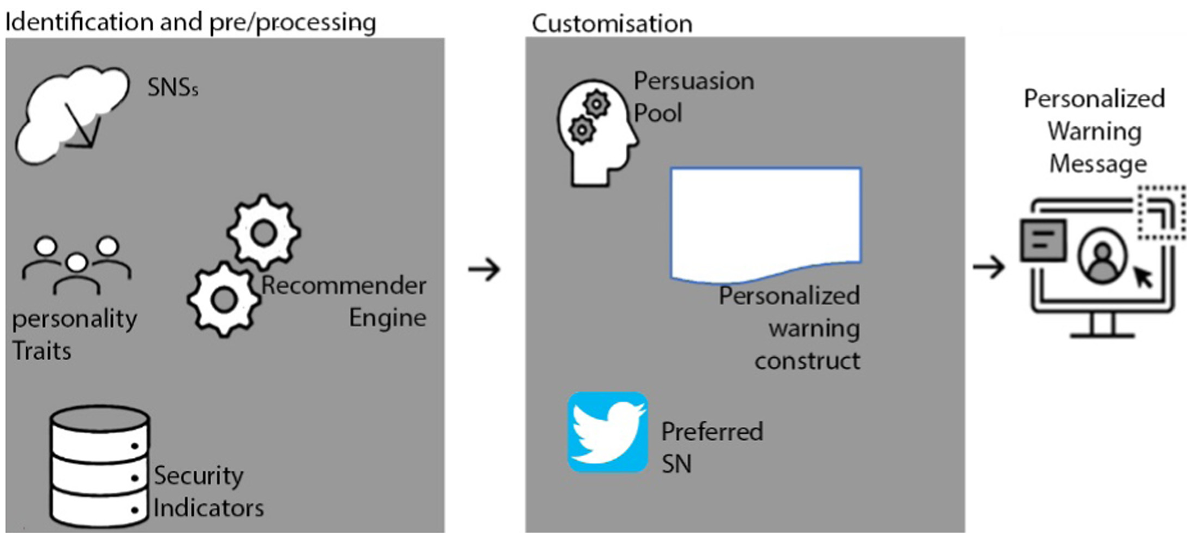
The proposed system operates in a two-stage pipeline: Identification & Pre-processing and Customization.
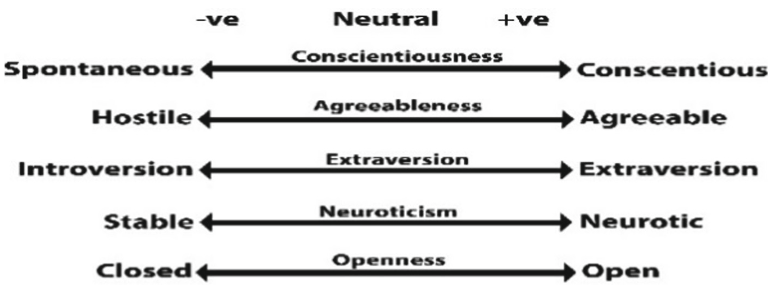
1. The Big 5 Adaptation
The system maps warning text to the Big 5 personality spectrum. For example, a "Conscientious" person might respond better to factual, high-clarity warnings, while others might require a more "socially-framed" nudge.
2. Digital Traces and Cialdini’s Principles
The most innovative part of this work is the use of social proof. By harvesting a user’s social network (SNS) data, the system identifies the "shortest path" to a trusted contact or expert.
- The Liking Principle: You are more likely to listen to a warning if it is "endorsed" by a face you recognize.
- The Authority Principle: Using social data to highlight "security experts" within your extended network.
Experiments: Measuring "Vibe" and Readability
The authors tested five variants of a standard phishing warning (e.g., "This website is fraudulent"). Using sentiment analysis, they found they could swing the emotional charge of the message from highly negative (-0.93) to positive/neutral (+0.46) without losing the core information.
| Message variant | Sentiment | Readability (Smog) |
|---|---|---|
| "This is typical of fraudulent websites..." | -0.93 (Extreme Negative) | 6.8 |
| "Young websites are famous for criminal activities..." | +0.46 (Positive/Alert) | 6.0 |
By adjusting the Smog Index (readability), they ensure that the warning is not only emotionally targeted but also cognitively accessible for the specific personality type.
Critical Analysis & Conclusion
This paper provides a blueprint for "Intelligent User Interfaces" in security. Instead of harder firewalls, we might need softer, smarter interfaces.
Takeaway: The "human factor" is the weakest link in security, but by using digital traces and personality mapping, we can turn human psychology into a defense mechanism.
Limitations: The primary challenge is privacy. Harvesting social media traces to "protect" a user creates a paradox—how much data must we sacrifice to stay safe? Furthermore, the authors note that the next step is validating this with real-world user behavior to see if these "personalized" nudges actually stop the clicks.
The Future: Imagine an AI-driven browser extension that scans your LinkedIn or Facebook profile, determines you are high in "Openness," and generates a bespoke warning that subtly appeals to your specific risk profile. Security is becoming a conversation, not just a command.